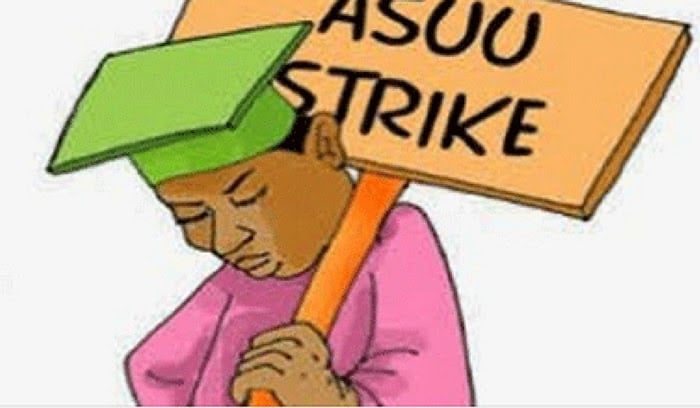
When the Academic Staff Union of Universities (ASUU) announced a two-week warning strike to begin on Monday, October 13, it felt like déjà vu for millions of Nigerian students.
For the next two weeks, at least, classrooms will go silent once again, and uncertainty will return to the country’s public university system for the first time since October 2022.
EDITOR’S PICKS
The federal government responded swiftly, warning that it would enforce the “no work, no pay” labour policy if the strike went ahead. The Ministry of Education described the rule as an “extant labour law” and accused ASUU of being “uncooperative despite efforts to prevent the strike.”
PRESS RELEASE
FGN URGES ASUU TO SHELVE STRIKE IN THE INTEREST OF STUDENTS, VOWS TO INVOKE NO WORK, NO PAY RULE
The Federal Government of Nigeria has called on the Academic Staff Union of Universities (ASUU) to reconsider its decision to embark on an industrial strike,…
— Bayo Onanuga, OON, CON (@aonanuga1956) October 12, 2025
But behind the familiar exchanges between union and government lies a painful reality: each confrontation ends with the same victims — the students.
A Cycle Without Consequences
ASUU’s demands are not new. The union has consistently asked for the signing of the renegotiated 2009 FGN-ASUU agreement, release of withheld salaries, revitalisation funding, and payment of arrears. The government insists it has shown “goodwill and flexibility,” but says it must uphold fairness and accountability in managing public resources.
What is equally familiar is the government’s threat of “no work, no pay.” It was brandished in 2022 when lecturers embarked on an eight-month strike, and again now. In theory, the policy discourages work stoppages. In practice, it rarely endures.
Once political pressure mounts and negotiations resume, back pay is quietly restored. Despite the government’s tough talk, lecturers often receive their withheld salaries after each settlement. This has reduced the rule to a bargaining chip rather than a deterrent, leaving no lasting consequence for either party.
The only group without compensation or leverage are the students, whose semesters vanish while both sides replay the same argument every few years.
Lives on Hold
For students, each strike is a rupture that sets back not just academic calendars but life plans.
Beyond lost lectures, the financial and emotional toll is enormous. Parents continue paying rent for idle hostels, while final-year students miss job opportunities or graduate later than planned. Some lose foreign admission offers because transcripts or certificates cannot be issued on time.
Unfortunately, if an agreement is not reached within the next two weeks to shelve further action, students may be looking at another period of being shut out of school for months without a definite end.
At the core of this dispute is mistrust built over decades. ASUU accuses successive governments of failing to honour agreements, while the federal government argues that previous deals were made without considering long-term fiscal realities.

Education Minister Tunji Alausa recently pleaded with ASUU to shelve its strike, saying negotiations were in the final stages. But ASUU president Chris Piwuna insisted that only concrete actions, not promises, would halt the walkout.
This standoff mirrors years of broken dialogue. Every administration inherits the unresolved remnants of the last, treating university strikes as temporary crises rather than structural failures. Meanwhile, Nigeria’s universities continue to slip in global rankings, research output declines, and students lose faith in the promise of public education.
FURTHER READING
Every strike ends eventually. Lecturers return to work, salaries are restored, and government officials move on. But for students, the damage lingers, in lost years, broken dreams, and a future held hostage by the past.
Philip Ibitoye is a Special Correspondent with EKO HOT BLOG. Click here to find daily analysis and critical insight on trending issues in Lagos and other parts of Nigeria.
Click here to watch the video of the week below: