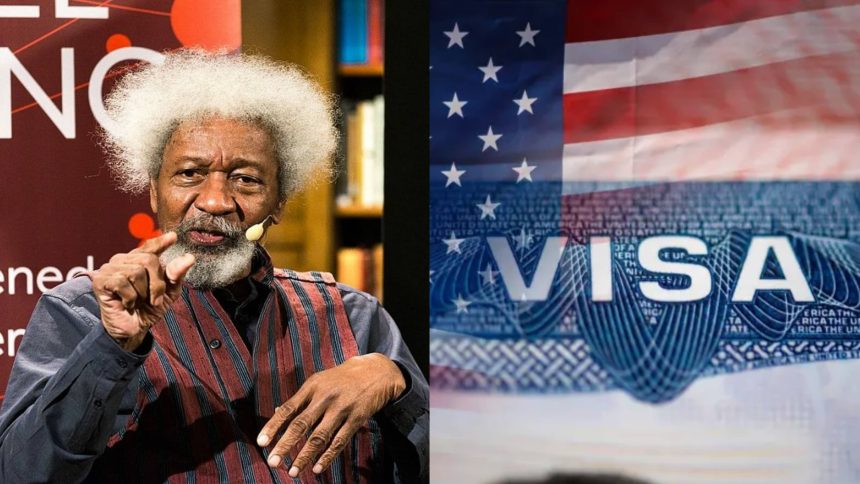
Nobel Laureate Professor Wole Soyinka on Tuesday revealed that the Donald Trump-led United States (U.S.) government has revoked his visa, a move he described as part of a “witch-hunt” against dissenting voices.
Speaking to reporters in Lagos, the 91-year-old author of Death and the King’s Horseman said he was informed by the U.S. Consulate General that his non-immigrant visa had been cancelled because “additional information became available after it was issued.”
EDITOR’S PICKS
Reading the letter publicly, Soyinka said: “I have no visa; I am banned, obviously, from the United States.” The development immediately triggered widespread reactions across local and international media, with many recalling his longstanding criticism of Trump and what he often called “the new face of American intolerance.”
While U.S. officials did not elaborate on the reason for the decision, Soyinka suggested that it might not be unconnected to his past statements describing Trump as “a white version of Idi Amin.” He insisted that the matter went beyond his personal circumstances. “This is about principle,” he said. “It concerns how dissent is treated and how free speech survives when it offends power.”
From Green Card to Green Light Out
The visa controversy marks a new chapter in a tension that began almost a decade ago.
In 2016, during Trump’s rise to power, Soyinka made international headlines when he vowed to destroy his U.S. green card if Trump won the election. “The moment they announce his victory, I will cut my green card myself and start packing up,” he announced. He called this, “Wolexit”, a pun on “Brexit”.
When the billionaire businessman defied predictions to clinch the presidency, Soyinka kept his word. At the time of the election, the Nobel Laureate had spent more than 20 years living in the U.S. teaching in many universities including Harvard, and the New York University’s Institute of African American Affairs where he was a scholar-in-residence.
Nonetheless, he tore up his Green Card, which granted him permanent residency in the U.S., saying he had “rendered it inoperable,” and promptly relocated to Nigeria. “I had a horror of what is to come with Trump,” he told journalists at the time, warning that America’s moral standing in the world was about to collapse under a wave of intolerance and ultra-nationalism.
The gesture was both symbolic and defiant. It was Soyinka’s way of announcing that he would not remain a permanent resident in a country he believed was turning away from its democratic ideals.
A Voice of Dissent Beyond Borders
Following his self-imposed departure from the U.S., Soyinka continued to speak out against the Trump administration and what he perceived as the erosion of America’s liberal values. At international conferences and public lectures, he often cited the Trump era as an example of how populism could mutate into authoritarianism.
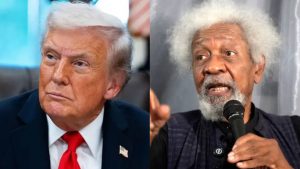
In one particularly controversial remark, he compared Trump to Uganda’s late dictator, Idi Amin, describing the former U.S. president as “a white version” of the African strongman. The statement drew sharp reactions from Trump supporters and even some American academics, but Soyinka remained unrepentant. “When power begins to attack reason,” he once said, “it becomes the duty of intellect to respond.”
His criticism also extended to U.S. immigration policies and border restrictions that, in his view, contradicted the values of liberty and equality America claimed to champion. Over the years, he became one of the most outspoken African intellectuals challenging U.S. moral exceptionalism, turning his disillusionment into a broader critique of global politics.
Torn Symbols, Unbroken Principles
To many observers, Soyinka’s visa revocation is the culmination of a long ideological standoff rather than an isolated incident. From tearing his green card in 2016 to losing his U.S. visa in 2025, the Nobel Laureate has consistently refused to separate art from activism or intellect from moral responsibility.
His relationship with the United States — once a symbol of his global engagement — has become a mirror of his convictions. For Soyinka, freedom is not guaranteed by citizenship or documents but by the courage to challenge power wherever it falters.
FURTHER READING
In the end, the man who rejected “Trump’s America” on principle now finds himself officially barred from it. Yet, as his latest remarks suggest, Soyinka’s dissent has only grown more forceful.
Philip Ibitoye is a Special Correspondent with EKO HOT BLOG. Click here to find daily analysis and critical insight on trending issues in Lagos and other parts of Nigeria.
Click here to watch the video of the week below: