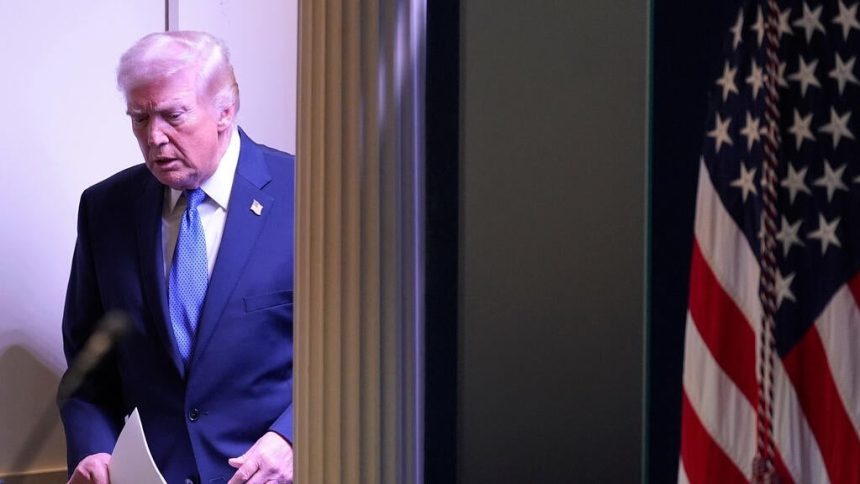
- President Donald Trump signed a proclamation Friday night establishing a 10% tariff on the majority of foreign imports, scheduled to take effect early Tuesday morning.
- The executive action follows a landmark Supreme Court ruling that struck down the administration’s previous global tariffs, which had been issued under the International Emergency Economic Powers Act (IEEPA).
- The new levies utilize Section 122 of the Trade Act of 1974, a provision allowing for temporary duties of up to 15% for a period of 150 days to address national balance-of-payment concerns.
President Donald Trump signed a proclamation on Friday night, February 20, 2026, imposing a 10% tariff on most foreign imports to the United States.
Eko Hot Blog reports that this action comes as a direct response to a Supreme Court decision issued earlier that day, which invalidated a previous regime of sweeping global tariffs.
EDITOR’S PICKS
- DSS Arrests El Rufai After Release From EFCC Custody
- Inside Tinubu’s Executive Order Stripping NNPCL of Oil Revenue Deduction Powers
- 5 Health Risks Men Face After Age 40
The new duties are slated to take effect at the start of business on Tuesday morning and will remain in place for an initial duration of 150 days.
While the administration seeks to restore its trade agenda, the move highlights an escalating legal battle between the White House and the judicial branch over the extent of executive authority in international commerce.
The legal strategy for the new tariffs represents a significant shift in methodology.
Previously, the administration relied on the International Emergency Economic Powers Act (IEEPA) to justify broad trade restrictions.
However, the Supreme Court ruled Friday that the IEEPA does not grant the President the specific authority to impose tariffs.
To bypass this restriction, President Trump invoked Section 122 of the Trade Act of 1974. This particular law permits a president to implement duties of up to 15% for a limited 150-day window to rectify “large and serious” balance-of-payment issues.
By utilizing this statute, the White House aims to provide a temporary bridge for its economic policies while navigating the fallout of the court’s ruling.
Certain categories of goods and specific trading partners have been excluded from the immediate 10% levy.
The proclamation outlines exemptions for certain food imports, critical minerals, electronics, and automobiles.
Additionally, goods from Canada and Mexico that fall under the trade agreement negotiated during the President’s first term are not subject to these new tariffs.
Despite these carve-outs, the President maintained a firm stance in a social media post on Truth Social, describing the 10% global tariff as a “Great Honor” to sign from the Oval Office.
He argued that the measures are necessary to address chronic trade deficits and to provide a much-needed boost to American manufacturing.
The financial impact of the new policy is expected to be different from the previous IEEPA-led regime.
Estimates from the nonpartisan Tax Foundation suggest that substituting the earlier tariffs with those under Section 122 will likely generate only about half the revenue previously anticipated.
There is also the possibility that revenue could be further diminished if international importers choose to delay shipments to wait out the 150-day expiration period.
When questioned by reporters on Friday regarding the status of previous trade deals, President Trump noted that while some agreements would remain in place, others would be effectively superseded by the new 10% baseline rate.
In tandem with the new tariffs, the administration is moving to launch broader trade investigations. U.S. Trade Representative Jamieson Greer has been directed to open probes into “unreasonable and discriminatory” practices by major trading partners under Section 301 of the Trade Act.
Greer indicated late Friday that these investigations will be conducted on an “accelerated timeline” and could result in additional targeted tariffs in the future.
Meanwhile, the Supreme Court’s ruling did not impact existing duties on steel, aluminum, and certain auto imports, as those were established under separate legal authorities.
Political and economic repercussions are already mounting. Illinois Governor J.B. Pritzker has reportedly sent the White House an $8.6 billion bill for tariff refunds following the Supreme Court’s ruling, a move that signals potential fiscal challenges for the federal government.
Economists continue to warn that the costs of such duties are frequently passed down to American consumers in the form of higher prices.
As the Tuesday implementation date approaches, the global market remains on edge, watching for the administration’s next steps in what has become a defining conflict over the future of international trade and constitutional limits.