- North Korea broke a 37-day operational pause on Tuesday by firing multiple close-range ballistic missiles (CRBMs) and tactical artillery rockets directly into the Yellow Sea.
- Defensively tracked by regional radar networks, the projectiles launched from the coastal Jongju area in North Phyongan Province, flying roughly 80 kilometres at a tight, low-altitude trajectory before impact.
- The rare combined firing exercise directly coincides with high-level intelligence reports suggesting an upcoming diplomatic state visit to Pyongyang by Chinese President Xi Jinping.
North Korea launched an “unidentified projectile” into the Yellow Sea off its west coast on Tuesday, South Korea’s military said.
Providing updated tracking on Tuesday, May 26, 2026, Seoul’s Joint Chiefs of Staff (JCS) clarified that the provocation involved a highly synchronized barrage of multiple close-range ballistic missiles (CRBMs) and heavy artillery rockets.
EDITOR’S PICK
- Fresh Details Emerge on Death of Odomola Monarch, Oba Adebowale Adeshina
- Sanwo-Olu Applauds LASU’s Academic Excellence After JAMB Ranking
- NRC Moves 176,820 Tonnes Of Cargo Through Lagos Ports In Q1
Field sensors detected the launches originating from the Jongju sector of North Phyongan Province at approximately 1:00 p.m. local time, with the weapon packages traveling about 80 kilometres (50 miles) across the West Sea before landing in open waters between the Korean peninsula and China.
The heavy weapons display marks North Korea’s eighth ballistic launch event of the year, ending a 37-day pause in active testing.
Pyongyang last executed a high-profile launch on April 19, when military engineers deployed short-range ballistic missiles to verify the destructive payload power and distribution characteristics of advanced cluster bomb warheads under the personal supervision of Kim Jong Un.
Regional defence analysts suggest that the state is actively exploiting frayed international diplomatic norms to systematically assert and cement its permanent nuclear status while ignoring standard global disarmament treaties.
The strategic timing of the combined firing exercise has drawn intense scrutiny from global security councils. South Korea’s Yonhap news agency reported last week that Chinese President Xi Jinping would likely visit North Korea sometime this week, citing unnamed government sources.
Although neither Beijing nor Pyongyang has officially confirmed the state visit, the missile tests follow tightly on the heels of recent summit talks held between President Xi and U.S. President Donald Trump in Beijing.
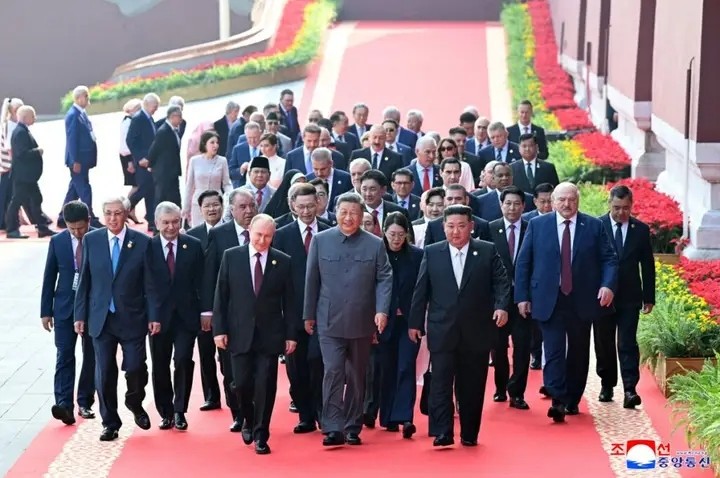
Analysts suspect the missile display is explicitly engineered to maximize Pyongyang’s leverage and demonstrate independent defensive solidarity before any formal regional negotiations commence.
Tensions on the peninsula have escalated as South Korean President Lee Jae Myung urged the local cabinet to aggressively expand the country’s military framework.
President Lee highlighted the urgent integration of artificial intelligence systems, drone combat units, and the potential diplomatic acquisition of a nuclear-powered submarine to ensure autonomous deterrence.
In response, Seoul, alongside its key Western allies in Washington and Tokyo, confirmed that tactical surveillance networks have been placed on high alert to monitor the West Sea corridor for any additional weapon system tests or border escalations.