- Bolivian President Rodrigo Paz has declared a nationwide 90-day state of emergency to break a crippling 50-day protest gridlock that has completely paralyzed transport networks and disrupted essential commodity lines.
- Heavily armed police units and military personnel, backed by state-run bulldozers, moved into the flashpoint city of El Alto and the administrative capital of La Paz before dawn to forcefully dismantle over 40 major anti-government roadblocks.
- The historic unrest, which has cost the Andean nation over $3 billion in economic losses, erupted after the country’s first non-socialist administration in two decades stripped away long-standing fuel subsidies to combat a severe dollar crunch.
The government of Bolivia has entered a high-stakes security clampdown after President Rodrigo Paz declared a nationwide 90-day state of emergency, authorizing the immediate domestic deployment of the military to crush an aggressive protest movement that has held the Andean nation hostage for nearly two months.
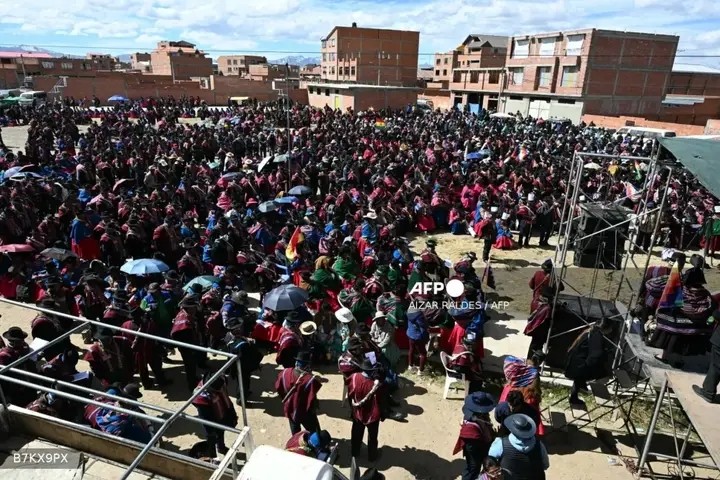
Eko Hot Blog reports that for over six weeks, an extensive coalition of labor unions, indigenous rights groups, miners, and rural coca farmers have choked the country’s primary logistics corridors, setting up thousands of roadblocks constructed from heavy timber, boulders, and industrial rubble.
EDITOR’S PICK
- Hamzat Appoints Obanikoro as Campaign DG Ahead of 2027 Lagos Governorship Race
- Tinubu’s State Police Plan Gains Momentum as Amendment Looms
- Residents Raise Alarm After Two Bodies Found in Lagos Waterway
The persistent blockades have induced acute, life-threatening shortages of fuel, refined petroleum, food supplies, and essential medicines across several major cities, completely isolating the administrative capital of La Paz and the neighboring urban hub of El Alto.
In a late-night televised address to the nation on Saturday, the 58-year-old president issued a stern final warning to demonstrators, stating that the state of emergency is designed to restore freedom of movement and free the citizenry from political actors trying to destabilize the country’s democratic institutions.
Hours after the presidential broadcast, joint convoys of armed tactical police and military units commenced synchronized clearance operations under the cover of darkness.
In El Alto, state-run heavy machinery and bulldozers plowed through deep layers of street debris to reopen strategic highways, drawing spontaneous applause from local residents who had been cut off from commercial trade and medical care.
Security forces have been mandated to enforce strict temporary restrictions on mass public gatherings, implement localized curfews in sensitive production centers, and carry out preventative arrests of any individuals attempting to erect new barricades.
While the Economy Ministry announced that major transit routes are expected to be fully operational within 48 hours under a measured and gradual application of force, military police and naval personnel have established permanent security cordons around the presidential palace and principal town squares to deter retaliatory riots from radical elements.
The explosive civil unrest marks the most severe political challenge faced by President Paz since taking office as the country’s first right-wing leader in two decades, ending nearly twenty consecutive years of governance by the leftist Movement Toward Socialism (MAS) party.
The crisis originally flared up in May after the administration abruptly eliminated long-standing state fuel subsidies in an aggressive bid to shrink a widening fiscal deficit, manage a acute shortage of U.S. dollars, and advance structural negotiations with the International Monetary Fund (IMF).
The initial economic pushback rapidly mutated into a broader political rebellion, with indigenous groups demanding the president’s immediate resignation and the total abandonment of liberal economic reforms.
The human toll has been severe, with human rights organizations confirming at least 17 deaths linked directly to the unrest, many stemming from instances where critically ill patients and oxygen supplies were blocked from reaching hospitals.
Although the president managed to secure a tentative peace agreement on Friday night with the Central Obrera Boliviana (COB), the nation’s largest umbrella labor union, by promising not to privatize state assets, radical highland indigenous networks have vowed to sustain their armed resistance.
President Paz has hit back at the holdout factions, directly accusing “narco-terrorist” elements loyal to exiled former president Evo Morales of financing the ongoing disruption from the tropical Chapare region.
Morales, who remains in hiding to avoid local trafficking charges, countered by claiming that the indigenous population is legitimately rebelling against a conservative regime that remains entirely submissive to Western interests.
As international allies like the United States ramp up logistical support and emergency assistance to mitigate the supply shocks, the global community is watching closely to see if the military deployment can successfully salvage Bolivia’s fragile economy or if the aggressive clearance operations will trigger a bloody escalation.