- South Korea’s highest judicial authority has dismissed all final appeals, permanently locking in a seven-year prison sentence for former President Yoon Suk Yeol over his unconstitutional 2024 martial law decree.
- The high-profile case validated criminal indictments proving Yoon forged the prime minister’s signature, blocked cabinet deliberations, and ordered the deletion of secure military phone logs to hide his tracks.
- The disgraced former leader remains in a high-security detention facility as he simultaneously battles separate convictions, including a life sentence for mounting an insurrection and a 30-year term for manufacturing a geopolitical drone crisis.
South Korea’s Supreme Court on Thursday issued a definitive landmark ruling, upholding the seven-year prison sentence slammed against disgraced former President Yoon Suk Yeol for crimes committed during his botched December 2024 martial law declaration.
Eko Hot Blog reports that the final judicial stamp officially brings an end to a dramatic series of appeals, cementing the legal downfall of the country’s former chief executive following his short-lived attempt to suspend civilian democratic rule.
EDITOR’S PICK
- Hamzat Appoints Obanikoro as Campaign DG Ahead of 2027 Lagos Governorship Race
- Tinubu’s State Police Plan Gains Momentum as Amendment Looms
- Residents Raise Alarm After Two Bodies Found in Lagos Waterway
The final verdict, which was broadcast on national television, saw the apex court completely dismiss cross-appeals filed by both Yoon’s defense attorneys and state prosecutors.
The presiding Supreme Court justice declared that a meticulous review of the lower appellate court records proved the seven-year sentence contained absolutely no structural or interpretation errors.
The defense team expressed immediate dissatisfaction with the outcome, labeling the process rushed and vowing to raise constitutional challenges, though apex court decisions are legally binding under South Korean law.
The legal parameters of the case centered on the deceptive and illegal machinations utilized by the former president in the hours leading up to his late-night national broadcast on December 3, 2024.
Investigators proved that Yoon willfully bypassed statutory democratic processes by selectively convening a secret, isolated group of ministers to rubber-stamp the decree while actively blocking broader cabinet deliberations.
Furthermore, the court validated charges that Yoon authorized the forgery of the prime minister’s official signature on the martial law decree document and later ordered an army commander to wipe data logs from secure military communication devices to eliminate digital evidence.
Even as his administration quickly unraveled, Yoon’s desperation escalated into physical intimidation.
Following an emergency late-night session where courageous lawmakers physically climbed fences to enter the National Assembly and unanimously vote down the decree, the former president deployed presidential security agents to block his own impending arrest.
Prosecutors also detailed how the presidency systematically distributed misleading media advisories to international press corporations in a failed attempt to validate the extra-constitutional power grab.
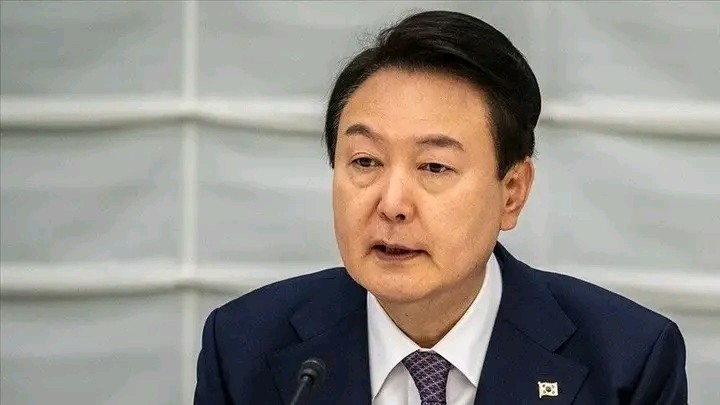
The shock six-hour martial law declaration plunged South Korea into its worst domestic political crisis in decades, sparking massive candlelight street protests, crashing local financial markets, and deeply alarming primary global allies including the United States.
While Yoon continually maintained that his actions were executed in good faith to eliminate “anti-state forces” and suppress subterranean threats from North Korea, subsequent independent court investigations exposed a far more sinister agenda.
In a staggering parallel trial, a lower district court handed Yoon a separate 30-year prison sentence after uncovering evidence that he intentionally deployed military drones into North Korean airspace to deliberately provoke a military skirmish, hoping to manufacture a regional security crisis that would justify his martial law takeover.
Following his formal impeachment and ouster from office in April 2025, a snap democratic election swept center-left Democratic Party leader Lee Jae Myung into the presidency.
With the apex court now validating his initial seven-year term alongside a looming life sentence for state insurrection, the fallen leader faces the prospect of spending the remainder of his life behind bars.