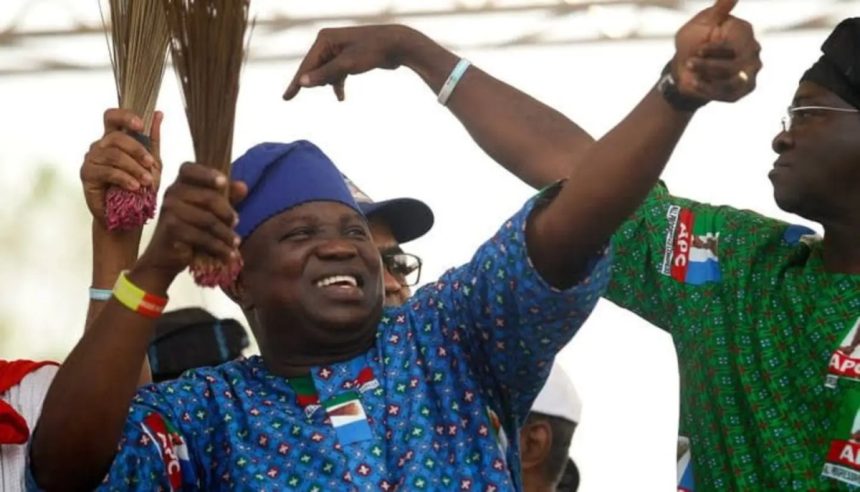
In the weeks leading up to Thursday’s endorsement, there were quiet conversations in Lagos political circles about the possibility of former Governor Akinwunmi Ambode throwing his hat into the 2027 governorship ring.
The reasoning among those sympathetic to his potential candidacy had a certain logic to it: since a returning Ambode could only serve one term, his four years in office would extend Christian governance of Lagos to 16 years, neatly balancing the 16 years of Muslim rule under former governors Bola Tinubu and Babatunde Fashola. For some, it was a compelling argument.
EDITOR’S PICKS
So it may have come as a surprise to some observers when Ambode issued a warm, personally signed statement on Thursday endorsing Deputy Governor Obafemi Hamzat as the APC’s consensus governorship candidate for 2027.
In the statement, Ambode described Hamzat as “a true Party man committed to the Party’s ideals and values of Unity and Progress,” adding that his adoption as consensus candidate was a reflection of “loyalty, hardwork and dedication to the party for over two decades.”
Big moment for Lagos and the APC.
Congratulations to Dr. Kadiri Obafemi Hamzat on emerging as our party’s Consensus Governorship Candidate. Your years of loyalty, consistency, and service have rightfully earned this mandate.
I remain committed to support the re-election of our… pic.twitter.com/mrprHztYI0
— Akinwunmi Ambode (@AkinwunmiAmbode) April 30, 2026
But to those who know Ambode well, the statement was entirely predictable. It was, in fact, the only thing Ambode would do. Because whatever else might be said of him, Ambode is — first and always — a party man.
Nigerian politicians are famously fluid in their loyalties. Defections are routine, alliances shift with the wind, and personal ambition almost always trumps party discipline. Against that backdrop, Ambode’s conduct stands out as genuinely unusual.
A History Of Putting Party First
This is not the first time Ambode has swallowed a bitter pill for the sake of the APC. In October 2018, he suffered what remains one of the most brutal defeats ever handed to a sitting governor in Nigeria. Babajide Sanwo-Olu, who would be Lagos governor for eight years, polled 970,851 votes against Ambode’s 70,901, making him the first incumbent governor to lose his party’s governorship ticket in that election season.
The margin was crushing and humiliating. Thirty-six out of 40 members of the Lagos State House of Assembly had rejected him, and his own deputy governor had voted against him.
The expectation in many quarters was that Ambode would defect to the Peoples Democratic Party (PDP) and contest the governorship as an opposition candidate. There had been strong rumours that he might dump the ruling party, and the opposition party even openly wooed him to come to their side. Many attributed the PDP’s delay in conducting its own Lagos primaries to Ambode’s possible arrival in their fold.
Instead, he addressed a press conference and accepted defeat.
“APC is a great party and the interests of our beloved State must always supersede that of any person or group,” Ambode said.
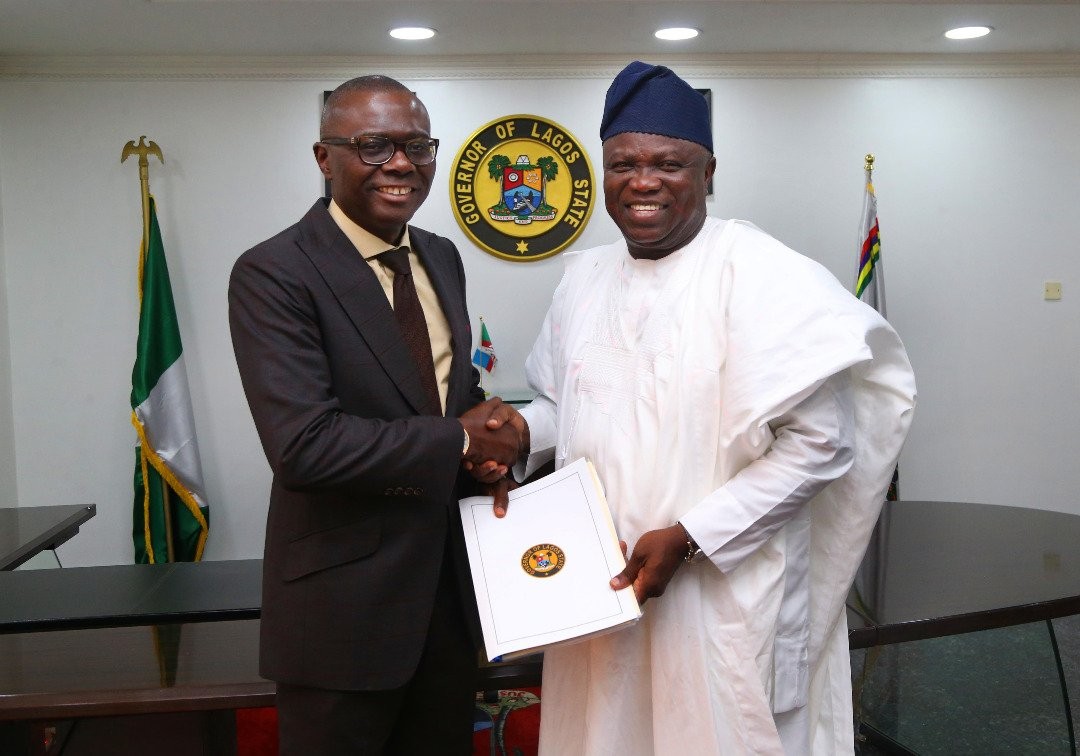
He remained in the party, supported the Sanwo-Olu ticket through the 2019 general election, and quietly kept his distance from opposition politics even during the years of estrangement from the party leadership that followed.
Thursday’s endorsement of Hamzat is consistent with that same temperament.
Saving The Party From Itself
Ambode’s endorsement did more than offer personal congratulations. It resolved a potential headache for the APC. A group, the Ambode Comeback Crusaders, had been publicly urging the party to consider the former governor for a second term, citing his record in infrastructure, transportation and healthcare.
His name was actively circulating as a possible aspirant. Had he declared his interest, the party would have faced an awkward primary: a former governor with genuine public goodwill on one side, a sitting deputy governor backed by President Tinubu, Governor Sanwo-Olu, and the GAC on the other.
That kind of contest, even where the outcome is not in doubt, generates noise, bitterness, and the sort of internal tensions that opponents exploit. Ambode’s endorsement shut that door cleanly. It signalled to every aspirant still considering the race that the former governor himself had stepped aside, removing the most credible rival Hamzat could face. The party can now march into the general election in near-perfect order.
The Record That Gives Ambode Leverage
Ambode’s deference to the party is not the posture of a man with nothing to offer.
His four years in office left a visible mark on Lagos. His administration expanded Bus Rapid Transit (BRT) capabilities, planned depot rollouts, and initiated projects that began integrating formal and informal transit in a city dominated by minibuses.
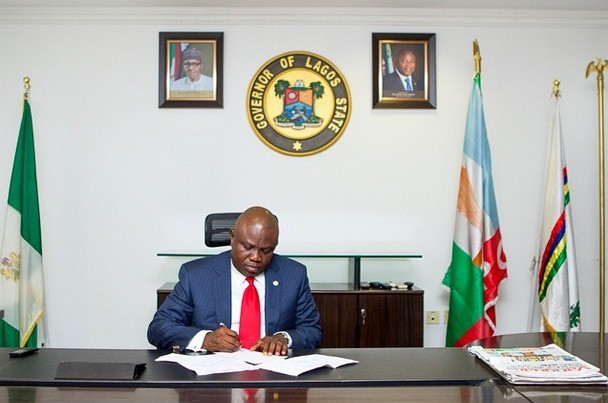
Construction of flyover bridges at Ajah and Abule-Egba, the expansion of the Ibeju-Agbe-Epe Road, and the construction of 114 inner roads — two each across the 57 local councils — were among the visible infrastructure interventions of his tenure.
The eight-lane Oshodi Airport Road expansion and the Oshodi Bus Interchange are among the legacy projects analysts credit to his administration.
There were also quieter, less-celebrated interventions that endeared him to ordinary Lagosians. In one move, he released N11 billion to offset pensioners’ gratuity liabilities, something the state had never done before. He upgraded 14 flagship primary healthcare centres, provided 20 mobile care unit ambulances and 26 transport ambulances across the state, and provided free medical services and psychosocial therapy to 700 survivors of domestic and sexual violence.
Ambode also distributed N500 million in grants to 275 community development associations to help them complete self-help projects.
Notably, he elevated the image of Epe, his hometown, through extensive infrastructural development and transformative projects, which earned him the reputation as the most popular politician in Epe Division.
When the former governor assumed office in 2015, the division was grappling with infrastructural decay, flooding, and erosion that had defined daily life for its residents for decades. His administration injected 30 kilometres of standard roads into Epe Township alone, stimulating real estate, commerce, and industrialisation. He also flagged off the Epe-Marina Lagoon reclamation project, a waterfront development initiative he likened to Dubai’s model.
Ambode launched the 1,000-hectare Alaro Satellite City in the Epe-Ibeju Lekki axis, projected to create over 200,000 jobs linked to the Lekki Free Trade Zone, the Deep Sea Port, and the proposed international airport. Community leaders have since described his achievements in Epe as unmatched, a sentiment the Epe Division Stakeholders Forum has echoed repeatedly.
These are tangible achievements. Lagosians who commute across the roads and flyovers he built remember who built them. That residual goodwill is a political asset.
An Asset On The Trail
Party insiders are quietly hoping the APC can put that asset to work.
With Hamzat set to face an opposition challenge in 2027, including potentially from the coalition platform, the African Democratic Congress (ADC), having Ambode visible on the campaign trail, speaking to his record and vouching for the APC candidate, could prove valuable in constituencies where his legacy remains a live memory.
One area where that goodwill will matter most is the Epe Division. Hamzat, who hails from Epe, will need the political structure there fully mobilised — from federal and state lawmakers to local government and LCDA chairpersons — and figures like Ambode can help consolidate support across the divides that Epe’s internal politics has historically produced.
Party leaders across the Epe Division and beyond note that the campaign’s success will require Hamzat to unite dissenting voices within his home division and across the state, bringing aggrieved local stakeholders and party figures who were sympathetic to other aspirants into a single coalition. That harmony, insiders say, will be crucial to ensuring victory in 2027.
FURTHER READING
Ambode has earned his place in aiding that process. He lost his ticket, kept his dignity, stayed in his party, and when his moment came to help rather than hinder, he helped. In Nigerian politics, that is not nothing. It is, in fact, rather rare.
Philip Ibitoye is a Special Correspondent with EKO HOT BLOG. Click here to find daily analysis and critical insight on trending issues in Lagos and other parts of Nigeria.
Click to watch the video of the week below: