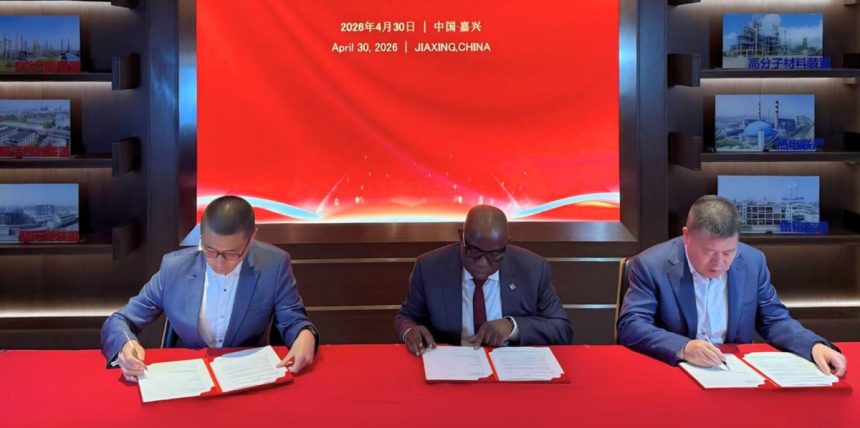
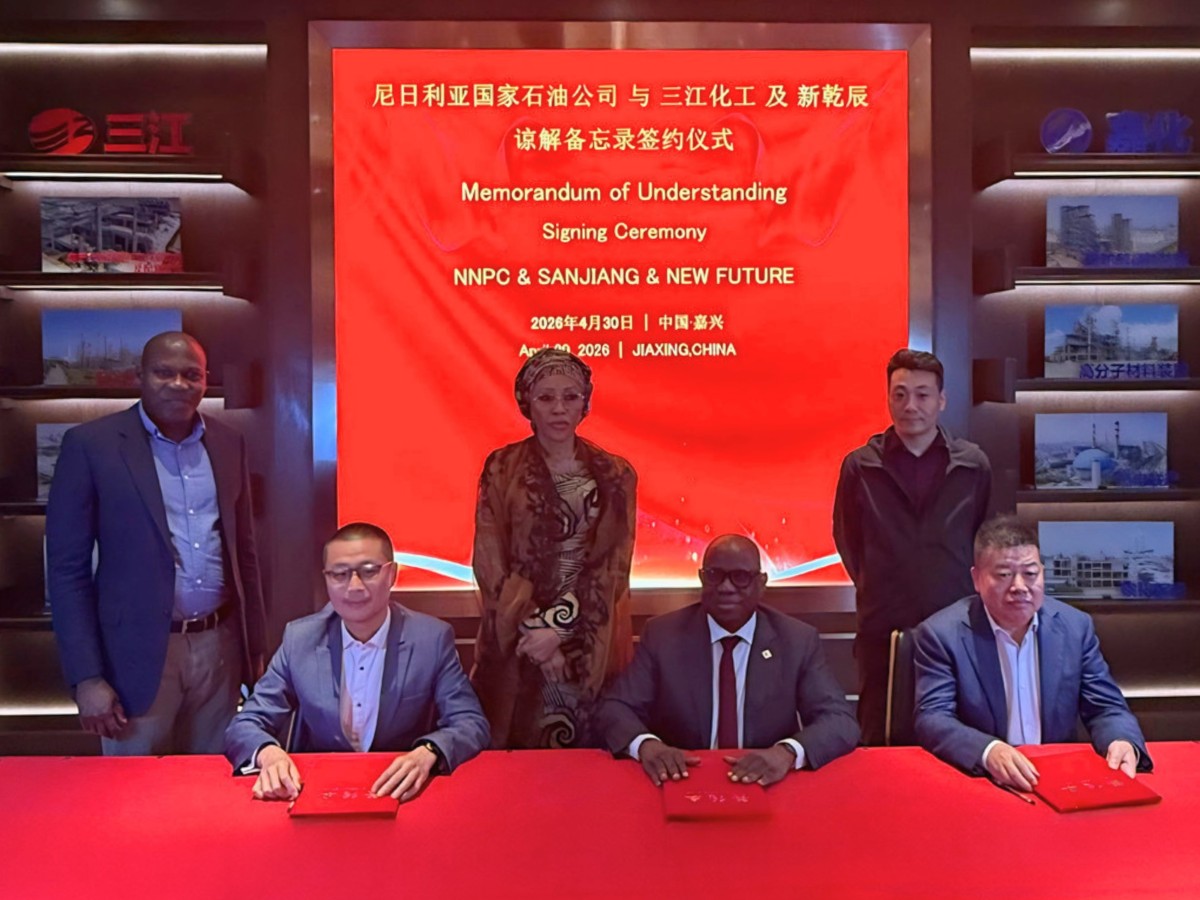
Last Thursday, April 30, 2026, the Nigerian National Petroleum Company Limited (NNPsigned a Memorandum of Understanding with two Chinese companies — Sanjiang Chemical Company Limited and Xinganchen (Fuzhou) Industrial Park Operation and Management Co. Ltd — in Jiaxing City, China, for what it describes as a potential Technical Equity Partnership.
The agreement, signed by NNPCL Group CEO Bayo Ojulari alongside the chairmen of both Chinese firms, covers the completion of outstanding rehabilitation work, operation and maintenance of the Port Harcourt and Warri refineries, and planned expansion into cleaner fuel standards, petrochemicals and gas-based industrial hubs.
EDITOR’S PICKS
Ojulari called the signing “a significant milestone,” noting that technical and management teams from all three sides had been engaged for more than six months before putting pen to paper. The MoU, he said, reflects “shared intent to progress discussions in good faith,” with definitive arrangements subject to further approvals.
It sounds promising. Nigeria has heard similar language before.
A Graveyard of Good Intentions
The history of Nigeria’s public refineries is, at its core, a history of announcements. The Port Harcourt refinery absorbed $1.56 billion in rehabilitation funding before being recommissioned in November 2024, only to never exceed 42 per cent of its nameplate capacity of 60,000 barrels per day. The Warri refinery consumed $897.6 million and ran for just 26 days after its December 2024 restart before a fault in its Crude Distillation Unit Main Heater forced a shutdown in January 2025.
Neither facility produced a litre of petrol.
The EFCC is currently investigating alleged misappropriation of the nearly $3 billion disbursed across all three state refineries, with former managing directors arrested and over N80 billion traced to the accounts of one sacked official.
Former NNPCL Group CEO Mele Kyari, whose management oversaw the recommissioning fanfare, has been interrogated by the anti-graft agency, with a Federal High Court ordering the freezing of his accounts.
Ojulari himself conceded the magnitude of the failure earlier this year at the Nigeria International Energy Summit: “We were running at a monumental loss to Nigeria. We were just wasting money.”
By July 2025, he had placed the sale of all three refineries on the table. Now, barely nine months later, he is signing MoUs in China. The shift from “we may sell” to “we are partnering” is not inherently contradictory — a Technical Equity Partnership is, in effect, a form of privatisation — but the credibility deficit built up over decades means that the burden of proof rests entirely on NNPCL and its new partners.
Why These Refineries Must Work
Despite that credibility deficit, functional public refineries are not merely a matter of national pride. They are an economic necessity, and nowhere is that clearer than in the shadow of the Dangote Refinery.
Commissioned in 2023 with a nameplate capacity of 650,000 barrels per day, the Dangote Refinery is Africa’s largest. It has, by most accounts, begun to deliver — but a single privately owned facility controlling the dominant share of Nigeria’s domestic refining capacity raises legitimate concerns about market power.
Energy analysts have previously warned that without competition, pricing and supply terms will ultimately reflect the interests of one operator. The deregulated fuel market, which was supposed to introduce competition, cannot function as designed if there is effectively only one major domestic refiner setting the terms.
The Port Harcourt and Warri refineries, between them, have a nameplate capacity of 185,000 barrels per day. Genuine operation at even two-thirds of that capacity would inject meaningful competition into the downstream sector, providing a counterweight to a monopoly in a commodity that affects the cost of virtually everything Nigerians consume.
For manufacturers, transporters and ordinary households counting on energy affordability, they need more than one supplier in the market.
The Test of This MoU
The NNPCL-China agreement clears the lowest possible bar: it exists on paper. What distinguishes it from its predecessors will be determined by whether equity is genuinely transferred, whether the Chinese partners bring operational expertise or simply capital, and whether a binding timeline with measurable targets is made public.
FURTHER READING
Ojulari’s new NNPCL has shown more transparency than its predecessor. That is a start. But Nigerians measuring progress by the standard of the last three billion dollars spent will need more than a ceremony in Jiaxing City to believe the refineries are finally coming back.
Philip Ibitoye is a Special Correspondent with EKO HOT BLOG. Click here to find daily analysis and critical insight on trending issues in Lagos and other parts of Nigeria.
Click to watch the video of the week below: