- INEC Warns Against Delay in Electoral Law Review Ahead of 2027 Poll
- Early passage of the law was crucial for effective planning
- Many of your recommendations require a review of our electoral legislation
The Chairman of the Independent National Electoral Commission (INEC), Prof. Mahmood Yakubu, has cautioned that delays in finalizing the legal framework for the 2027 general election could disrupt the commission’s preparations.
EDITOR’S PICKS
- The Past Is Gone, I Forgive and Move On – Jonathan
- Spotify Names Ayra Starr Top Female Force in Afrobeats
- Fela Didn’t Inspire Me – Burna Boy
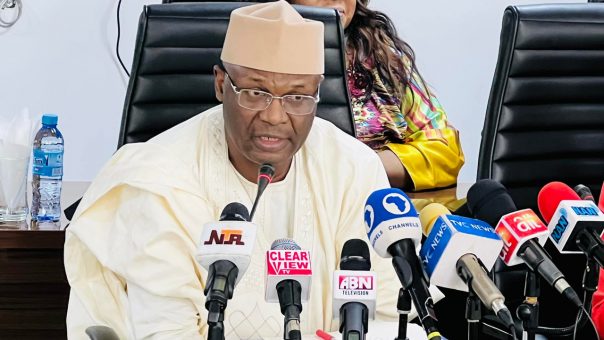
EKO HOT BLOG reports that Yakubu issued the warning in Abuja on Thursday while receiving a delegation of the European Union Election Observation Mission (EU EOM) follow-up team to Nigeria.
He urged the National Assembly to fast-track consideration of the electoral reform proposal before it, stressing that early passage of the law was crucial for effective planning.
“Election is a process governed by law. Many of your recommendations require a review of our electoral legislation. This is why the Commission has engaged the National Assembly, including holding a retreat with the Joint Committee on Electoral Matters.
We appeal for expeditious consideration of the reform proposal because uncertainty in the legal framework can unsettle the Commission as elections draw nearer,” Yakubu said.
The INEC boss noted that this was the third time the Commission was hosting an EU follow-up mission. He recalled visits in 2017 and 2022 before commending the delegation led by Barry Andrews, who headed the 2023 EU observation mission.
Yakubu highlighted that of the 23 recommendations made in 2023, eight required INEC’s direct action, with others needing intervention from the executive, legislature, judiciary, political parties, and civil society.
He explained that INEC had already acted on recommendations within its administrative powers and was collaborating with stakeholders on broader reforms while awaiting legislative action.
The EU delegation, led by Andrews, expressed satisfaction with some reforms but stressed that Nigeria must move beyond partial compliance to guarantee transparency.
He warned that slow progress in judicial, administrative, and constitutional reforms, particularly around result publication, continued to undermine public trust.