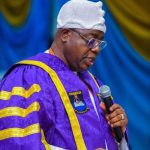
- Zamfara State Governor, Dauda Lawal, has revealed that he flatly rejected a ₦300 million ransom demand when his own brothers were abducted in 2019, telling the kidnappers to execute them rather than enrich criminals.
- The Governor emphasized that paying ransoms directly funds and encourages the proliferation of the kidnapping industry, noting that his brothers were eventually freed for free after three months.
- Speaking at a high-level townhall in Abuja, Lawal utilized his personal trauma to aggressively lobby for the creation of state police, arguing that governors cannot be held accountable as Chief Security Officers without a direct command-and-control structure.
Zamfara State Governor, Dauda Lawal, has sent shockwaves through the national security conversation by revealing that he explicitly refused to pay a massive ₦300 million ransom demand when his biological brothers were kidnapped in 2019.
Eko Hot Blog reports Lawal stated that he adopted the extreme, hardline position because negotiating with armed bandits and yielding to financial blackmail only serves to institutionalize and incentivize the multi-million naira abduction industry in Nigeria.
EDITOR’S PICK
- Hamzat Appoints Obanikoro as Campaign DG Ahead of 2027 Lagos Governorship Race
- Tinubu’s State Police Plan Gains Momentum as Amendment Looms
- Residents Raise Alarm After Two Bodies Found in Lagos Waterway
The Governor made the disclosures on Thursday, July 9, 2026, while speaking as a panelist at the high-profile ARISE News and THISDAY Townhall Conference held in Abuja.
Reflecting on the agonizing personal ordeal, Lawal explained that he chose to prioritize long-term societal deterrence over immediate emotional compliance, telling the criminal network that they would not receive a single dime from his household, even if it meant taking his siblings’ lives.

According to Governor Lawal, the kidnappers held his brothers in captivity for three grueling months, expecting the family’s resolve to shatter under pressure.
However, when the criminal gang realized that no financial windfall was forthcoming, they ultimately released the hostages alive without receiving any monetary compensation.
Lawal argued that if families, elites, and government institutions collectively starved criminals of ransom payouts, the economic incentive driving banditry would collapse, forcing perpetrators to reconsider the viability of the enterprise.
The Zamfara State Chief Executive seamlessly connected his historical family crisis to the broader, lingering structural deficiencies plaguing Nigeria’s centralized internal security framework.
Lawal used the Abuja townhall platform to passionately advocate for the constitutional establishment of decentralized state police formations.
He lamented the profound administrative frustration shared by many state governors who are widely labeled as the “Chief Security Officers” of their respective domains but completely lack the legal authority to command, deploy, or discipline federal security agents operating within their borders.
Lawal questioned the logic of holding state governors politically accountable for security breakdowns when the entire operational command-and-control hierarchy terminates at the Inspector General of Police and the Presidency in Abuja.
He asserted that state policing would introduce direct, localized democratic accountability, allowing citizens to judge elected state leaders based on measurable safety outcomes while enabling regional administrations to custom-tailor tactics to fit unique local terrains.
To prove that states are already bearing the financial brunt of national defense despite these legal limitations, Lawal revealed that the Zamfara State Government currently finances over 30 percent of all federal security operations within its territory.
He disclosed that his administration has procured over 500 operational vehicles for security forces over the last three years, recently adding 35 advanced Armoured Personnel Carriers (APCs) and Mine-Resistant Ambush Protected (MRAP) vehicles to the frontlines.
Furthermore, the state has deployed high-tech surveillance and attack drones to actively track and neutralize bandit cells in their forest hideouts, proving that aggressive infrastructural funding, rather than weak-kneed negotiations with armed syndicates, remains the only sustainable path to reclaiming national sovereignty.