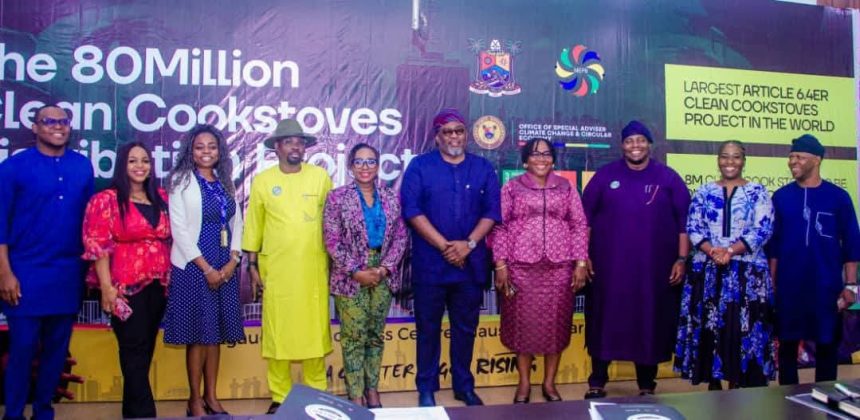
In a bold push to address climate change and tackle unemployment, the Lagos State Government has launched what could become Africa’s biggest green credit initiative, with a target to create 35 million jobs and improve lives across Nigeria.
The initiative, tagged the 80 Million Credit Float Project, was unveiled this week at the Bagauda Kaltho Press Centre, Alausa. It aims to tackle environmental degradation while distributing 80 million eco-friendly loans and empowering millions of Lagos residents, particularly women and youth, through access to clean energy, green businesses and new jobs.
- In a bold push to address climate change and tackle unemployment, the Lagos State Government has launched what could become Africa’s biggest green credit initiative, with a target to create 35 million jobs and improve lives across Nigeria.
- EDITOR’S PICKS
- More Train Sets for Lagos Blue Line Rail: What It Means for Commuters
- As Unsafe Abortions, Unskilled Care Kill Women, Here’s What Lagos Is Doing About It
- Trump-Inspired? Nigeria May Be About to Invest in Border Fencing
- A Climate Action Project with Economic Gains
- Lagos to Launch Africa’s First Subnational Carbon Exchange
- ₦1 Billion Annually to Each Local Government
- FURTHER READING
- Here’s One Question WAEC Is Still Struggling to Answer One Week After Late-night Exams
- After Decades of Pollution, Relief in Sight for Communities Near Olusosun Dumpsite
- ANALYSIS: What Moody’s Upgrade of Nigeria’s Credit Rating Means for Economy
EDITOR’S PICKS
At the heart of the plan is a sweeping transition to clean energy solutions, including the free distribution of six million clean cookstoves and the establishment of Africa’s first subnational carbon exchange, a financial mechanism expected to draw over $1 billion in revenue over the next 15 years.
“We are not just implementing a project,” said Ope George, Lagos State’s Commissioner for Economic Planning and Budget. “We are shaping the future of climate and economic resilience in Nigeria.”
A Climate Action Project with Economic Gains
Unlike many sustainability programmes that rely heavily on donor support, the Lagos model blends environmental strategy with economic pragmatism. Through green credit loans, the state hopes to empower individuals and small businesses to adopt clean energy practices, such as solar energy systems, sustainable agriculture and low-emission transport.

The jobs expected from this initiative are not just aspirational. The project is designed to foster new green businesses, expand renewable energy access and establish community-level environmental projects across the state’s 1,000 communities.
“It’s a people-centred solution,” said Dr Olawale Akinwunmi, President of GreenPlinth Africa, the project’s implementation partner. “From cookstove manufacturers to carbon auditors and forest stewards, we are building a new labour economy based on sustainability.”
According to experts, the project could be a game-changer for women and informal sector workers, who are often sidelined in climate action planning. The introduction of clean cookstoves, starting with Makoko, a densely populated waterfront settlement, aims to reduce the health risks posed by indoor air pollution, which disproportionately affect women and children.
Additionally, the initiative includes a ₦10,000 “Pay-to-Cook” stipend for households using the clean cooking methods, creating both a behavioural nudge and a social safety net.
“It’s not just about clean air, it’s about dignity and economic inclusion,” said Mrs Titi Oshodi, Special Adviser to Governor Sanwo-Olu on Climate Change and Circular Economy. “Women will not only be users of clean technology, they’ll be trained as vendors, technicians and entrepreneurs.”
Lagos to Launch Africa’s First Subnational Carbon Exchange
One of the most groundbreaking aspects of the project is the launch of the Lagos Carbon Exchange (LCX), the first of its kind at the subnational level in Africa and the second globally after California. This platform is expected to allow Lagos to monetise its emissions reductions and reinvest the proceeds into public services such as health, education and clean transport.
“This platform will allow Lagos to trade carbon credits and reinvest the earnings into clean energy, transportation, healthcare and job creation,” Oshodi said.

She added that every local council in Lagos would receive ₦1 billion annually to fund community-based green projects, including tree planting, waste recycling, flood control and urban farming.
“It gives us long-term sustainability,” said Dr Adebola Odunsi, the Chief Transformation Officer for the initiative. “We’re not waiting for aid. We’re building an economy where climate action pays.”
₦1 Billion Annually to Each Local Government
The 80 Million Credit Float Project will also allocate ₦1 billion annually to each of the state’s 57 local government areas to fund localised green projects, from tree planting and waste recycling to flood mitigation and urban farming. The goal, according to the project managers, is to foster bottom-up ownership of the green transition.
Already, plans are in motion to plant 400 million economic trees across the state, supporting food security and combating deforestation. Health insurance coverage for each participating household will also be rolled out, alongside job training programmes in solar energy and sustainable construction.
With global climate finance still falling short of needs across the developing world, Lagos may be setting a precedent for how subnational governments can take charge. By linking climate action to economic inclusion and job creation, it offers a blueprint that other cities could adapt.
FURTHER READING
“This is not just a Lagos story,” George said. “It is an African story. A story of resilience, of innovation, and of a people who refuse to choose between saving the planet and saving their livelihoods.”
Watch Our Video Of The Week: