- How Terrorists Killed Gen. Braimah in Borno
- Survivors describe coordinated assault by insurgents in large numbers
- Military sources deny claims of vehicle failure in incident
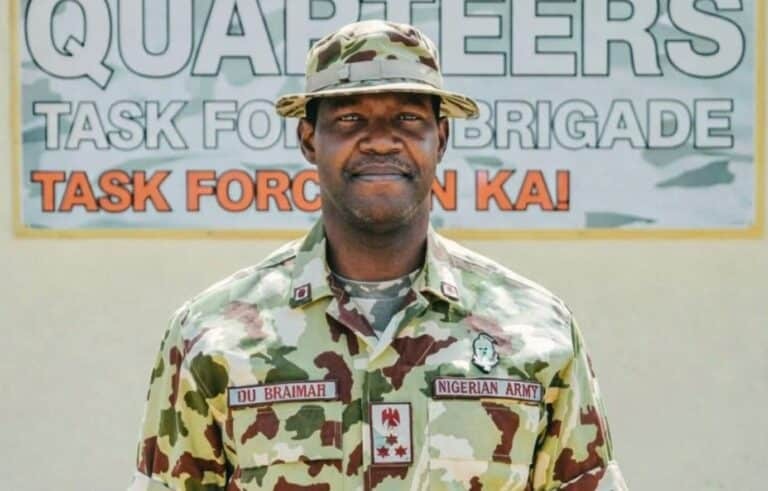
Fresh details have emerged on the circumstances surrounding the killing of the Commander of the 29 Task Force Brigade, Oseni Braimah.
The senior officer was killed during a midnight attack on a military base in Benisheikh, Borno State.
The assault, which occurred around 12.30 a.m. on Thursday, was carried out by suspected Boko Haram and Islamic State West Africa Province fighters. The attackers reportedly launched coordinated strikes on multiple military positions in the strategic town of Benisheikh in Kaga Local Government Area along the Maiduguri Damaturu highway.
EDITOR’S PICKS
- JAMB Delists 23 CBT Centres, Warns 89 After Mock UTME Review
- NASA Astronauts Return to Earth After First Human Trip to the Moon in 50 Years
- INEC Shifts Nationwide Voter Revalidation Until After 2027 General Election
EKO HOT BLOG reports that while the Nigerian Army maintained that the attack was repelled and dismissed reports of heavy casualties and equipment failure, accounts from soldiers and residents suggested a large scale offensive that overwhelmed troops and caused significant destruction.
Witnesses said the attackers moved in large numbers, targeting at least three military formations before advancing into surrounding civilian areas.
A soldier who survived the attack, speaking anonymously, described the operation as highly coordinated.
“We are used to coordinated attacks, but this was different. They came in large numbers from different directions at the same time. It felt like they had studied our positions for weeks,” he said.
Another survivor said the attackers had a clear numerical advantage, which affected the outcome of the confrontation.
“We stood our ground at first, but they were too many. They attacked from different angles. It was like an ambush,” he said.
According to him, morale among troops declined as reports emerged that other positions had been overrun.
“When we started hearing that our colleagues in other locations had been overrun, it shook us. Then someone shouted that the Brigade Commander was dead. That was when fear fully set in,” he added.
Sources said the confusion and psychological impact of the attack disrupted coordination among troops, forcing some to retreat toward the town.
The gun battle reportedly lasted more than one hour and 30 minutes, with multiple explosions forcing both soldiers and civilians to flee.
In the aftermath, reports circulated that Brigadier General Braimah died due to a malfunctioning Mine Resistant Ambush Protected vehicle.
However, military sources disputed the claim.
“The insurgents actually set the MRAP on fire during the attack. Saying he died because the vehicle didn’t start is not accurate. The situation was far more complex,” a senior source within the brigade said.
Another insider noted that only those present with the commander at the time of the attack could provide a complete account, adding that many of them also died.
“I am aware that the insurgents closed in from various angles at the same time. It was like an ambush plan. But when the gun battle became intense, the terrorist formation scattered. What helped them was their numbers; there were too many of them,” the source said.