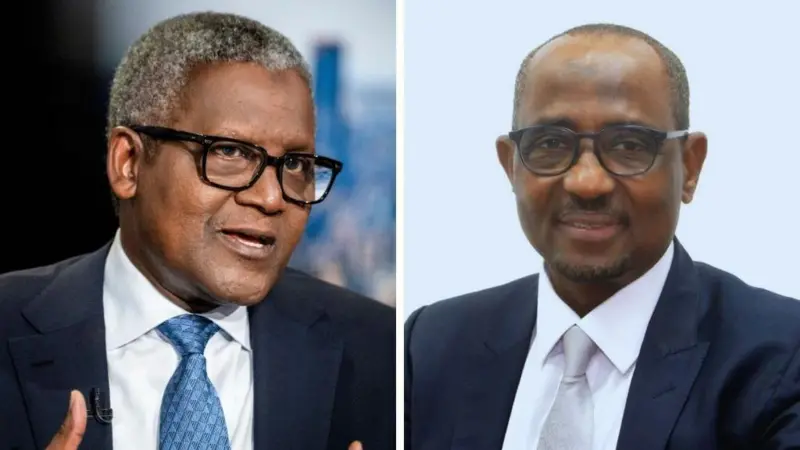
The Nigerian Midstream and Downstream Petroleum Regulatory Authority (NMDPRA) is likely not having the best of times.
Africa’s richest man, Aliko Dangote, has gone for the jugular, publicly and relentlessly, by turning the spotlight on the most personal of subjects: the education of the regulator’s chief executive’s children.
EDITOR’S PICKS
What began as complaints about regulatory conduct has escalated into a full-blown public confrontation, with allegations framed not merely as misconduct, but as economic sabotage.
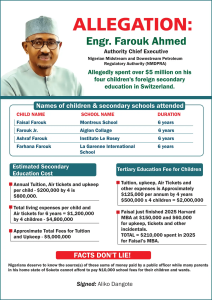
At the centre of the storm is Farouk Ahmed, Chief Executive of the NMDPRA, whom Dangote has accused of spending about $5m on the secondary education of his four children in Switzerland, with additional millions allegedly spent on tertiary education abroad. Dangote insists the figures are incompatible with earnings from public service and has challenged Ahmed to submit himself to scrutiny by the Code of Conduct Bureau or Tribunal.
EKO HOT BLOG observed that the regulator, for now, is silent.
From Regulation to Reputation
Dangote’s attack is notable not just for its substance, but for its method.
Rather than confining his grievances to policy disputes or regulatory decisions, the billionaire industrialist has chosen a deeply personal line of argument: how a public official funds elite foreign education for his children. He has named schools, broken down alleged tuition and upkeep costs, and drawn a stark contrast between the claimed spending and the reality of ordinary Nigerians struggling to pay modest school fees.
By repeatedly emphasising that even his own children attended secondary school in Nigeria, Dangote frames the issue as one of moral authority and public accountability. His argument is not that foreign education is inherently wrong, but that unexplained wealth in public office corrodes trust, discourages investors, and raises questions about regulatory impartiality.
He has gone further, warning that if the allegations are denied, he is prepared to publish documentary evidence and pursue legal avenues to compel disclosure from the schools involved.
A Proxy Battle Over Nigeria’s Oil Future?
Beyond the personal allegations lies a broader struggle over Nigeria’s downstream petroleum sector. Dangote has consistently criticised what he describes as regulatory failures, entrenched interests, and an import-dependent system that undermines domestic refining. He argues that powerful actors benefit from fuel imports and that regulatory decisions have made the environment hostile to new refineries, despite dozens of licences being issued.
Seen in this light, the public war may be about more than school fees.
Dangote, as the owner of a massive privately built refinery, has a direct stake in how the downstream sector is regulated. His insistence that “a trader should never be a regulator” suggests deep suspicion of conflicts of interest within the system. The attack on Ahmed’s personal finances may therefore serve as a proxy battle, an attempt to delegitimise a regulator whose policies or posture he views as inimical to local refining and long-term national interest.
Questions That Linger
Still, critical questions remain unanswered. Why has Dangote chosen this moment to escalate the dispute so publicly? Is the focus on alleged foreign education spending primarily about accountability, or is it a tactical move in a larger regulatory chess game? And does taking such allegations to the court of public opinion strengthen institutional reform, or risk personalising what should be a systemic debate?
For now, the NMDPRA has declined to respond, leaving Dangote’s serious, detailed, and politically explosive claims hanging in the air.
FURTHER READING
Whether this confrontation leads to formal investigations, regulatory changes, or simply hardens positions on both sides will determine if this episode becomes a turning point in Nigeria’s oil governance, or just another high-profile clash between power and authority.
Philip Ibitoye is a Special Correspondent with EKO HOT BLOG. Click here to find daily analysis and critical insight on trending issues in Lagos and other parts of Nigeria.
Click here to watch the video of the week below: