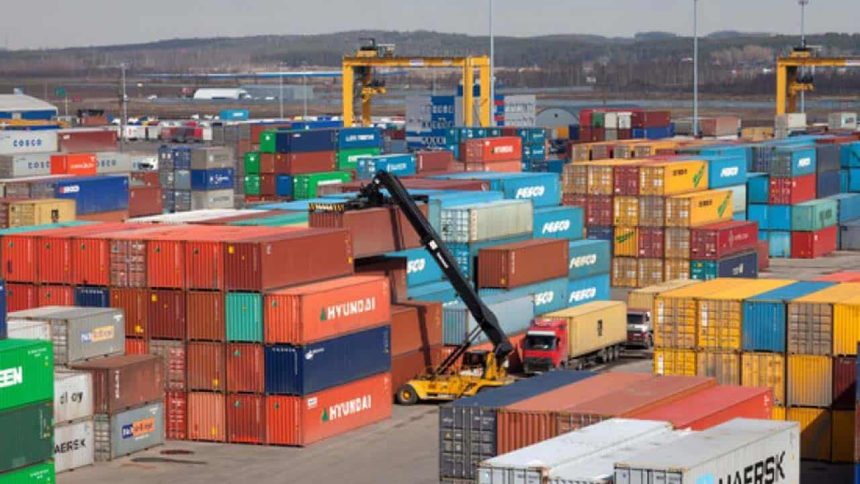
The National Bureau of Statistics (NBS) on Thursday released its Foreign Trade Statistics Report for the third quarter (Q3) of 2025, showing that Nigeria maintained a healthy trade surplus but with signs of pressure on the horizon.
The surplus stood at ₦6.69 trillion, a drop of 10.36 percent from the ₦7.4 trillion recorded in Q2 2025. While the numbers reflect continuing strength in export performance, they also highlight areas of vulnerability in the country’s trade structure.
EDITOR’S PICKS
Trade Balance: Surplus, But Softening
Nigeria’s total merchandise trade rose to ₦38.93 trillion in Q3, a 2.36 percent increase from the previous quarter and an 8.71 percent rise year-on-year. Exports accounted for 58.59 percent of total trade at ₦22.81 trillion, while imports settled at ₦16.12 trillion.
The slight quarter-on-quarter export growth — just 0.28 percent — contrasts sharply with firmer import growth, contributing to the narrowing surplus. This suggests external demand may be stabilising, even as Nigeria’s reliance on imports for fuel, machinery and industrial inputs remains deep.
Crude oil exports, long the backbone of Nigeria’s external sector, were valued at ₦12.8 trillion, representing 56.14 percent of total exports.
Non-crude oil exports totalled ₦10 trillion, accounting for 43.86 percent, although truly non-oil products — goods outside both crude and refined oil — contributed a modest ₦2.99 trillion (13.14 percent of exports). This points to the slow pace of diversification despite ongoing government efforts.

What Nigeria Exported And Where It Went
Crude oil remained the dominant commodity, but the composition of export destinations is even more telling.
India retained its position as Nigeria’s largest buyer, purchasing ₦2.26 trillion worth of goods (9.9 percent of total exports). Spain, France, the Netherlands and Italy followed, and together, the top five destinations accounted for 38.34 percent of all exports.
The concentration of export partners, particularly among European and Asian buyers, highlights both Nigeria’s global linkages and the risks of dependency on a narrow market base. A downturn in any of these economies could directly dent Nigeria’s earnings.
On the import side, China remained Nigeria’s leading trading partner with goods valued at ₦4.78 trillion, nearly 30 percent of all imports. The United States followed with ₦3.21 trillion, while India, the UAE and Belgium completed the top five. The dominance of China and the U.S. points to Nigeria’s continued reliance on external suppliers for machinery, refined fuels, chemicals and other critical industrial inputs.
Why the Numbers Matter
Beyond the headline surplus, the Q3 data offers a deeper look into the structural realities of Nigeria’s foreign trade.
The heavy reliance on crude oil exports continues to expose the economy to global price swings, while the high volume of imports in mineral fuels, machinery and transport equipment, and chemicals, which collectively make up more than 70 percent of total imports, reflects persistent weaknesses in domestic refining and manufacturing capacity.
The narrowing surplus also comes at a time of naira volatility and broader fiscal constraints, suggesting that Nigeria’s external buffers may not be expanding at the pace needed to support currency stability.
FURTHER READING
Still, the overall increase in total trade and the resilience of export earnings offer some optimism. The report shows that Nigeria remains firmly integrated into global markets, but strengthening non-oil exports and reducing dependence on imported industrial goods will be crucial for a more balanced and resilient trade profile in the quarters ahead.
Philip Ibitoye is a Special Correspondent with EKO HOT BLOG. Click here to find daily analysis and critical insight on trending issues in Lagos and other parts of Nigeria.
Click here to watch the video of the week below: