- Millions of mourners flooded the major boulevards of Tehran on Monday for the funeral procession of slain Supreme Leader Ali Khamenei, shutting down the capital’s airspace and bringing the country to a standstill.
- The massive state-backed ceremonies are being utilized by Tehran to project resilience and ideological defiance following a volatile five-week war with the United States and Israel.
- Amid public displays of grief and open demands for military revenge, intense political attention remains focused on Khamenei’s successor and son, Mojtaba Khamenei, who has not been seen in public since taking power.
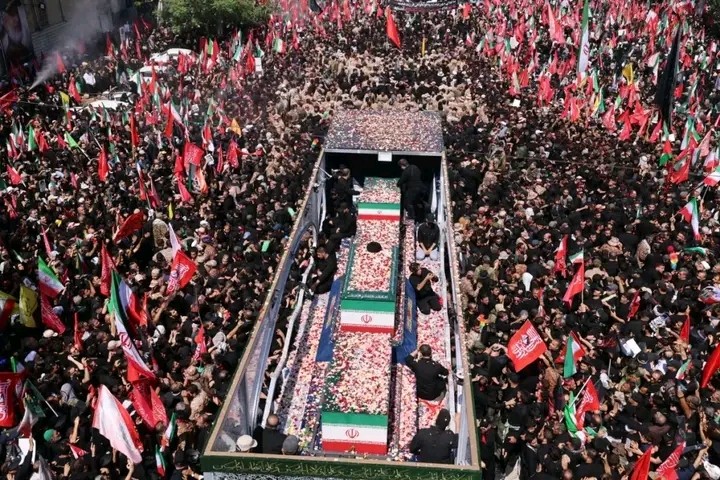
Vast crowds gathered for the funeral procession of Iran’s slain supreme leader Ali Khamenei in Tehran on Monday, with authorities estimating millions were on the streets in numbers that could rival those of his predecessor’s farewell nearly four decades ago.
Eko Hot Blog reports that authorities have yet to give an official turnout figure, but media images showed huge numbers stretching along major boulevards in the Iranian capital.
EDITOR’S PICK
- Hamzat Appoints Obanikoro as Campaign DG Ahead of 2027 Lagos Governorship Race
- Tinubu’s State Police Plan Gains Momentum as Amendment Looms
- Residents Raise Alarm After Two Bodies Found in Lagos Waterway
The ceremonies offer Iran an opportunity to project resilience after five weeks of war with the United States and Israel, although attention remains focused on Khamenei’s successor, his son Mojtaba Khamenei, who has not appeared in public since taking power.
After lying in state for two days at Tehran’s Grand Mosalla religious complex, the body of Khamenei, who was killed on the first day of the Middle East war on February 28, began its journey through the capital accompanied by massive crowds.
Flower petals covered the coffin as it made its way along the streets. Authorities are hoping to avoid a repeat of the chaos that marred the 1989 funeral of Khamenei’s predecessor Ayatollah Ruhollah Khomeini, which drew an estimated 10 million people.
Crowd surges during Khomeini’s farewell killed more than 10 people and injured over 10,000, prompting officials to install massive concrete walls at the complex this time to separate the public from the coffin and prevent stampedes.
Tehran’s airspace was closed on Monday as the country stood still to remember the former leader. Mourners marched through the streets waving the flags of Iran and the Tehran-backed Lebanese militant group Hezbollah, as well as red flags symbolising revenge.
Others gathered in Imam Hussein Square in eastern Tehran and hung an effigy of US President Donald Trump. In sweltering heat, trucks sprayed mourners with water to cool them, while organisers handed out Iranian flags and pictures of Ali and Mojtaba Khamenei along the 20-kilometer procession route.
Three of Ali Khamenei’s sons made a rare public appearance at the funeral on Sunday, further highlighting the absence of Mojtaba, who was named supreme leader shortly after his father’s killing but has yet to appear in public.
Officials have said he was wounded in the airstrikes, which were based on US intelligence, but the severity of his injuries remains unclear.
Meanwhile, the new commander of Iran’s powerful Revolutionary Guards, Ahmad Vahidi, whose predecessor was killed on February 28, appeared at the funerals alongside Esmail Qaani, the shadowy head of the Guards’ Quds Force.
The Iranian government is eager to tout the mass mobilisation in support of the authorities after mass protests took place in January that rights groups say were quelled by a crackdown that killed thousands of people.
The Middle East war is currently on hold following a ceasefire and an initial accord struck with the US.
However, both Washington and Tehran have warned they are ready to resume military action, and vengeance has been a major theme throughout the funeral events.
Monday’s procession will be followed by similar events in the clerical hub of Qom on Tuesday and in Iraq’s holy cities of Najaf and Karbala on Wednesday, culminating in Khamenei’s burial in his hometown of Mashhad in northeastern Iran on Thursday.
Delegations from Palestinian Hamas and Lebanon’s Hezbollah were both sent to the ceremonies, as Khamenei long pursued a course of military confrontation with the West.