- The Palestinian Islamist movement Hamas has officially announced the dissolution of its executive administrative committee, which has directly governed the internal affairs of the Gaza Strip for nearly twenty years.
- The dissolution is designed to clear a direct administrative pathway for the National Committee for the Administration of Gaza (NCAG), a specialized body of technocrats tasked with establishing civilian institutional rule.
- While the exit from day-to-day governance signals a major policy evolution following the October 2025 ceasefire, deep diplomatic rifts persist regarding the complete disarmament of Hamas fighters and the total scope of Israeli military withdrawal.
The Palestinian movement Hamas has confirmed the immediate dissolution of its long-standing internal governance apparatus within the Gaza Strip.
Eko Hot Blog reports that the surprise administrative withdrawal marks the conclusion of an era that began in 2007 when Hamas took full control of the territory following institutional friction with the rival faction, Fatah.
EDITOR’S PICK
- Hamzat Appoints Obanikoro as Campaign DG Ahead of 2027 Lagos Governorship Race
- Tinubu’s State Police Plan Gains Momentum as Amendment Looms
- Residents Raise Alarm After Two Bodies Found in Lagos Waterway
According to local media statements released on Monday, July 6, 2026, the formal dissolution is intended to dismantle long-standing administrative pretexts and allow an independent body to assume full management of the war-devastated coastal enclave.
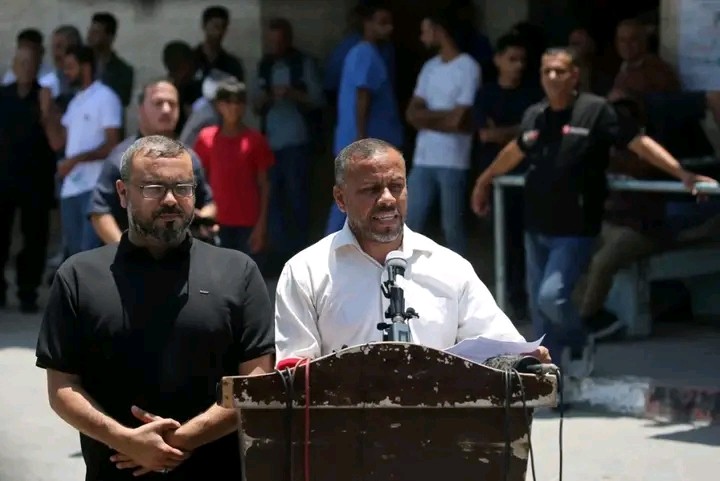
During a press briefing held at the Al-Aqsa Hospital in Deir al-Balah, Ismail al-Thawabta, the head of the Gaza government media office, confirmed that Mohammed al-Farra, the chief of the government’s emergency committee, had formally submitted his resignation.
This development effectively terminates the operational authority of the legacy Hamas executive branch.
Leadership is now transitioning to the National Committee for the Administration of Gaza (NCAG), an institutional governance body originally conceptualized under a peace framework mediated by US President Donald Trump during the bilateral ceasefire negotiations of October 2025.
Hamas spokesperson Hazem Qassem emphasized that the strategic decision was executed in coordination with various Palestinian factions during high-level consultative meetings held in Cairo, Egypt.
By voluntarily stepping away from public administration, Hamas leaders stated they intend to clear a path for international reconstruction efforts and minimize pretexts for continuous external aggression.
The new technocratic administrative body is set to be led by Palestinian technocrat Ali Shaath.
However, practical implementation remains highly complex as the committee has been forced to operate externally for months due to strict security objections raised by Israeli authorities regarding their physical entry into the territory.
The transition process also faces significant hurdles regarding the transition between the structural phases of the 2025 ceasefire agreement.
While the initial phase successfully facilitated the mutual exchange of the remaining Israeli hostages for detained Palestinians, the implementation of phase two has remained completely frozen.
Israeli defense forces have steadily expanded their tactical footprint, currently maintaining physical control over approximately 70 percent of the Gaza geographic territory.
Furthermore, Israeli negotiators have firmly rejected any arrangement that permits a return to power for Hamas, while simultaneously expressing deep reservations about a direct administrative takeover by the Ramallah-based Palestinian Authority at this specific interval.
The core diplomatic friction now centers entirely on the unresolved question of weapons stockpiles and territorial security.
Hamas leadership has explicitly maintained that they will not engage in any negotiations regarding the gradual surrender or management of their organizational arsenal until a functional, recognized Palestinian administration is fully established and operational on the ground.
With regional mediators continuing to facilitate rigorous diplomatic rounds in Cairo, the international community is watching closely to see if the formal introduction of the Ali Shaath-led technocratic committee can successfully break the months-long diplomatic stalemate.