
- NASA has positioned the Artemis lunar program as a precursor to eventual human missions to Mars
- The moon will serve as a testing ground for these innovations, allowing NASA to refine tools
- NASA has positioned the Artemis lunar program as a precursor to eventual human missions to Mars
The National Aeronautics and Space Administration (NASA) is set to launch its Artemis II mission from Kennedy Space Center in Florida today at 6:24 p.m. ET, carrying four astronauts on a historic journey around the moon.
Eko Hot Blog gathered that this mission marks the first time in over five decades that humans will return to the moon’s vicinity.
EDITOR’S PICK
- G7 Meets in France Amid Middle East Tensions
- Epe in Focus: Tinubu to Announce Lagos APC Consensus Governorship Candidate Monday
- Bisola Badmus Rallies Support for Biola Bayo Following Heated Baba Ijesha Interview Backlash
The crew NASA astronauts Reid Wiseman, Victor Glover, and Christina Koch, along with Canadian Space Agency astronaut Jeremy Hansen could surpass the distance record set by the Apollo missions, venturing farther from Earth than anyone in history.
The launch, delayed previously in February and March due to technical issues such as hydrogen leaks and helium flow problems, represents a major step in NASA’s Artemis program.
A Stepping Stone to Mars
NASA has positioned the Artemis lunar program as a precursor to eventual human missions to Mars.
Scientists emphasize that the technology and research required for a direct journey to the red planet are still under development, especially in ensuring astronaut safety during a mission 200 times farther than the moon, with far higher exposure to cosmic radiation.
Every component of the Artemis missions, from life support systems to in-space resource utilization, provides critical data for planning Mars expeditions.
The moon will serve as a testing ground for these innovations, allowing NASA to refine tools and techniques before tackling the extreme challenges of Martian travel.
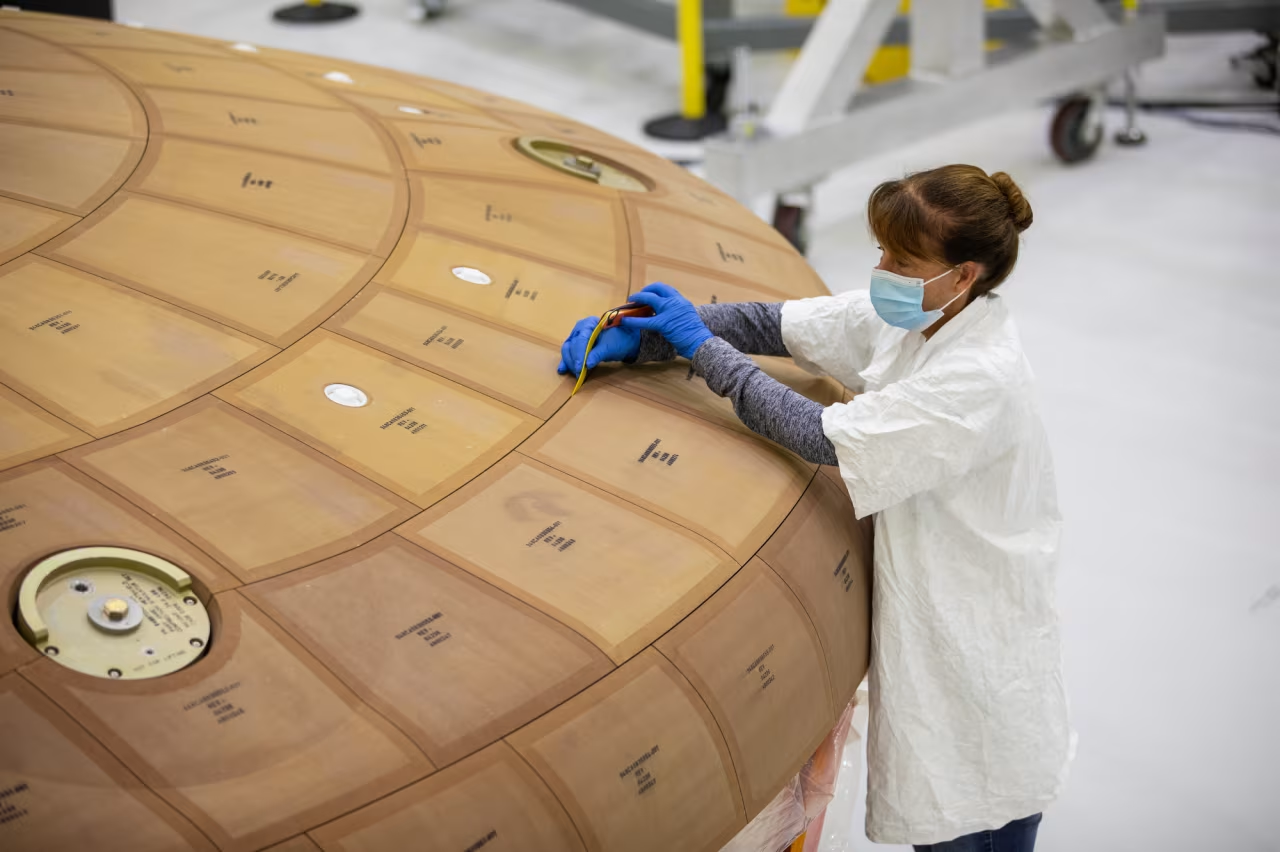
For Artemis II, the Orion spacecraft will test its heat shield under extreme conditions, re-entering Earth’s atmosphere at 11 kilometers per second (7 miles per second) a speed far exceeding previous missions to low-Earth orbit.
Future Mars missions may require even higher re-entry speeds, up to 13 kilometers per second (8 miles per second).

NASA’s medical team will monitor the astronauts’ responses to space radiation, which poses greater risks beyond low-Earth orbit due to high-energy solar particles.
The moon’s relative accessibility allows scientists to study how microgravity, radiation, and other deep-space conditions affect human health, providing vital insights for long-duration spaceflight.
According to NASA, “The moon offers a unique environment to understand how altered gravity, intense radiation, and other space-specific conditions impact living systems, knowledge that is essential for sustaining life on Mars and beyond.”
FURTHER READING