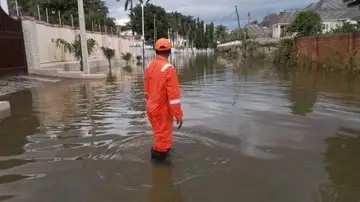
- The National Emergency Management Agency (NEMA) has warned that over 30 states are at risk of serious flooding during the 2026 rainy season, based on newly developed climate-related risk frameworks.
- NEMA Director General Zubaida Umar is calling for the immediate reintroduction of monthly environmental sanitation, the clearing of drainages, and the full operationalization of local emergency committees.
- The agency has identified flood risk profiles and produced vulnerability maps for at-risk communities to assist federal and state governments in targeted disaster risk reduction.
The Director General of the National Emergency Management Agency (NEMA), Zubaida Umar, has issued a stern warning to state governments to brace for a challenging 2026 rainy season.
Eko Hot Blog reports that during a strategic visit to Adamawa State on Wednesday night, May 13, 2026, Umar revealed that NEMA has finalized its “2026 Climate-Related Risk Management, Preparedness, and Mitigation Framework.”
EDITOR’S PICKS
- JAMB Delists 23 CBT Centres, Warns 89 After Mock UTME Review
- NASA Astronauts Return to Earth After First Human Trip to the Moon in 50 Years
- INEC Shifts Nationwide Voter Revalidation Until After 2027 General Election
The agency’s Early Warning System has already flagged 30 states where the impact of flooding could be severe, necessitating urgent grassroots intervention.
To mitigate the humanitarian and economic fallout, NEMA is advocating for a multi-sectoral approach involving traditional institutions, religious organizations, and the private sector to amplify early warning messages.
The proposed preventive actions include a return to strict environmental sanitation and the fortification of State Emergency Management Agencies (SEMAs).
Governor Ahmadu Fintiri of Adamawa State welcomed the proactive stance, pledging that his administration would implement the recommendations to protect farmlands and infrastructure, which have historically suffered during the annual rains.
Nigeria continues to struggle with the twin challenges of climate change and poor urban planning, which often turn seasonal rains into destructive disasters.
In recent years, the combination of blocked waterways and unregulated development has led to significant loss of lives and mass displacements.
By releasing vulnerability maps and risk profiles early, NEMA hopes to move the nation from a reactive “disaster response” mode to a “preventive planning” strategy, aiming to safeguard the lives of millions in vulnerable communities before the peak of the 2026 rainy season.