- NGF, Sugar Council Seal Partnership to Boost Local Sugar Production
- The partnership aligns with the NSDC’s mandate to develop Nigeria’s sugar sector
- Bakrin stressed that sugar projects integrate host communities through employment and outgrower schemes
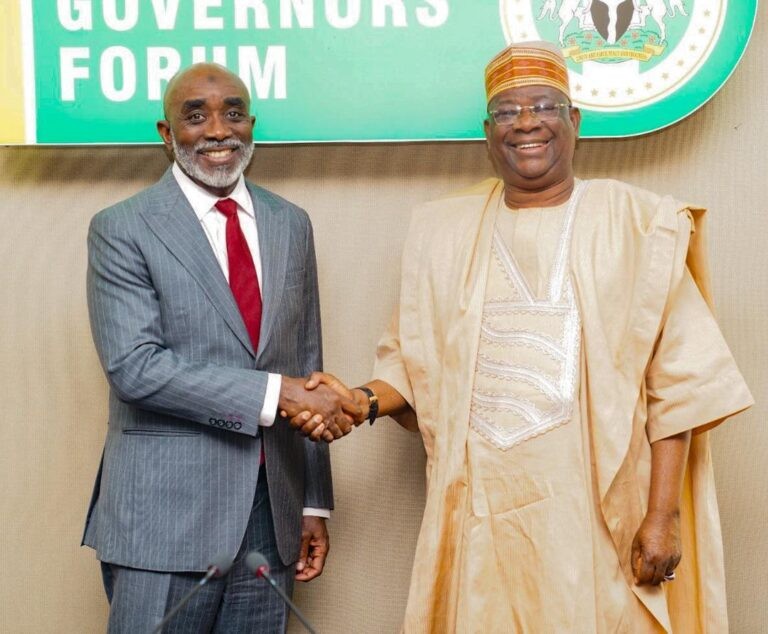
The Nigeria Governors’ Forum (NGF) and the National Sugar Development Council (NSDC) have sealed a strategic partnership aimed at prioritising sugar as a key product for accelerating industrial and economic development across Nigerian states, Eko Hot Blog reports.
As part of the agreement, the NGF has committed to including sugar projects among priority initiatives presented to development partners within and outside the country. The decision followed a high-level meeting in Abuja between officials of both bodies, convened at the request of the NSDC.
EDITOR’S PICK
- NUC Reaffirms Support for Global Academic Partnerships as UNILAG Signs MoU
- UNILAG, University of Birmingham Sign MoU to Explore Transnational Education Partnership
- UNILAG–Birmingham Partnership Will Transform Nigeria’s Education Sector – Alausa
The partnership aligns with the NSDC’s mandate to develop Nigeria’s sugar sector, halt the importation of raw sugar, create jobs and achieve national self-sufficiency in sugar production.
Under the agreement, the NGF will work with the NSDC to support states in preparing investor-ready sugar projects, facilitate structured engagement between state governments and investors, and improve coordination around critical enablers such as land access, infrastructure provision and incentive frameworks.
Speaking at the meeting, the Executive Secretary and Chief Executive Officer of the NSDC, Mr Kamar Bakrin, highlighted the vast investment opportunities in the sugar sector and urged governors of sugarcane-suitable states to embrace large-scale sugar development.
He identified 11 states with proven potential for profitable sugar production as Oyo, Kwara, Niger, Nasarawa, Kaduna, Kano, Bauchi, Gombe, Jigawa, Adamawa and Taraba.
Bakrin noted that recent macroeconomic developments have enhanced the competitiveness of locally produced sugar, as exchange rate movements have made imports significantly more expensive while most local production inputs remain naira-denominated.
According to him, Nigeria possesses strong fundamentals for sugar production, with assessments showing about 1.2 million hectares of suitable land nationwide. He added that only 200,000 hectares are required for the country to attain sugar self-sufficiency.
“The availability of land, water resources, labour and policy incentives positions Nigeria favourably for large-scale sugar investments,” Bakrin said.
He disclosed that Nigeria’s sugar sector is currently valued at about $2 billion and could grow to $7 billion across Africa under the African Continental Free Trade Agreement (AfCFTA). He also noted that the domestic market for sugar by-products alone is worth about $10 billion.
Bakrin stressed that sugar projects integrate host communities through employment and outgrower schemes, promoting inclusive development and environmental sustainability.
Citing commercial viability, he explained that a model sugar project producing 100,000 metric tons annually would require an estimated investment of about $250 million, with an internal rate of return of roughly 24 per cent, alongside additional revenue from by-products such as ethanol and bio-electricity.
Also speaking, the Director-General of the NGF, Dr Abdulateef Shittu, said many state governments are already engaged in, or showing interest in, sugar-related investments spanning agriculture, land development and agro-industrial projects.
He, however, noted that unlocking the sector’s full potential would require stronger coordination, credible investment frameworks and better alignment between federal policies and state development priorities.
Shittu pledged the NGF secretariat’s commitment to supporting states to prioritise sugar investments as a tool for rural development, job creation and sustainable economic growth.