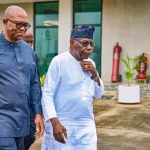
- The Presidency says public submissions on the National Policing Bill will close Thursday
- Femi Gbajabiamila urged Nigerians to contribute to the proposed state police framework
- He said strong safeguards are needed to prevent political abuse of state police
The Presidency has fixed 5pm on Thursday, August 13, 2026, as the deadline for Nigerians to submit views on the proposed National Policing Bill, as discussions over the creation of state police continue.
Eko Hot Blog reports that the Chief of Staff to President Bola Tinubu and Chairman of the Presidential Working Group on the Bill, Femi Gbajabiamila, announced the deadline on Wednesday.
EDITOR’S PICK
- How Lagos Achieved 57.4% Exclusive Breastfeeding Rate
- Shaibu Lists Nigeria’s Biggest Security Challenges
- Vote, Protect Your Mandate, Governor Adeleke Urges Residents Ahead of August 15 Polls.
He said the ongoing consultation was intended to gather practical recommendations from Nigerians and professionals on how a new policing structure could operate without compromising citizens’ rights or national security.

According to Gbajabiamila, particular attention is being given to concerns about political interference, police misconduct, independent oversight and the sharing of intelligence between federal and state police formations.
He stressed that the consultation was not a substitute for the legislative process, noting that the National Assembly would have the final responsibility to examine, modify, approve or reject the Bill once it is formally presented.
Gbajabiamila said the argument over state police should not be presented as a choice between bringing policing closer to communities and preventing political abuse.
He maintained that Nigeria needed a policing system capable of achieving both objectives.
“We can bring policing closer to the people while building strong national standards, independent oversight and firm safeguards for every citizen,” he said.
The former Speaker of the House of Representatives called on Nigerians to make specific recommendations on ways to prevent political interference in policing.
He also sought views on who should investigate serious cases of police misconduct and how intelligence should be exchanged between federal and state authorities operating in different jurisdictions.
Gbajabiamila acknowledged concerns that state police could potentially be used by governors against political opponents, protesters, journalists or minority groups.
He described such concerns as legitimate, arguing that adequate safeguards must be incorporated into the proposed legislation before any state police structure is established.
“Proximity does not guarantee justice,” he said, adding that the law must prevent political office holders from using police powers to suppress legitimate opposition or peaceful dissent.
He said the proposed framework would require police officers to operate within the Constitution, human rights principles and the rule of law.
According to him, the legislation would also make it easier for officers to reject unlawful orders, investigate misconduct and expose attempts to interfere with policing for political purposes.
The proposed National Policing Bill is expected to establish national standards for the recruitment, screening, training and remuneration of police officers.
It would also address pensions, equipment, professional conduct, use of force, disciplinary procedures, public complaints and independent oversight.
Gbajabiamila said these safeguards would be necessary to ensure that any state police service operates professionally rather than becoming an extension of political power.
He added that citizens must have access to effective and independent mechanisms through which they can report misconduct and seek redress.
On the constitutional requirement for state police, Gbajabiamila explained that Section 214 of the 1999 Constitution currently provides for the Nigeria Police Force as the country’s police institution.
As a result, he said, the establishment of state police cannot be achieved solely through ordinary legislation and would require an amendment to the Constitution.
Both chambers of the National Assembly have already approved proposed constitutional amendments seeking to establish separate Federal Police and State Police Services.
However, Gbajabiamila said the constitutional amendment process still has several stages to pass through.
The proposed amendments must be forwarded to the 36 state Houses of Assembly, where at least 24 must approve them before the process can proceed to the President for assent.
Until those constitutional requirements are completed, he said, state police remains a proposal rather than an operational reality.
Gbajabiamila also clarified that even if the constitutional amendment and National Policing Bill are approved, every state would not automatically be required to establish its own police service.
He explained that individual states would have to decide whether they were prepared to create such services.
Any state choosing to establish a police service would need to pass its own enabling legislation, create the necessary institutions and provide funding.
Such states would also have to satisfy the national requirements for establishing and operating a state police service before officers could begin policing.
States that decide not to establish their own police formations would continue to rely on the Nigeria Police Force for policing services.
The Presidency is therefore seeking public contributions before the consultation window closes, with the submissions expected to help shape the proposed framework for policing reform and the possible introduction of state police in Nigeria.
FURTHER READING