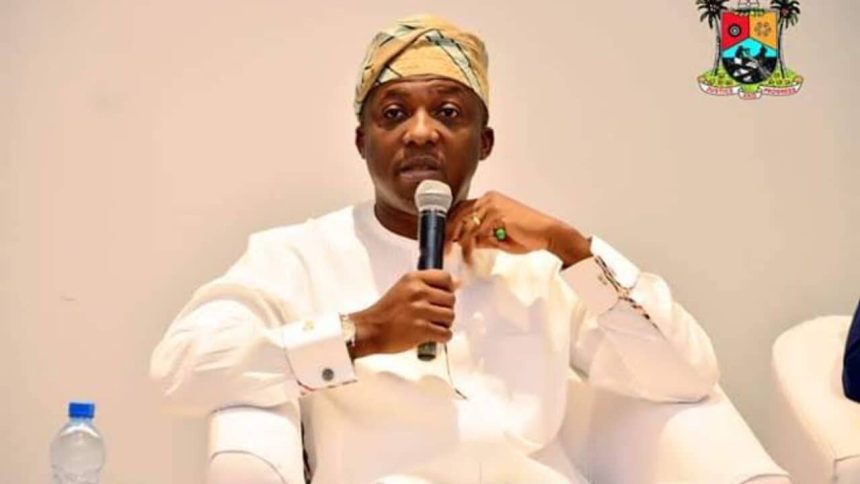
The Lagos State Government’s renewed raid on street beggars and urchins along the Lekki–Ajah and Lekki–Epe expressways has reignited an old but unresolved debate: is the state protecting vulnerable children or criminalising poverty?
That question played out publicly in a sharp online exchange between the Lagos State Commissioner for Environment and Water Resources, Tokunbo Wahab, and former BBNaija housemate Tacha, on Wednesday, turning a routine enforcement exercise into a wider policy argument.
EDITOR’S PICKS
EKO HOT BLOG wades into the details and provides an in-depth analysis of the argument.
The trigger: Enforcement meets outrage
Wahab announced that raids on street beggars and urchins were continuing as part of efforts to “restore order, ensure public safety, and keep roads and public spaces clear.” The framing was familiar: street trading and begging, especially by minors, pose safety risks and undermine urban order.
The raid on street beggars and urchins has continued along the Lekki–Ajah Expressway and in other parts of Lagos, as part of ongoing enforcement efforts to restore order, ensure public safety, and keep our roads and public spaces clear. pic.twitter.com/33wD7vecZ2
— Tokunbo Wahab (@tokunbo_wahab) January 7, 2026
Tacha’s response cut straight to the moral core of the issue. Rather than asking why children were being arrested, she argued, society should ask why they were on the streets in the first place. Pointing to the Lekki–Epe Expressway, she described hundreds of children begging daily, dodging speeding vehicles, getting injured and, in some cases, dying.
For her, arrests do not solve the problem; they “add fear to poverty.” She blamed government failure, arguing that if the state were serious, it would prioritise proper vocational centres with boarding facilities and real pathways out of poverty. In her sharpest line, she suggested that those who looted public funds, not children struggling to survive, deserved arrest.

“If anyone deserves arrest, it’s the officials who looted public funds and left children with no choice but the streets!” Tacha wrote.
The first question shouldn’t be why arrest these kids? It should be why are they on the streets in the first place?
These children are on the streets because the government failed them.. Along the Lekki–Epe Expressway alone, you’ll see hundreds of kids begging every single day.… https://t.co/LhjJxZycSw
— TACHA🔱🇬🇭 🇳🇬 (@Symply_Tacha) January 7, 2026
Her post resonated because it reflected what many Lagos residents see daily: minors exposed to danger, with enforcement appearing reactive rather than transformative.
The government’s defence: Law, data and existing structures
Wahab’s reply rejected what he described as emotional, knee-jerk advocacy.
Enforcement, he said, must be guided by law, data and long-term social responsibility. Leaving children on highways in the name of compassion, he argued, is not empathy but neglect. For the government, the very danger Tacha highlighted is the reason intervention cannot be abandoned.
He pushed back strongly against the claim that the state has done nothing. According to him, Lagos public schools are tuition-free, with WAEC fees covered, and the state runs free technical colleges, vocational centres and skills-acquisition programmes teaching trades such as shoemaking, fashion, ICT, photography and creative arts. He also cited interventions by NGOs, religious bodies and community groups, arguing that while these efforts may be imperfect, it is inaccurate to say there are no options.
On the specific issue of raids, Wahab said apprehended children are profiled: some are returned to parents, many of whom do not live in Lagos, while others willing to learn skills are given free admission through the Ministry of Youth and Social Development. He drew a clear line on responsibility, stating that government “is not to parent recalcitrant children,” but invited Tacha and others to partner with the state beyond social media advocacy.
Where the arguments collide
Both sides speak to real failures, but from different angles. Tacha’s argument exposes the human cost of policy gaps: children on highways are evidence that social safety nets, however well designed on paper, are not reaching the most vulnerable. Her criticism taps into a broader distrust of governance, where poverty is seen as a by-product of corruption and mismanagement.
The government’s response, however, highlights a different truth: a megacity cannot ignore laws or safety risks, and the presence of children on expressways is itself a form of systemic neglect. From this view, enforcement is not punishment but intervention, especially when it is linked to profiling, family tracing and skills programmes.
The tension lies in execution. If vocational centres, free schools and rehabilitation pathways exist, why do the same children keep returning to the streets? And if enforcement is necessary, how does the state ensure it does not become a cycle of arrest, release and return to poverty?
FURTHER READING
Ultimately, the debate is less about whether children should be removed from highways — few disagree on that — and more about what happens next. Until enforcement is clearly and consistently matched with visible, effective reintegration and support, Lagos will continue to face the same question: is it saving children, or merely policing poverty?
Philip Ibitoye is a Special Correspondent with EKO HOT BLOG. Click here to find daily analysis and critical insight on trending issues in Lagos and other parts of Nigeria.
Click here to watch the video of the week below: