- The Senate Committee on the Downstream Petroleum Sector has pledged to permanently resolve the ongoing regulatory turf war between the Nigerian Midstream and Downstream Petroleum Regulatory Authority and the Oil and Gas Free Zone Authority.
- Lawmakers aim to eliminate overlapping statutory mandates that stall industrial operations, promising transparent legal amendments to safeguard national energy security and boost marketplace stability.
- The leadership of OGFZA has warned federal bodies against promoting toxic regulatory ambiguities, insisting that massive mega-investments like the Dangote Industries Free Zone must be legally permitted to operate under unified, global free-zone practices.
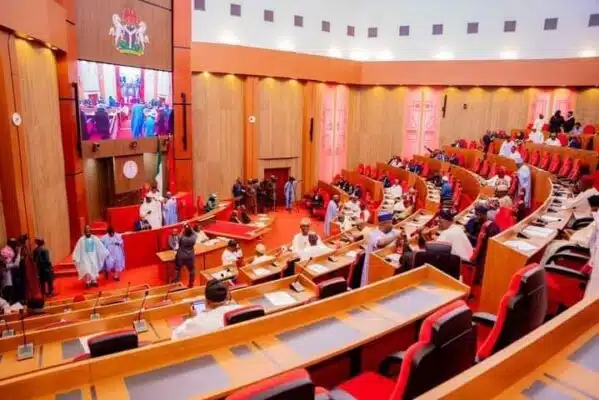
The upper legislative chamber of the National Assembly has initiated a legislative process to permanently dismantle the operational bottlenecks and jurisdictional friction existing between the Nigerian Midstream and Downstream Petroleum Regulatory Authority (NMDPRA) and the Oil and Gas Free Zone Authority (OGFZA).
The commitment was formally announced on Friday by the Chairman of the Senate Committee on Downstream Petroleum, Senator Abdulrahman Sumaila, at the conclusion of a specialized five-day legislative retreat held in Yenagoa, the Bayelsa State capital.
EDITOR’S PICK
- Hamzat Appoints Obanikoro as Campaign DG Ahead of 2027 Lagos Governorship Race
- Tinubu’s State Police Plan Gains Momentum as Amendment Looms
- Residents Raise Alarm After Two Bodies Found in Lagos Waterway
Sumaila stated that the upper house is deeply determined to establish a harmonized regulatory environment that protects consumer interests, ensures total energy security, and builds concrete investor confidence within the nation’s oil and gas architecture.
The multi-day retreat was intentionally structured to provide an objective, neutral platform for top-tier executives, legal experts, and state regulators to address overlapping statutory provisions that have frequently caused friction between the two federal bodies.
Senator Sumaila explained that the committee’s final report will present unbiased, evidence-based recommendations designed to introduce absolute legal certainty to the sub-sector.
He affirmed that where permanent legislative revisions, policy shifts, or constitutional amendments are deemed necessary to prevent future institutional collisions, the Senate will not hesitate to draft and enact such reforms in the overriding commercial interest of the federation.
The primary legislative focus is to build a streamlined, highly accountable ecosystem capable of strengthening Nigeria’s position as Africa’s premier industrial and energy hub.
Contributing directly to the legislative discourse, the Managing Director of the Oil and Gas Free Zone Authority, Alhaji Bamanga Jada, delivered an impassioned appeal to all regulatory stakeholders to immediately halt actions that promote toxic administrative ambiguities.
Jada emphasized that all state apparatuses bear a collective responsibility to maintain an enabling environment for complex corporate investments, relying strictly on the rule of law.
He argued that for Nigeria to maximize its economic potential, major industrial free-zone operators, most notably the multi-billion-dollar Dangote Industries Free Zone, must be granted the unhindered right to enjoy the globally recognized “one-stop-shop” operational principle.
This model dictates a singular, smoothly coordinated regulatory interface rather than subjecting major capital investors to redundant, multi-layered regulatory demands from competing agencies.
Moving forward, the Senate Committee is set to thoroughly review all formal submissions, legal arguments, and structural presentations compiled during the Yenagoa sessions before laying its comprehensive legislative framework before the whole house.
By systematically defining the boundaries of institutional oversight, the upcoming reforms aim to eliminate bureaucratic duplicate processes, lower the cost of doing business in Nigeria’s specialized free zones, and ensure that institutional partnerships are completely synchronized with the broader macroeconomic growth strategies of the federal government.