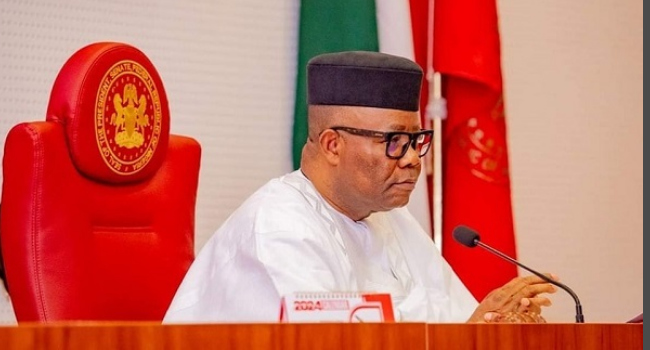
- Parliamentary rules are not about silencing dissent but about preserving institutional order
- The Senate reclaims its moral authority and shields itself against institutional decay
- The Nigerian Senate shares principles with legislatures in the UK, Canada, and Australia
Senate President Godswill Akpabio has declared that the National Assembly will not become a “hostage” to the “disruptive instincts” of any single member.
Eko Hot Blog reports that he insisted the upper chamber must uphold strict discipline and respect for its rules to preserve the sanctity of Nigeria’s democracy.
EDITOR’S PICK
- Osun Assembly, Senator Clash Over Arrest, Sealing of Amotekun Bases
- Dollar To Naira Exchange Rate Today, October 11, 2025
- EXPOSED: Blacklisted Benin Varsities Using Nigerian Polytechnics to Sneak Graduates into NYSC
Akpabio made the firm statement today, Saturday, through his media aide, Eseme Eyiboh, titled “The Trials and Triumphs of a Resilient Nigeria’s 10th Senate.”
Although he did not name a specific lawmaker, his comments come amid tension surrounding Senator Natasha Akpoti-Uduaghan (Kogi Central), who recently concluded a contested six-month suspension.

The Senate President maintained that enforcing parliamentary rules is not about silencing dissent but about preserving institutional order.
He argued that discipline is the hallmark of every advanced democracy, noting that the Nigerian Senate shares principles with legislatures in the UK, Canada, and Australia.
Akpabio stressed that the Senate’s Standing Orders are not “ceremonial relics” but the “living constitution” of the institution, designed to protect fairness and stability.
He defended the legislature’s right to discipline members, drawing parallels to the British House of Commons, where lawmakers face swift consequences, including suspension or expulsion, for undermining parliamentary dignity.
Akpabio concluded that the 10th Senate demonstrates that “freedom within order is the truest form of democracy,” asserting that by enforcing its rules, the Senate reclaims its moral authority and shields itself against institutional decay.
FURTHER READING