By Olabode Opesitan
He inherited a sector that had normalised paralysis, a system where strikes were not an interruption but a tradition. Yet in barely three years, he has delivered the one thing that eluded four administrations before him: stability.
EDITOR’S PICK
- Argument Over Pot of Soup Lands Aba Man in Police Custody
- The Ajayi Estate Case and Africa’s Legal Dilemma
- Oba of Benin Summons Native Doctors, Priests Over Rising Insecurity
He is the fifth President to govern Nigeria since the return to democracy, but he is the first to break the cycle of disruption that held universities hostage for decades. The contrast is not emotional. It is empirical. It is written in the arithmetic of lost academic years and the exhaustion of millions of students who spent their youth waiting for campuses to reopen.
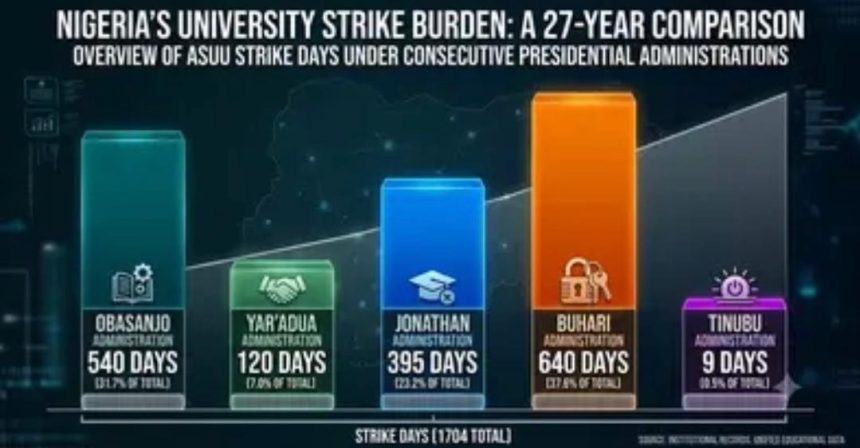
The data is brutal. Obasanjo lost roughly 540 days to strikes. Yar’Adua lost 120 days. Jonathan lost 395 days. Buhari lost 640 days, the worst record in the Fourth Republic. Tinubu, by contrast, has recorded fewer than ten days of disruption, and even those were tied to inherited arrears rather than fresh disputes. This is the first administration since 1999 to govern without a full-blown ASUU shutdown.
The significance is not merely the absence of strikes. It is the return of predictability to a sector that had forgotten what predictability felt like. For the first time in a generation, Nigerian universities are beginning to resemble citadels of learning rather than conclaves of frustration. Students now plan their semesters with confidence. Parents no longer brace for sudden closures. Lecturers are negotiating reforms rather than barricading campuses.
The drivers of past instability were deep and structural. ASUU’s demands were anchored in revitalisation funds, Earned Academic Allowances, and the long-running battle over autonomy and the IPPIS payroll platform. These were not whimsical grievances. They were the unresolved legacies of the 2009 Agreement and the 2012 Needs Assessment that documented the decay of public universities.
Tinubu confronted these inherited liabilities with a managerial clarity that previous administrations lacked. He reopened negotiations without hostility.
He restored withheld salaries. He initiated a new funding framework. Most importantly, he broke a 16-year stalemate by renegotiating the old 2009 Agreement into a fresh legal roadmap that is subject to review every three years under the Renegotiated FGN-ASUU Agreement, In
Renegotiated FGN-ASUU Agreement, concluded on
23 December 2025 and signed on 14 January 2026. This pact delivered a 40 percent basic salary bump, a CAA increase, a 1 percent GDP research funding framework, and a moratorium on new universities.
Another quiet revolution strengthening this new stability is the student loan programme, which now functions as both a structural and psychological shock absorber. Over 1.5 million students have already benefited from the N282 billion disbursed so far by NELFUND, with N183.9 billion paid directly to 301 tertiary institutions for tuition and N98.3 billion transferred to students to support living expenses. The impact is unmistakable. Universities have regained financial capacity, students no longer live with the fear of unpaid fees, and parents have been relieved of the heavy burden of upkeep.
It is a triple trigger of delight that has reinforced stability across the entire system.
The reforms are not cosmetic. They are transformative. Six major clauses have already been fully implemented. Three are in progress, including restructured allowances and cadre adjustments. Five remain outstanding, including the N30 billion stabilisation tranche and four months of arrears. Even ASUU acknowledges that progress is real, though it insists that trust will remain fragile until the monitoring committee is inaugurated and outstanding balances are paid.
Yet the ripple effects are unmistakable. Academic calendars are holding. Postgraduate programmes are regaining momentum. International collaborations, once suspended due to instability, are returning. The private sector, long wary of investing in university-based research, is re-engaging. Stability is not symbolic. It is catalytic.
Critics may argue that the absence of strikes is not proof of systemic reform. But the evidence suggests a deeper shift. Tinubu has not silenced ASUU. He has engaged it. He has not evaded the structural issues. He has confronted them. He has not merely prevented strikes. He has altered the conditions that produce them.
Tinubu has not solved every problem in the university system. No honest observer would claim that. But on the single most destructive issue that has crippled Nigerian tertiary education since 1999, he has delivered what no other President delivered:
Uninterrupted learning, Uninterrupted teaching, Uninterrupted hope, PostScript
The stability in the university system reflects the steady coordination of Dr. Tunji Alausa, the Minister for Education whose disciplined engagement with ASUU and data-driven approach has strengthened trust and improved sector management. It is also appropriate to note the groundwork laid by Professor Tahir Mamman, the first Minister for Education in the Tinubu era whose initial policy direction helped shape the reforms now being consolidated.