- The US military launched its third consecutive night of heavy airstrikes targeting key Iranian coastal facilities, while Iran’s Revolutionary Guards retaliated with missile and drone strikes hitting US assets in Bahrain and Jordan.
- Following the collapse of a fragile June ceasefire, US Central Command (CENTCOM) is formally reinstating a naval blockade on all ships entering or departing Iranian ports, effective Tuesday night.
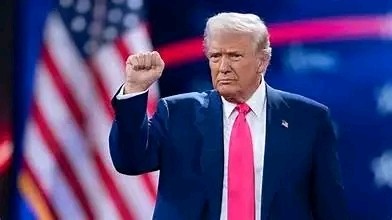
- President Donald Trump announced the US is “taking over” the Strait of Hormuz to act as its “guardian,” proposing a unilateral 20 percent fee on all commercial cargo transiting the strategic waterway to reimburse US security costs.
The United States has launched a third consecutive night of heavy military strikes on targets across Iran.
Eko Hot Blog reports that president Donald Trump announced plans to reimpose a naval blockade on Iranian ports and proposed a controversial 20 percent fee on all commercial cargo transiting the vital Strait of Hormuz.
EDITOR’S PICK
- Why Africa Still Cannot Win the FIFA World Cup Despite Its World Class Talent
- Man Allegedly Slits Father’s Throat, Mutilates Body in Anambra
- Lagos Court Convicts Director, Company Over N822.4m Fraudulent Conversion
Despite the renewed bombardment, Trump insisted Monday that a permanent deal with the Islamic Republic remains possible.
The diplomatic overtures, however, are being severely tested on the water. According to the United Arab Emirates Ministry of Defence, Iranian cruise missiles struck two national oil tankers in Omani territorial waters within the strategic Strait of Hormuz.
The attack killed an Indian crew member and wounded eight others, marking a bloody collapse of the fragile maritime truce.
In response, the US military executed a massive five-hour mission hitting key coastal facilities, including targets in Bushehr and Bandar Abbas.
US Central Command (CENTCOM) stated the operation was designed to degrade Tehran’s capacity to disrupt international commercial shipping.
Hours after the American airstrikes, Iran’s Revolutionary Guards retaliated by launching multiple waves of missiles and drones.
The attacks targeted US military facilities in Bahrain, prompting the island kingdom, home to the US Navy’s 5th Fleet, to sound emergency air defense sirens.
Tehran also launched aerial strikes into neighboring Jordan, which reported shooting down four incoming Iranian missiles.
“We’re going to hit them very hard tonight, and we’re going to hit them hard tomorrow,” Trump warned from the White House.
The direct military exchanges represent the fiercest clash between the two countries since an interim ceasefire was brokered in June 2026.
Under that June agreement, the US had lifted its previous blockade of Iranian ports. However, Trump declared that the deal was effectively “over” after Iranian forces repeatedly threatened and attacked commercial vessels passing through the Hormuz waterway.
On Monday, Trump announced that the United States would assume unilateral control over the strait, dubbing the US “The Guardian of the Strait of Hormuz” on his Truth Social platform.
He declared that the US would levy a 20 percent fee on all commercial ships navigating the waterway to offset the military cost of securing the passage.
While the US Navy plans to let non-Iranian vessels navigate the strait freely, CENTCOM confirmed that a strict blockade on all ships travelling to or from Iranian ports would take effect at 20:00 GMT on Tuesday.
The proposed 20 percent transit fee has already drawn sharp international criticism and mockery.
Iranian Foreign Minister Abbas Araghchi sarcastically posted on social media that while Trump was right that whoever secures the passage deserves compensation, “20% is of course too much” and that Tehran would “be fair” and charge less.
Meanwhile, international maritime groups and legal experts have strongly questioned the move, pointing out that international law generally forbids charging mandatory tolls simply to transit through international straits.
As fears of a prolonged blockade grip the energy markets, global oil prices surged by over nine percent on Monday, with Brent crude climbing past $84 a barrel.
Financial experts warn that a protracted disruption in the strait, which handles one-fifth of the world’s oil supply, could quickly push Brent prices past $100 a barrel.
The White House also confirmed that President Trump formally notified Congress last week that the United States has resumed military hostilities against Iran.
This notification opens a new 60-day window under the War Powers Resolution, allowing the Pentagon to conduct military operations in the region without immediate congressional approval.
In addition to the blockade, Trump warned of further strikes if Iran does not back down, specifically threatening to target Pickaxe Mountain, a deeply buried, undeclared nuclear enrichment site near Natanz.
Despite the heavy fighting, diplomatic channels have not been completely severed. Iran’s Foreign Ministry spokesman, Esmaeil Baqaei, acknowledged that the June memorandum of understanding was “in crisis”.
However, he noted that Tehran is still communicating with international mediators in Qatar, Pakistan, and Oman in an effort to prevent the conflict from spiraling into a total regional war.