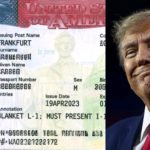
- United States President Donald Trump has issued a sweeping executive directive requiring Nigerians and other foreign nationals to return to their home countries to process permanent residency applications, heavily restricting adjustment of status within the U.S.
- The restrictive mandate systematically alters the landscape for international students, skilled workers, and tourists, explicitly barring individuals from treating short-term visas as an automatic stepping stone to a green card.
- The structural crackdown builds upon a series of severe immigration freezes enacted by Washington, following an absolute halt on citizenship petitions for citizens originating from 19 blacklisted countries.
United States President Donald Trump has directed that Nigerians and other nationals applying for green cards must return to their home countries to apply for the process except in extraordinary circumstances.
Disclosed via an official regulatory statement on Friday, May 22, 2026, Eko Hot Blog reports that the updated policy shift was formalized through the United States Citizenship and Immigration Services (USCIS).
EDITOR’S PICK
- Fresh Details Emerge on Death of Odomola Monarch, Oba Adebowale Adeshina
- Sanwo-Olu Applauds LASU’s Academic Excellence After JAMB Ranking
- NRC Moves 176,820 Tonnes Of Cargo Through Lagos Ports In Q1
The agency maintained that the administrative restructuring is strictly geared toward restoring the original legislative intent of federal immigration statutes, compelling non-citizens to channel residency petitions through global consular offices overseen directly by the Department of State.
The institutional directive effectively ends the routine practice of adjusting visa statuses while residing inside American borders.
USCIS spokesman Zach Kahler clarified that the policy change is designed to close administrative loopholes and minimize the volume of undocumented migrants who slide into the shadows after receiving residency denials on American soil.
By demanding that foreign applicants complete the entire vetting pipeline from their native countries, the Trump administration expects to dramatically lower domestic enforcement costs while freeing up limited administrative resources to address severe human trafficking cases, naturalization applications, and violent crime investigations.
The enforcement protocols will place an immediate burden on temporary visitors, including tens of thousands of Nigerian scholars, specialized professionals under employment frameworks, and vacationers traveling on non-immigrant visas.
The federal government emphasized that short-term entry permits are legally meant for finite, specific purposes and must not function as an unofficial entry point to legal permanent residency.

Under the new legal framework, immigration officers will expect temporary visa holders to depart the United States completely once their authorized stay expires, rather than transitioning directly into long-term residency tracks from within the country.
This latest development marks a sharp escalation in a broader, continuous campaign targeting legal immigration pathways from select African and Asian territories.
Back in December 2025, the White House ordered a complete freeze on permanent residency and citizenship processing for Nigerian citizens and various other nationals affected by an expanded travel ban.
That administrative action was swiftly triggered following a high-profile shooting incident involving two National Guard soldiers in Washington, D.C.
With the freeze now extending into mandatory home-country processing, legal analysts anticipate immediate operational gridlocks at foreign consulates as international applicants scramble to navigate the new system.