- Two powerful earthquakes measuring 7.2 and 7.5 magnitude struck Venezuela in rapid succession, marking the strongest seismic activity to hit the nation in over a century and leaving at least 920 people dead and 3,360 injured.
- Acting President Delcy Rodríguez has fully militarized the worst-hit coastal region of La Guaira to secure transit routes, while emergency officials warn that at least 172 individuals remain trapped alive beneath collapsed high-rise structures.
- Rescue operations face severe delays due to constant aftershocks, a lack of heavy machinery, and the total closure of the damaged Maiquetía “Simón Bolívar” International Airport, prompting fears from the USGS that fatalities could surpass 10,000.
The combined death toll from the twin earthquakes that struck north-central Venezuela on Wednesday night has officially climbed to 920, with 3,360 others documented as injured.
Eko Hot Blog reports that authorities are facing a monumental humanitarian crisis as more than 50,000 people remain unaccounted for following the 7.2 and 7.5-magnitude shocks.
EDITOR’S PICK
- Hamzat Appoints Obanikoro as Campaign DG Ahead of 2027 Lagos Governorship Race
- Tinubu’s State Police Plan Gains Momentum as Amendment Looms
- Residents Raise Alarm After Two Bodies Found in Lagos Waterway
The second tremor has been classified by seismologists as the most powerful seismic event to hit the South American nation in over one hundred years, causing widespread structural failure across multiple northern states.
Jorge Rodríguez, the head of Venezuela’s National Assembly, confirmed that at least 383 buildings have been completely leveled or severely compromised, with 172 people confirmed to be trapped beneath concrete ruins.
In response to the scale of the destruction, the coastal region of La Guaira has been placed under strict military control.
Both the National Assembly leadership and acting President Delcy Rodríguez announced the militarization to manage security and keep critical transit corridors open, warning civilian volunteers that mounting traffic congestion is severely blocking medical teams from evacuating critically injured victims.
To coordinate relief logistics, the federal government has converted the Foreign Ministry building in Caracas into a central distribution hub for emergency food, clean water, and medical supplies.
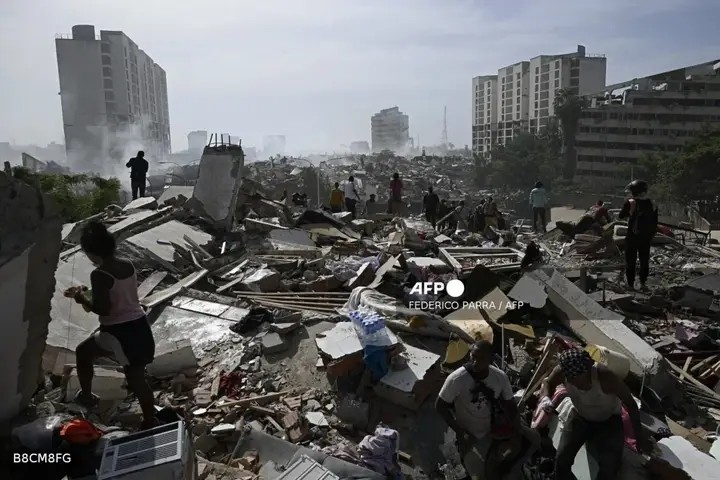
Simultaneously, engineering teams under the supervision of the Sectoral Vice President of Public Works and Services, Juan José Ramírez, are deploying specialized percussion equipment to break through dense concrete slabs in a desperate search for survivors.
However, rescue operations have slowed to a crawl in several isolated coastal communities due to continuous aftershocks and a critical shortage of heavy earth-moving equipment.
The resource deficit has forced residents to claw through the debris using basic hand tools like pickaxes and shovels.
The ultimate casualty count is expected to rise sharply as search-and-rescue teams advance into completely flattened residential quarters.
The United States Geological Survey issued an assessment stating that final fatalities are highly likely to reach the thousands, with a strong statistical probability of exceeding 10,000 deaths.
International aid deployment has also run into immediate logistical bottlenecks following the indefinite closure of the Maiquetía “Simón Bolívar” International Airport due to extensive terminal and runway fractures.
Despite the infrastructural shutdown, international governments are preparing relief packages, with U.S. Secretary of State Marco Rubio stating that the United States has finalized a rapid, large-scale, whole-of-government response to assist the nation as soon as entry points become viable.
Meanwhile, thousands of families are uploading data to online missing persons registries as the critical window for survival begins to close.