
Between 2021 and 2025 at least 6704 Nigerians filed asylum applications in Cyprus according to data from the Asylum Information Database compiled by the European Council on Refugees and Exiles using figures from the Cyprus Asylum Service and the European Union Agency for Asylum.
EDITOR’S PICK
- Federal Lawmaker Yaya Tongo Dies In Abuja Hospital
- Rep. Wale Raji Celebrates Alhaja Aduke Salimot Seriki on Birthday
- Nancy Isime Recalls Alex Ekubo’s Fearless Humor, Generosity at Late Actor’s Tribute
For many, Cyprus represented a gateway to Europe and a chance at stability. But the outcome was almost always the same. In 2025 Nigerian applicants recorded an overall protection rate of just 0.16 percent one of the lowest recorded in the country.
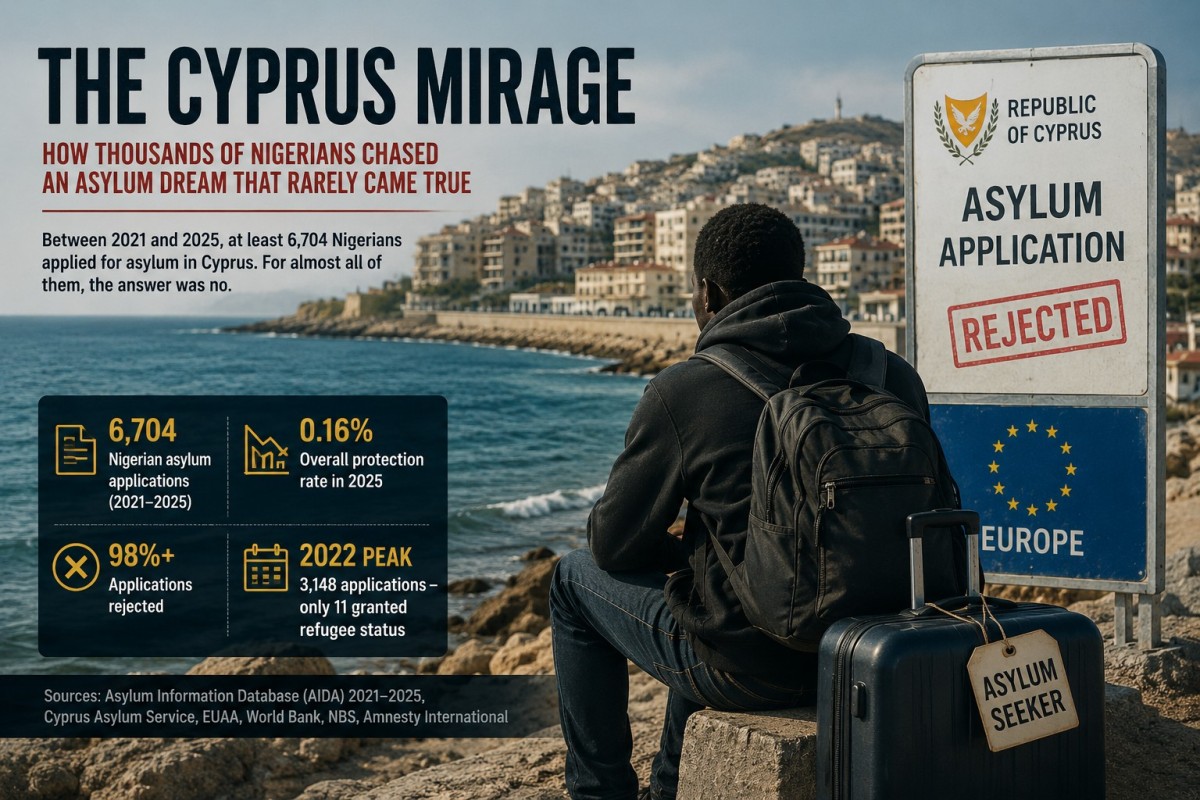
Applications peaked at 3148 in 2022 before falling steadily to 428 in 2025 a decline of about 70 percent over the period. In 2022 only 11 Nigerians out of 3148 received refugee status. By 2025 only a small number were granted protection while the overwhelming majority were rejected.
The numbers point to a system where hope and reality rarely meet.
Why Cyprus Became a Destination
Cyprus is not among the most talked about migration destinations for Nigerians compared with the United Kingdom Canada or Germany yet it has steadily grown into a significant route for students workers and asylum seekers.
The country offers relatively easier admission into private universities lower tuition compared with much of Western Europe and fewer barriers for entry on student visas. For many young Nigerians these pathways begin as legitimate educational journeys.
However after arrival circumstances often change. Rising tuition costs limited job opportunities expired residence permits and financial pressure leave many migrants with difficult choices.
At that point asylum becomes one of the few remaining legal options to stay.
But asylum is not designed as a general migration pathway. Under international refugee law applicants must prove a well founded fear of persecution based on race religion nationality political opinion or membership of a particular social group. Economic hardship unemployment or insecurity alone are not usually sufficient grounds for protection.
This gap between legal expectation and migrant reality is at the heart of the Cyprus case.
The Safe Country Designation
A major turning point came in 2021 when Cyprus classified Nigeria as a safe country of origin alongside countries such as Bangladesh Pakistan India Ghana and Senegal.
This classification does not mean the country is free from violence or hardship. It is a legal presumption used in asylum processing that assumes applicants from such countries are generally not entitled to protection unless they can present strong evidence to the contrary.
In practice it changes everything. Applications are fast tracked and the burden of proof shifts heavily onto the applicant. Instead of authorities establishing whether protection is needed applicants must prove why they are exceptions to a general rule of safety.

Legal scholars have criticised the broad application of such lists arguing that they can ignore regional conflicts and individual risk factors. Agostina Pirrello of Utrecht University has noted that country of origin assessments can be used in ways that reflect policy preferences rather than individual protection needs.
The result in Cyprus has been consistently high rejection rates for Nigerians.
A System with Almost No Margin for Success
The statistical pattern is striking.
In 2021 1555 Nigerians applied for asylum. In 2022 the figure rose sharply to 3148. In 2023 it dropped to 1019. In 2024 it fell further to 554 and in 2025 it stood at 428.
Across all five years the outcome remained largely unchanged. Approval rates stayed extremely low while rejection rates consistently exceeded 98 percent in most years.
In 2022 only 11 Nigerians were granted refugee status and none received subsidiary protection. Similar patterns continued in subsequent years.
When compared with the European Union average the gap becomes clearer. In early 2026 the recognition rate for Nigerian applicants across the EU stood at about 13 percent roughly 80 times higher than in Cyprus.
This makes Cyprus one of the most difficult asylum systems in Europe for Nigerian applicants.
The Route to Cyprus
Most Nigerians arriving in Cyprus do so legally at first often through student visas tied to private universities. These institutions have become a major entry point for international students seeking affordable education in Europe.
Others arrive through irregular migration routes including entry through Turkish administered Northern Cyprus before crossing into the southern part of the island where European Union law applies.

Cyprus itself is geographically small and politically divided. The northern part is not internationally recognised as a separate state and does not operate a formal asylum system. Migrants who reach the south enter a full European asylum jurisdiction.
However Cyprus is also outside the Schengen Area meaning asylum seekers cannot freely travel onward to other European countries while their cases are pending. This creates a form of geographic containment where applicants remain trapped on the island while their cases are processed.
Life After Application
For many asylum seekers in Cyprus the legal process is only the beginning of a longer period of uncertainty.
Reports from European monitoring bodies describe overcrowded reception facilities limited access to employment and long waiting periods. In 2023 authorities extended the waiting period before asylum seekers could legally work from one month to nine months leaving many without income for extended periods.
Conditions in reception centres have been widely criticised including overcrowding and inadequate living standards. Outside these centres many asylum seekers rely on informal housing and low paid irregular work where available.
There have also been reports of social tension including racist attacks and increased policing of migrant communities.
In 2024 the offices of KISA a civil society organisation supporting migrants and asylum seekers were attacked in an incident that raised concerns about growing hostility toward migrant advocacy groups.
Nigeria and the Push Factors
The Cyprus asylum trend cannot be separated from conditions in Nigeria itself.
In recent years Nigeria has faced severe economic pressure including currency devaluation following the removal of fuel subsidies and exchange rate reforms in 2023. Inflation reached over 34 percent in 2024 while the naira lost significant value against major currencies.
According to World Bank estimates more than 115 million Nigerians were living in poverty by 2023.
Security challenges have also remained significant. Armed groups operating in different regions have been linked to kidnappings and violent attacks. Nigerian authorities have reported large ransom payments linked to abductions in recent years.
These conditions have contributed to what is widely described as the Japa phenomenon a growing desire among young Nigerians to migrate abroad in search of better opportunities.
While many pursue legal routes through education or skilled migration some find themselves entering asylum systems when other options fail or become inaccessible.
Why the Numbers Are Falling
One of the most notable trends in Cyprus is the sharp decline in Nigerian asylum applications after 2022.
This reduction is not necessarily linked to improved conditions in Nigeria but rather to increased awareness of rejection rates in Cyprus. Information spreads quickly through migrant networks social media and returning migrants who share experiences of failed applications and difficult living conditions.
By 2025 the number of applications had fallen significantly but not stopped entirely. Hundreds of Nigerians still applied despite the extremely low probability of success.
The persistence of applications reflects a deeper reality. For many migrants the decision is not based on statistical probability but on limited alternatives at home and abroad.
Cyprus has become a case study in the limits of modern asylum systems when confronted with large scale economic migration pressures.
For Nigerian applicants the island represents both opportunity and closure a legal entry point into Europe that rarely leads to protection or long term settlement.
Between 2021 and 2025 thousands made the journey. Almost all were rejected.
Yet the flow continues albeit at a reduced pace suggesting that the forces driving migration from Nigeria remain stronger than the deterrents created by one of Europe most restrictive asylum environments.
In the end the Cyprus story is not only about policy or numbers. It is about the distance between expectation and reality and the enduring gamble of those who believe that somewhere beyond that gap a different life might still be possible.
FURTHER READING