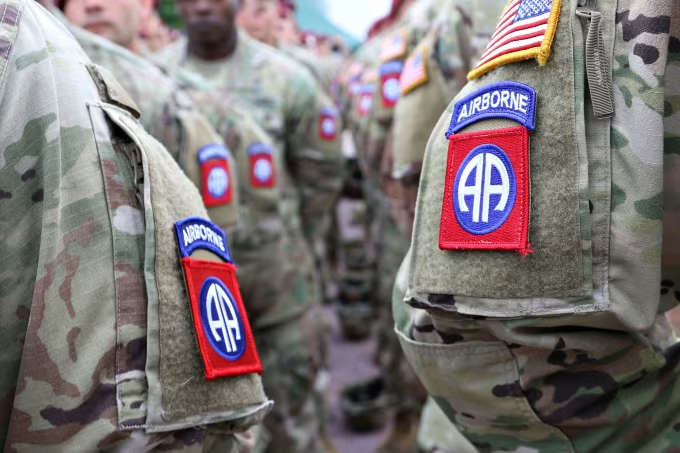
- Approximately 1,000 elite paratroopers from the 82nd Airborne Division, including Major General Brandon Tegtmeier, are deploying to provide the U.S. with immediate “boots on the ground” capability.
- The deployment occurs even as President Trump claims to have reached a 15-point agreement with Tehran, highlighting a “dual-track” strategy of military pressure alongside peace talks.
- These soldiers join roughly 9,000 recently rerouted Marines and sailors, bringing the total U.S. force in the region to over 50,000 personnel amid ongoing strikes on strategic infrastructure.
Approximately 1,000 soldiers from the U.S. Army’s elite 82nd Airborne Division are preparing to deploy to the Middle East in the coming days, signaling a significant escalation in military posturing.
Eko Hot Blog reports that this contingent includes Major General Brandon Tegtmeier and his division staff, along with a battalion from the 1st Brigade Combat Team, which currently serves as the military’s Immediate Response Force (IRF).
EDITOR’S PICK
- Ogun Begins Crackdown on Illegal Parks at Sango Border Over Rising Accidents
- Police Nab 30-Year-Old ‘Super M’ During Stop-and-Search in Lagos
- LASG Launches Investigation Into Cosmetic Surgery Death
This rapid-response unit is designed to deploy within hours of receiving official orders, acting as a “ready unit” for any contingencies that may arise as the Trump administration navigates a volatile landscape with Iran.
The deployment comes at a paradoxical moment in U.S. foreign policy, as President Donald Trump recently stated that 15 points of agreement have been reached in discussions aimed at ending the ongoing conflict.
While the President suggested that Iran is eager to make a deal, the physical reality on the ground tells a story of massive military buildup.
In addition to the paratroopers, two Marine Expeditionary Units and Amphibious Ready Groups, comprising roughly 9,000 Marines and sailors, have had their deployments accelerated and rerouted from the Indo-Pacific to the Middle Eastern theater, bringing substantial aviation and logistics firepower to the region.
The current atmosphere mirrors the tensions of 2020 following the killing of Qasem Soleimani, with the U.S bolstering its presence even as diplomatic “outreach” is reportedly occurring.
While Iranian sources have acknowledged the existence of sustainable proposals to end the war, the deployment of the 82nd Airborne suggests that the U.S is taking no chances.
This “boots on the ground” readiness serves as a stark backdrop to the administration’s claims of a nearing peace deal, leaving international observers and military analysts questioning whether the region is headed toward a diplomatic breakthrough or an expanded military engagement.
This military movement is part of a broader, high-stakes strategy that has seen U.S missile interceptor bases in Jordan, Saudi Arabia, and the UAE targeted in recent strikes.
As the 82nd Airborne prepares to move, the global community remains on edge, watching to see if the increased military pressure will force a definitive resolution or ignite a larger crusade in the Middle East.