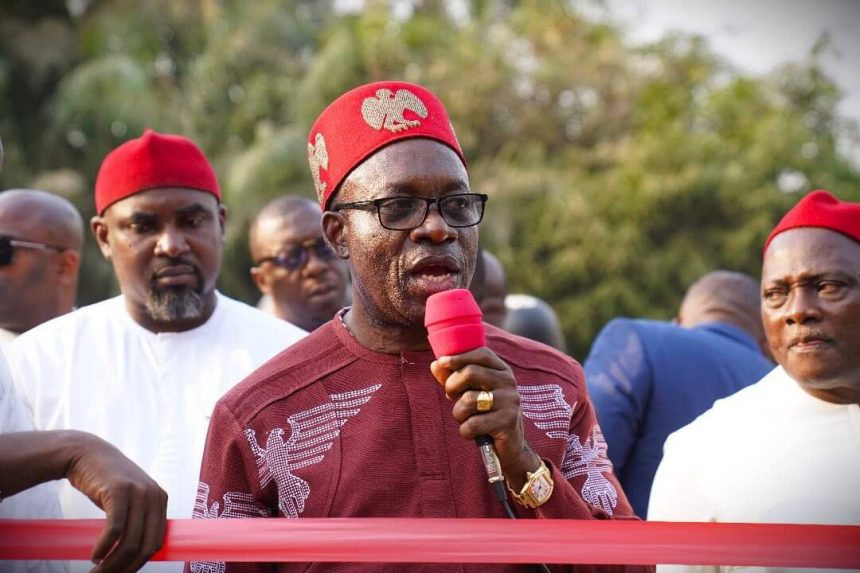
Anambra State Governor Chukwuma Soludo’s pledge to reward loyal party supporters with cash for every ward won by the All Progressives Grand Alliance (APGA) in the forthcoming November 8 governorship election has ignited debate across Nigeria’s political space.
While the governor’s camp insists the promise is a harmless incentive to energise supporters, opposition parties and civil society organisations argue it amounts to vote-buying, a criminal offence under the Electoral Act, 2022.
EDITOR’S PICKS
The Governor’s Promise and the Political Backlash
At a campaign rally in Umunze, Orumba South Local Government Area, Governor Soludo announced that each APGA ward that secures victory in the upcoming election would receive ₦1 million, with additional prizes of ₦5 million, ₦3 million, and ₦2 million for the top-performing wards. The governor said similar rewards were offered during the party’s senatorial campaigns, describing them as “incentives” for grassroots mobilisation.
Ahead of the November 8th election, Soludo has clearly lost the confidence of the people of Anambra, and it shows.
Only a sitting governor who has run out of public goodwill would so openly resort to cash for votes, in direct violation of Sections 121 and 127 of the Electoral… pic.twitter.com/TyGRDlol1x
— Bolaji Abdullahi (@BolajiADC) October 26, 2025
However, the declaration sparked immediate outrage. The All Progressives Congress (APC), Labour Party (LP), African Democratic Congress (ADC), and the Peoples Democratic Party (PDP) all condemned the announcement as a blatant case of vote inducement and abuse of office.
APC’s National Vice Chairman (South-East), Dr. Ijeomah Arodiogbu, accused the governor of “open vote-buying” and vowed to petition the Independent National Electoral Commission (INEC), the Economic and Financial Crimes Commission (EFCC), and the police. The Labour Party’s spokesperson, Obiora Ifoh, described the move as “weaponising poverty,” while the PDP’s Mike Ahumibe said it undermined electoral integrity.
Similarly, ADC’s National Publicity Secretary, Bolaji Abdullahi, asked INEC to act swiftly, describing Soludo’s promise as “a public confession of vote-buying.”
Civil society organisations, including the Centre for Anti-Corruption and Open Leadership and YIAGA Africa, also raised red flags. Rights activist Debo Adeniran said Soludo’s action had “monetised the electoral process,” while YIAGA’s Jennifer Dafwat argued that vote-buying extends beyond election-day cash handouts to include any form of inducement aimed at influencing voters’ choices.
What the Electoral Act Says
Under Section 121(1) of the Electoral Act 2022, it is an offence for any person to “directly or indirectly, by himself or by any other person on his behalf, give, lend, or offer any money or other valuable consideration” to influence voting behaviour. The law also criminalises attempts to induce voters or electoral officers before, during, or after elections. Violators risk fines, imprisonment, or both.
Legal experts argue that while the governor’s promise may not directly target individual voters, it could still breach the spirit of the law by tying financial rewards to electoral outcomes. By linking monetary incentives to ward victories, critics contend that Soludo’s pledge effectively commodifies political participation and creates an uneven playing field.
INEC Chairman, Prof. Joash Amupitan, had earlier emphasised the significance of the Anambra election in consolidating Nigeria’s democracy, a context that now heightens scrutiny of Soludo’s remarks. Election observers say the commission must determine whether the governor’s statements constitute inducement under the law or fall within the boundaries of internal party motivation.
Motivation or Manipulation?
The Anambra State Commissioner for Information, Dr. Law Mefor, defended the governor, describing the promise as “motivation for supporters” rather than vote-buying. He argued that political mobilisation often includes both intrinsic and extrinsic rewards, insisting that no votes were being “priced or purchased.”
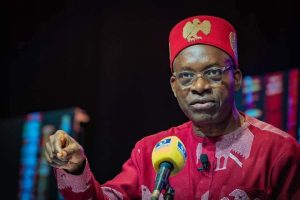
Still, analysts warn that such promises, whether well-intentioned or not, expose deeper flaws in Nigeria’s political culture — one where electoral contests are frequently shaped by material incentives rather than ideology or performance. As the election approaches, the debate underscores a critical question for Nigeria’s democracy: when does political motivation become manipulation?
FURTHER READING
Whether Soludo’s cash-for-votes pledge is viewed as legitimate campaign strategy or a violation of electoral ethics, its implications will test the resolve of INEC and the boundaries of political accountability in the country’s evolving democracy.
Philip Ibitoye is a Special Correspondent with EKO HOT BLOG. Click here to find daily analysis and critical insight on trending issues in Lagos and other parts of Nigeria.
Click here to watch the video of the week below: