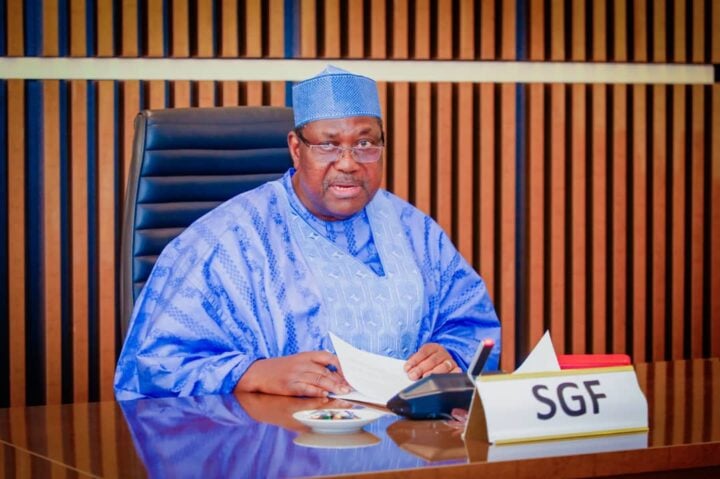
The Secretary to the Government of the Federation (SGF), George Akume, stirred a fresh security debate on Wednesday after suggesting that recent remarks by United States (US) President Donald Trump may have emboldened violent groups operating across Nigeria.
Trump had labelled Nigeria a “country of particular concern” and accused the federal government of ignoring attacks on Christians—comments Akume says violent actors have seized upon to launch new assaults.
EDITOR’S PICKS
Akume’s comments, delivered during a security briefing in Abuja, have raised questions about whether external rhetoric can materially influence extremist behaviour or whether the federal government is deflecting responsibility for persistent insecurity.
Dissecting Akume’s Claim
Akume’s central argument is that Trump’s recent remarks labelling Nigeria a “country of particular concern” created an international narrative that violent groups sought to exploit. He suggests these comments encouraged insurgents and bandits to launch new attacks in order to validate or dramatise those claims.
However, the chain of reasoning is difficult to substantiate. For one, the violent actors operating in Nigeria, whether Boko Haram factions or profit-driven bandit networks, have long demonstrated continuity in their attacks that aligns more with internal dynamics than with shifts in foreign rhetoric. Their operational cycles typically correspond to seasonal factors, security force movements, access to weapons, disputes over resources, or internal leadership struggles, not external political statements.
Moreover, the claim presumes that groups like ISWAP or rural bandit gangs calibrate their actions in response to comments made thousands of kilometres away. These groups have historically relied on local grievances, economic incentives, and ideological narratives that do not require validation from foreign leaders. Their propaganda rarely centres on international diplomatic debate; instead, it is framed around state weakness, military targets, ransom economics, or religious messaging crafted for local and regional audiences.
Akume’s argument also overlooks the fact that the factors enabling violent groups — porous borders, weapons proliferation after the Libyan collapse, community-level disputes, and inadequate policing — are longstanding structural weaknesses. These conditions existed long before Trump’s remarks and continue to be the decisive factors shaping the frequency and scale of attacks. Even the June 2025 Yelewata massacre he cited reflects deep operational capacity by attackers, not opportunism triggered by foreign commentary.
It’s certainly hard to see how Trump’s comments led to terrorists abducting 25 schoolgirls in Kebbi State on Monday or killing and abducting worshippers at a church on Tuesday.
Akume’s comments ultimately attempt to shift the conversation outward, but the drivers of Nigeria’s insecurity remain overwhelmingly internal. A claim that external rhetoric “emboldened” attackers risks obscuring these domestic realities rather than explaining them.
What the Government Says It Is Doing
In his briefing, Akume provided a lengthy outline of the federal government’s efforts to contain insecurity.
He traced the evolution of violent extremism from Boko Haram’s emergence in 2002 under Mohammed Yusuf, through its escalation under Abubakar Shekau, to its reconfiguration as ISWAP following allegiance to ISIS in 2015. He stressed that insurgency in the north-east remains ideologically driven, while banditry in the north-west stems from competition over land and water, illegal mining, cattle rustling, and the transformation of kidnapping into “an organised industry.”
He defended the armed forces as “highly capable, experienced and professional,” arguing that Nigeria does not require foreign boots on the ground, only targeted assistance in intelligence, technology, and equipment. Akume also pointed to broader reforms, including enhanced border security, tighter coordination against illegal mining, and expanded intelligence-sharing with allies, including the US.
The SGF rejected claims that any group is facing genocide, emphasising that Boko Haram, ISWAP, and bandit groups kill Muslims and Christians alike. Framing the conflict as sectarian, he insists, only fuels tension and undermines the state’s efforts.
Beyond Blame: Where Responsibility Truly Lies
While Akume’s argument acknowledges the impact of international narratives on Nigeria’s global image, attributing renewed attacks to Trump’s comments alone appears overstated. Violent groups exploit weak governance, not diplomatic rhetoric. Their resurgence, especially in regions where security presence is thin or compromised, points to structural issues the government is yet to fully resolve.
Nigeria’s challenges stem from systemic underinvestment in security, slow policy execution, a dysfunctional intelligence architecture, and weapons flowing freely across the Sahel since Libya’s collapse. These factors, not international remarks, constitute the deeper drivers of insecurity.
FURTHER READING
Trump’s comments may have irritated the Nigerian government or complicated diplomatic optics, but the government’s responsibility remains unchanged: addressing the local enablers of violence. Blame games cannot substitute for coherent action.
Philip Ibitoye is a Special Correspondent with EKO HOT BLOG. Click here to find daily analysis and critical insight on trending issues in Lagos and other parts of Nigeria.
Click here to watch the video of the week below: