A post on X by Ridwan Ajetunmobi, Senior Special Assistant on Media to Governor Babajide Sanwo-Olu, announcing Lagos State’s 2026 budget presentation on Tuesday, has set off a public exchange on the state’s fiscal sustainability and budgeting practices.
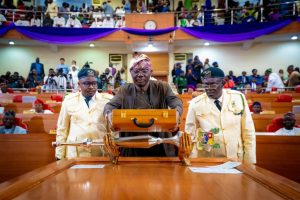
Ajetunmobi disclosed that the governor laid a N4.237 trillion spending plan before the Lagos State House of Assembly, projecting N3.99 trillion in total revenue and a deficit of N243.3 billion. Independent revenue was set at N3.12 trillion, federal transfers at N874 billion, while the expenditure structure showed 52 percent capital spending and 48 percent recurrent.
BREAKING!!!
Lagos State budget hits N4 trillion, as Governor Babajide Sanwo-Olu presents 2026 Expenditure to the State House of Assembly.
DETAILS:
The 2026 Budget — N4,237,107,009,308
• Total Revenue — N3,993,774,552,141
• Deficit Financing — N243,332,457,167
REVENUE… pic.twitter.com/YPTVreyM3m
— AJE (@Riddwane) November 25, 2025
EDITOR’S PICKS
The post drew criticism from Zamfara’s Commissioner for Budget and Economic Planning, Abdulmalik Gajam, who argued that Lagos’ spending pattern was problematic for a state with limited federal support.
Gajam said a 52–48 percent capital-to-recurrent split placed the state in a vulnerable position, insisting that Lagos could not maintain its fiscal expansion without federal subsidies or intervention. He suggested that the state’s revenue profile could not comfortably support its debt obligations, and cast doubt on Lagos’ reported 81 percent performance of the 2025 budget, claiming that heavy recurrent expenditure would naturally inflate such numbers. For emphasis, he dismissed any claim of Lagos’ independence from federal support as “karyace” — a lie.
Lagos future will be in jeopardy having a capital financing of 52% and recurrent at 48%. Without federal government subsidy and investment intervention there is no how for them to keep up. If your revenue cannot serve your debt servicing there is no how for you to grow but to… https://t.co/DJRAz4mXh5
— Abdulmalik Gajam (@Officialgajam) November 25, 2025
His remarks prompted a detailed and combative rejoinder from the governor’s Special Adviser on Media and Publicity, Gboyega Akosile, who said the commissioner’s assessment lacked grounding in public finance principles. Akosile argued that Lagos’ numbers were not only defensible but consistent with global megacity standards, and proceeded to break down the figures to counter each of Gajam’s claims.
A key point in the rebuttal was the interpretation of the 52 percent capital allocation. Akosile argued that Gajam mischaracterised the figure as “capital financing” rather than capital expenditure. According to him, Lagos’ 52 percent capital ratio sits within the 40–65 percent range typically recorded by major cities facing large infrastructure demands, such as Johannesburg, Nairobi, Cairo, São Paulo and Gauteng.
For Lagos, he said, aggressive capital spending reflects its status as a high-growth urban economy managing large transport, housing, health and technology infrastructure pressures. Seen in that context, the 52 percent allocation—slightly above the midpoint of global trends—positions Lagos more as a growing city prioritising long-term investment than an administration skewing spending unsustainably toward capital projects.
Dear Abdulmalik, I’ve had to do a bit of searching after my attention was drawn to your tweet-a reaction to the very audacious, bold and progressive N4.237t budget proposal of Governor @jidesanwoolu of Lagos State. I realised that your background (education) may have been a… https://t.co/sML8TGv97Q
— Gboyega Akosile (@gboyegaakosile) November 26, 2025
On revenue independence, Akosile presented Lagos’ internally generated revenue of N3.12 trillion as evidence that the state is not dependent on federal transfers. With federal allocations contributing just N874 billion, the state’s budget is structured such that recurrent obligations—including salaries, overheads and basic operations—are projected to be fully covered by IGR. From a fiscal standpoint, this places Lagos among Nigeria’s least federally dependent states, a position reinforced by Akosile’s claim that Lagos’ reliance on the Federation Account Allocation Committee (FAAC) is around 22 percent.
He also addressed Gajam’s central argument that Lagos cannot comfortably service its debt. Akosile said Lagos’ projected debt service for 2026 stands at N527.3 billion, representing 13.2 percent of total revenue—well below the global prudential benchmark of 30 percent used by institutions like the IMF and the World Bank. While he did not provide a breakdown of principal versus interest repayments, the figure suggests that Lagos’ debt servicing remains within a manageable threshold. From a comparative perspective, a subnational entity operating at less than half of the globally accepted ceiling would typically not be classified as entering debt distress, even if its absolute debt figure is large in naira terms.
Akosile also challenged the idea that Lagos’ strong 2025 budget performance was an illusion created by recurrent spending. He cited figures from January to September 2025 showing N1.238 trillion spent on capital projects compared to N818.6 billion on recurrent items. If accurate, these numbers mean capital spending constituted 60 percent of actual expenditure, higher than even the proposed 2026 capital ratio. This trend suggests Lagos has been able to push physical and infrastructure projects through at a time when many states struggle to execute capital budgets beyond 40 percent. It also means that Lagos’ performance rate was driven by project execution rather than routine expenditure, countering Gajam’s claim that recurrent-heavy spending inflated performance.
Beyond the immediate figures, Akosile framed Lagos’ fiscal management within a wider structural context. He pointed to the Lagos State Development Plan 2052 and fiscal tools such as the Medium-Term Expenditure Framework, Medium-Term Fiscal Framework, outcome-based budgeting, and IPSAS accounting standards as evidence of a long-term planning culture. He coupled these with Lagos’ TSA regime and digital revenue systems, arguing that these institutional frameworks underpin the state’s revenue growth and fiscal discipline.
He then cited broader economic indicators to bolster the case that Lagos is operating from a position of strength. These include Lagos’ contribution of 29 percent to Nigeria’s GDP, its historical dominance of foreign direct investment inflows, its status as home to 73 percent of the country’s startups, and its purchasing power parity GDP estimated at $259 billion, which he said ranks it as Africa’s second-largest city economy.
While Gajam’s critique reflects a wider debate over the sustainability of Lagos’ rapid budget expansion — crossing N4 trillion for the first time — Akosile’s rejoinder positions the state as both structurally and fiscally prepared to manage the scale of its spending. His argument suggests that Lagos’ budget is not simply a large financial document but a reflection of decades-long revenue growth, urban expansion and institutional reforms.
FURTHER READING
But it also leaves hanging the technical question often raised by independent analysts: whether Lagos’ projected revenue targets, particularly its IGR, can consistently keep pace with its growing capital commitments without slipping into higher deficits.
Philip Ibitoye is a Special Correspondent with EKO HOT BLOG. Click here to find daily analysis and critical insight on trending issues in Lagos and other parts of Nigeria.
Click here to watch the video of the week below: