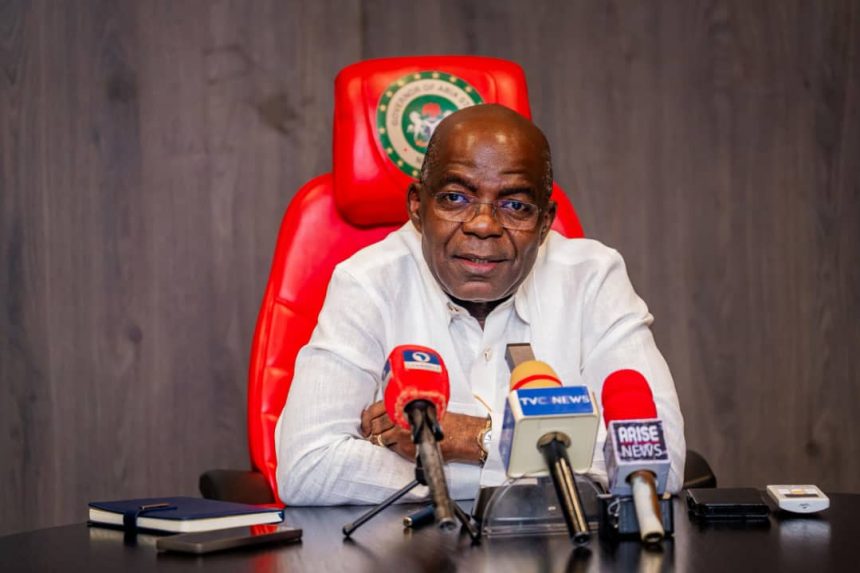
When a journalist walked into Abia State Governor Alex Otti’s monthly media chat in Umuahia on Friday and asked a reasonable question, he could not have expected what followed.
Instead of an answer, he received a public dressing-down, one that revealed far more about the governor’s discomfort with scrutiny than about any supposed lack of preparation by the press.
EDITOR’S PICKS
Chika Nwabueze, a journalist with the BON media group, had asked Otti to provide concrete, quantifiable evidence, beyond visible road projects, showing how his policies since May 2023 had improved the economic conditions and living standards of Abia residents. It was a fair, professionally framed question. What came next was not.
WATCH as Governor Alex Otti Clashes with Journalist Over “Measurable Impact” at February Media Chat with Abia people.
The journalist; “Your administration has received praise for visible infrastructure projects and reforms, but critics say that measurable impact, transparency… pic.twitter.com/BEP43V93b3
— CHUKS 🍥 (@ChuksEricE) February 28, 2026
The question was not the problem
Otti’s response was telling. Rather than cite any figures — unemployment rates, poverty indices, household income data, or health outcomes — the governor turned the question back on the journalist, suggesting that as a resident of Abia, Nwabueze ought to have gathered such data himself.
“You are the one that will provide data,” Otti said.
This is a curious inversion of accountability. A governor who has been in office for nearly three years, overseeing a state budget and a team of civil servants, ought to have socio-economic data at his fingertips. The fact that he did not produce any and instead accused the journalist of being “irresponsible” and “stupid” raises a question the governor may not have intended: does the data exist at all?
Visible projects are not the same as measurable impact
Otti pointed to improved roads, functional health centres, public transport, and elements of free education as evidence that residents should be able to “feel” the change. These are not nothing. Infrastructure improvements matter. But they are inputs, not outcomes.
What Nwabueze was asking for and what serious governance demands is evidence of impact: Are people earning more? Is child mortality falling? Are more children completing school? Are businesses registering and growing?
A repaired road is a means to an end, not the end itself. Any government that cannot or will not answer those follow-up questions is not yet governing by results.
The danger of a governor who cannot be questioned
The most troubling aspect of this exchange was not the governor’s inability to produce data. It was his contempt for the very act of being asked. Otti described his media chat as a “serious” platform not intended to “massage opposition” as if a question about governance outcomes were an act of political hostility rather than a basic journalistic duty.
Media engagements exist precisely so that the public, through its press, can hold power to account. A governor who publicly humiliates journalists for asking hard questions sends a chilling message: challenge me at your peril. That posture does not belong in a democracy, regardless of how many roads have been built.
FURTHER READING
Otti may well have genuine achievements to show for his time in office. But on Friday in Umuahia, he chose defensiveness over data, and condescension over clarity. That was his mistake and it was entirely his own.
Philip Ibitoye is a Special Correspondent with EKO HOT BLOG. Click here to find daily analysis and critical insight on trending issues in Lagos and other parts of Nigeria.
Click to watch the video of the week below: