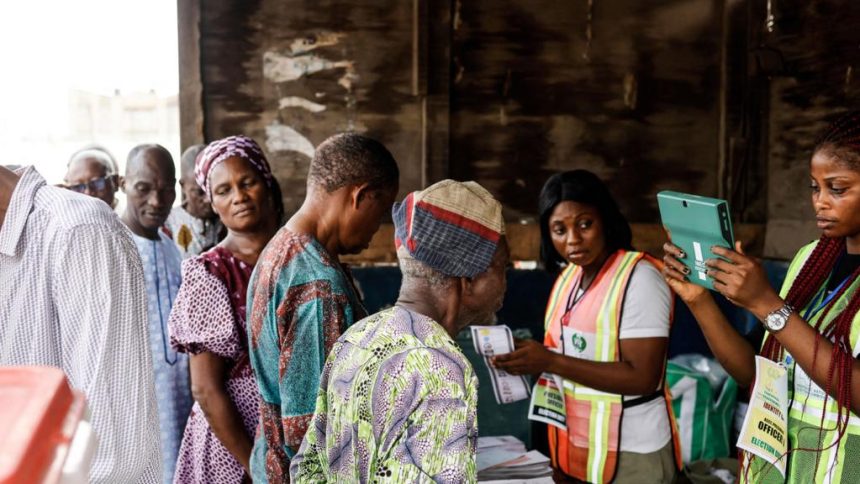
The bid to deliver a more credible, transparent, and technology-driven general election in 2027 gained momentum on Wednesday as the Senate passed for second reading the Electoral Act 2022 (Repeal and Enactment) Bill, 2025 (SB. 903) — a sweeping reform package that seeks to overhaul Nigeria’s electoral framework.
The bill, which has already stirred robust debate among lawmakers, civil society groups, and political stakeholders, proposes far-reaching amendments designed to restore public confidence in Nigeria’s electoral system.
EDITOR’S PICKS
EKO HOT BLOG gathered that at the heart of the proposed law are provisions for compulsory electronic voting, mandatory electronic transmission of results, early voting for essential workers, and the replacement of the permanent voter card (PVC) with alternative forms of identification such as the National Identification Number (NIN) and international passport.
These changes, according to the joint committee on electoral matters which unveiled the proposals during a public hearing last Monday, are intended to “modernise Nigeria’s elections and ensure that every vote truly counts.”
The reforms also include the creation of an Electoral Offences Commission, and measures to enhance the independence of the Independent National Electoral Commission (INEC), long seen as key to improving electoral credibility.
Fixing the Transmission Gap
One of the most consequential changes in the bill is the proposed amendment to Section 60(5) of the current Electoral Act, which would make electronic transmission of results mandatory.
Under the proposed amendment, “The presiding officer shall transmit the results, including the total number of accredited voters, to the next level of collation both electronically and manually.”
This provision directly addresses one of the major flashpoints of the 2023 general elections, when delayed or incomplete uploads to the INEC Result Viewing Portal (IReV) fuelled allegations of result manipulation and widespread public distrust.
Civil society organisations, represented at the hearing by Akin Akingbolu of Yiaga Africa, argue that the move is overdue.
“Strengthening the Electoral Act to make electronic transmission of results mandatory, including the upload of polling unit-level results and results sheets, will deepen the credibility of electoral outcomes and ensure votes count,” Akingbolu said.
Lawmakers backing the bill believe the amendment will close the loopholes exploited during collation, reduce human interference, and ensure that polling unit results are transparently available to all stakeholders in real time.
Lessons from 2023: Technology Without Law Is Not Enough
The 2023 elections, the first to deploy the Bimodal Voter Accreditation System (BVAS) nationwide, were expected to mark a turning point for Nigeria’s democracy. However, technical hitches, including failed biometric authentication, poor battery performance, and weak internet connectivity, undermined public confidence.

Compounding these issues were judicial interpretations that, according to Senator Enyinnaya Abaribe (Abia South), failed to keep pace with INEC’s technological evolution.
“The problem with Nigeria’s electoral system is not the technology but the interpretation of laws by the courts,” Abaribe observed earlier this month.
Analysts say that unless the legal framework explicitly mandates electronic processes, technological innovations like BVAS and IReV will remain vulnerable to selective enforcement and post-election legal ambiguity.
Stronger Deterrents Against Electoral Misconduct
The proposed law also takes aim at electoral malpractice through stiffer penalties for officials who compromise the process.
A new clause prescribes a minimum one-year jail term or a fine of ₦1 million — or both — for any presiding or collation officer who issues unstamped or unsigned ballot papers or result sheets.
“A presiding officer or collation officer who distributes or causes to be distributed any ballot paper or result sheet not duly stamped and signed commits an offence liable on conviction to imprisonment for a term of not less than one year or to a fine not less than ₦1,000,000 or both,” the amendment states.
Such provisions are designed to make election officials more accountable and to close procedural gaps often exploited to alter results or invalidate ballots.
A Preemptive Timeline for Post-Election Justice
Perhaps one of the most ambitious proposals is the plan to move the 2027 general elections to November 2026, six months before the May 29 handover date. The rationale is to allow all post-election disputes to be resolved before inauguration, a long-standing demand of election observers who have criticised Nigeria’s tendency to swear in candidates whose victories remain legally contested.
By creating this buffer, lawmakers hope to strengthen the legitimacy of elected leaders and prevent prolonged post-election tensions that often destabilise governance in the early months of a new administration.
Restoring Trust
In sum, the Electoral Act 2025 (Repeal and Enactment) Bill represents a critical legal and institutional reset for Nigeria’s democracy. While technology can aid transparency, only a clear, enforceable law can ensure consistency, accountability, and fairness across the electoral process.
As the bill progresses to committee stage and eventual third reading, public attention will remain fixed on whether the National Assembly and executive can align on these reforms before the next election cycle begins.
FURTHER READING
If enacted and effectively implemented, the new law could mark a watershed moment, transforming Nigeria’s elections from perennial contests of controversy into genuine reflections of the people’s will.
Philip Ibitoye is a Special Correspondent with EKO HOT BLOG. Click here to find daily analysis and critical insight on trending issues in Lagos and other parts of Nigeria.
Click here to watch the video of the week below: