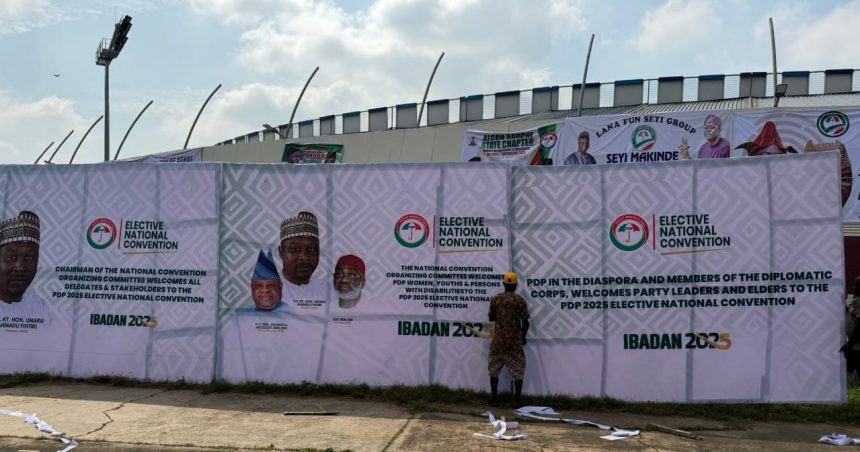
The Peoples Democratic Party (PDP) is pressing ahead with its national convention in Ibadan this weekend despite two subsisting Federal High Court rulings restraining the event and a decision by the Independent National Electoral Commission (INEC) not to monitor the exercise.
EKO HOT BLOG gathered that four governors — Bauchi’s Bala Mohammed, Zamfara’s Dauda Lawal, Adamawa’s Ahmadu Fintiri and Oyo’s Seyi Makinde — arrived in Ibadan on Friday, signalling the resolve of one faction to proceed.
EDITOR’S PICKS
However, the absences of another four, including Osun State Governor Ademola Adeleke and Rivers Governor Siminalayi Fubara, underline widening internal cracks as rival blocs dig in ahead of the 2027 elections.
Does a State High Court Order Override a Federal High Court Judgment?
At the heart of the PDP’s escalating crisis is a clash of court orders.
On Friday, Justice Peter Lifu of the Federal High Court, Abuja, ordered the PDP to suspend its convention pending the inclusion of former Jigawa governor Sule Lamido in the chairmanship race. The judge held that Lamido had been unlawfully denied the opportunity to purchase the nomination form, thereby breaching his rights under the party’s constitution.
This ruling reaffirmed an earlier decision by Justice James Omotosho, also of the Federal High Court, halting the convention and restraining INEC from participating.
But the Oyo State High Court, in a separate ruling delivered on November 3, authorised the PDP to proceed and directed INEC to monitor the exercise. The party’s South-West chairman, Kamorudeen Ajisafe, insists the Oyo ruling is the one being obeyed.
Legally, both courts sit at similar levels in Nigeria’s judicial hierarchy. However, when matters involve federal institutions and national party processes, the Federal High Court is generally regarded as having the more appropriate jurisdiction. This dynamic places the PDP on shaky legal ground as it adopts the state court ruling while two federal orders remain unvacated.
The conflicting directives leave the party vulnerable to fresh litigation, prolonged uncertainty, and allegations of selective obedience to the law.
INEC’s Boycott and the Risk of a Futile Exercise
INEC’s decision not to monitor the Ibadan convention introduces another layer of complexity. Senior officials of the commission told PUNCH that INEC intends to comply strictly with the Federal High Court order and will therefore stay away from the exercise.
For political parties, INEC’s presence is not symbolic, it is a statutory requirement. Under the Electoral Act, national conventions that elect or ratify party officers must be monitored by the commission to achieve legal recognition. Any convention conducted without INEC’s supervision may produce leaders whose legitimacy could be challenged internally and in court.
The withdrawal of INEC thus raises the possibility that the outcome of the convention, regardless of turnout or stakeholder support, could be deemed invalid. This risk compounds the party’s internal troubles, as two rival factions already operate from separate secretariats amid accusations of sabotage, unconstitutional actions and parallel loyalties.
Meanwhile, stakeholders like former Senate President Bukola Saraki have warned that holding the convention under such conditions could cause “irreparable damage” to the party, including possible defections by first-term governors in Osun, Plateau and Zamfara.
FURTHER READING
As the PDP proceeds with the Ibadan convention, it does so against a backdrop of legal uncertainty and political division, conditions that will shape its stability long after the weekend’s events.
Philip Ibitoye is a Special Correspondent with EKO HOT BLOG. Click here to find daily analysis and critical insight on trending issues in Lagos and other parts of Nigeria.
Click here to watch the video of the week below: