- APC Signals 2027 Strategy as Top Leaders Back Tinubu, Push Party Cohesion
- The trio framed the party’s future success around institutional memory
- Vice President Shettima delivered an extensive tribute to Tinubu’s political journey
Three of Nigeria’s most powerful political figures; Vice President Kashim Shettima, Senate President Godswill Akpabio and Speaker of the House of Representatives Tajudeen Abbas on Friday publicly reaffirmed their support for President Bola Ahmed Tinubu, urging party unity, disciplined expansion and closer coordination between the executive and legislature as the ruling All Progressives Congress (APC) prepares for the 2027 general elections.
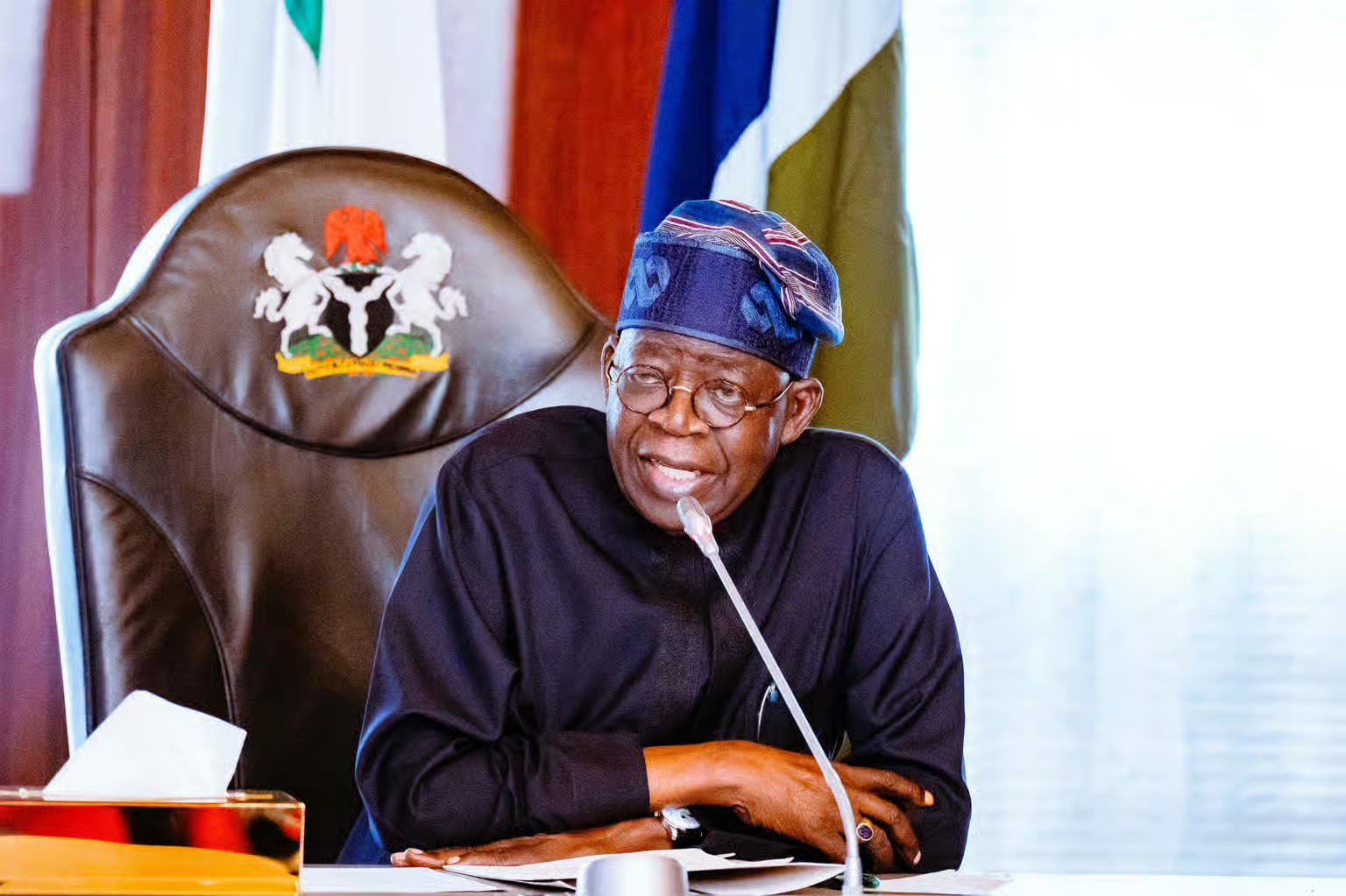
Speaking at the APC National Executive Committee (NEC) meeting held at the Presidential Villa in Abuja, Eko Hot Blog reports that the trio framed the party’s future success around institutional memory, coalition-building, effective lawmaking and the avoidance of internal divisions.
EDITOR’S PICK
- Fire Breaks Out in 22 Storey Building in Lagos
- 2027: Tinubu Sets Up APC Strategy, Conflict Resolution Committee
- Hon. Tobun Reaches Over 10,000 Households with Christmas Support Across Epe Constituency I
Vice President Shettima delivered an extensive tribute to Tinubu’s political journey, crediting him with sustaining Nigeria’s opposition politics long before the 2013 merger that produced the APC. He argued that the party’s current dominance—now controlling 28 states—was built on resistance to one-party rule and the courage of leaders who organised under political risk.
“Politics rewards memory, and today memory must begin with gratitude,” Shettima told NEC members. “Nigeria’s opposition did not survive by accident. It survived because one man refused to surrender the political space.”
He cautioned against overestimating the influence of social media on electoral outcomes, stressing that elections are decided by coalitions, credibility and sound political judgment rather than online slogans. Warning that incumbency alone would not secure victory in 2027, Shettima described the next election cycle as a test of discipline, organisation and historical awareness.
Senate President Akpabio pledged continued legislative backing for Tinubu’s reform agenda, noting that the National Assembly had processed executive bills and requests in a timely manner to ensure stability in governance. He aligned himself with policy documents presented by the APC national leadership and governors, saying they would guide Senate deliberations when lawmakers reconvene.
Akpabio urged governors to strengthen collaboration with legislators at both state and federal levels, describing the legislature as closest to the grassroots and central to democratic consensus. He also announced that amendments to the Electoral Act would be completed before the end of January, providing clear timelines for party congresses, primaries and the 2027 elections.
Joining APC governors, Akpabio endorsed a fresh vote of confidence in Tinubu, acknowledging the “difficult terrain” faced by the administration while insisting that economic and security reforms were beginning to yield results.
Speaker Abbas focused his remarks on governance delivery and institutional alignment, urging the APC to see governance as “a contract between the party and the Nigerian people.” He argued that while political parties win elections, institutions determine outcomes—and history would judge whether APC-led governments successfully connected the two.
Abbas praised Tinubu’s pursuit of “difficult but necessary” reforms and highlighted the House of Representatives’ legislative output: 2,263 bills processed between June 2023 and June 2025, with 237 passed and 68 signed into law—the most productive two-year period since 1999. Nearly 80 per cent of the enacted laws, he noted, originated from private-member bills.
He said strengthened oversight had led to the recovery of mismanaged funds and improved compliance among government agencies, while inclusion policies had expanded participation for women, youth and persons with disabilities.
Turning to internal party dynamics, Abbas warned that the APC had evolved significantly since its early victories and must carefully manage relations between founding members and newer blocs to avoid fragmentation. He proposed measures to safeguard cohesion, including a quarterly governance performance dashboard, a legislative-executive tracking framework for manifesto commitments, and stronger internal dispute-resolution mechanisms.
Across their remarks, Shettima, Akpabio and Abbas struck a common note: the APC must remain a party that not only wins elections but earns public trust through tangible governance outcomes. All three endorsed the vote of confidence earlier passed by APC governors in President Tinubu’s leadership.
FURTHER READING
- Kano Assembly Loses Two Lawmakers in Tragic Double Death
- NLC Demands Fair Tax System, Workers’ Inclusion
- ‘Freedom of Worship Must Be Protected’ – Tinubu Tells Nigerians in Christmas Message
Click here to watch video of the week