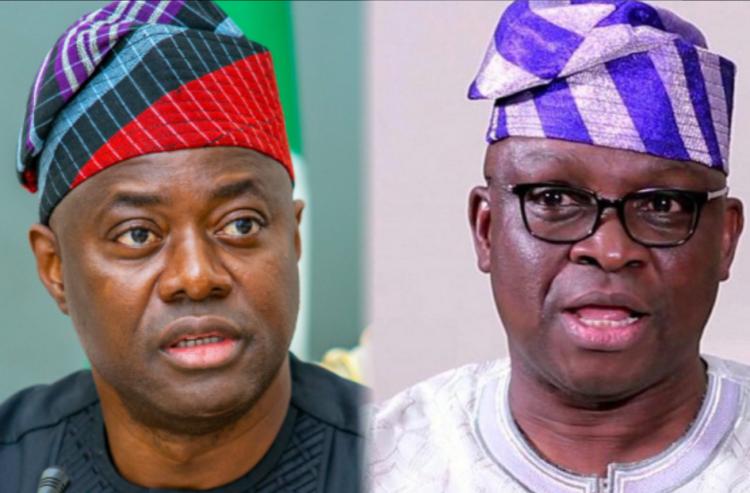
A fresh political feud has erupted between Oyo State Governor Seyi Makinde and former Ekiti State Governor Ayodele Fayose, centring on claims and counter-claims over an alleged ₦50 billion Federal Government intervention linked to the January 2024 Bodija explosion in Ibadan.
What began as a political remark at a media chat has since snowballed into allegations of diversion of public funds, release of official documents, and sharp rebuttals from the Oyo State Government.
EDITOR’S PICKS
The controversy was triggered last Tuesday when Governor Makinde, during a media interaction, disclosed aspects of a private meeting he said he had with President Bola Ahmed Tinubu and the Minister of the Federal Capital Territory, Nyesom Wike.
In that conversation, Makinde suggested that assurances were given about political support and party matters. The disclosure angered Fayose, a known ally of President Tinubu, who accused Makinde of breaching confidence and, more significantly, of being economical with the truth about federal support extended to Oyo State after the Bodija explosion.
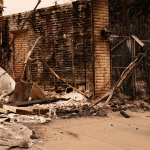
The explosion, which occurred in January 2024, killed several residents, destroyed properties, and displaced many families. At the time, both the Oyo State and Federal Governments pledged support for victims and reconstruction efforts, with Oyo State later announcing that ₦4.5 billion had been paid directly to affected victims.
Fayose’s allegation and the disputed document
Reacting to Makinde’s media chat, Fayose alleged that the Oyo State governor received ₦50 billion from the Federal Government as intervention funds for the Bodija explosion but released only ₦4.5 billion to victims, diverting the rest for political purposes, including an alleged presidential ambition.
Makinde, through his Chief Press Secretary, Sulaimon Olarenwaju, dismissed the allegations as unfounded and challenged Fayose and his associates to present verifiable proof.
The former Ekiti governor subsequently released a document which he described as evidence of the ₦50 billion payment and challenged Makinde to take him to court.
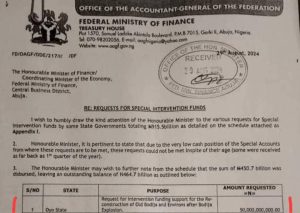
However, a review of the document by EKO HOT BLOG shows that while it indicates a request routed from the Office of the Accountant-General of the Federation to the Minister of Finance for a ₦50 billion special intervention fund for Oyo State, it does not show that the said amount was actually disbursed to the state. The document reflects a request and internal processing, but contains no confirmation of payment or transfer of ₦50 billion into Oyo State accounts.
Despite this, Fayose has maintained that Makinde is withholding full disclosure and insisted that other federal intervention funds received by the Oyo State Government have not been made public.
Makinde camp’s response: ₦30bn released, ₦20bn withheld
In response, the Oyo governor’s spokesperson confirmed that Makinde indeed requested ₦50 billion from the Federal Government after the Bodija explosion. However, he stated that only ₦30 billion was released, while the remaining ₦20 billion was withheld.
According to Olanrewaju, what existed was a promise of ₦50 billion, not a full disbursement. He said the ₦30 billion released was subjected to accountability mechanisms, with ₦4.5 billion paid directly to victims as immediate support, while the balance was deployed for reconstruction, road repairs, and other interventions in the affected area. He also claimed that the remaining ₦20 billion was not released due to conditions attached to its disbursement, which Governor Makinde allegedly declined to meet.
Olanrewaju described Fayose’s claims as politically motivated, linking them to Makinde’s recent declaration that he would not support President Tinubu’s re-election bid in 2027. He argued that the controversy was part of wider political hostilities within the Peoples Democratic Party (PDP) and beyond, insisting that the governor’s handling of the Bodija intervention funds was transparent and verifiable.
What is established and what remains unclear
A careful review of the positions advanced by both camps shows that elements of truth and gaps exist on each side of the argument.
On the one hand, official records support the claim that ₦4.5 billion was the only amount formally approved and announced as direct financial support to victims of the Bodija explosion. On May 13, 2025, the Oyo State Executive Council approved the ₦4.5 billion package for survivors and affected residents during a meeting held at the Governor’s Office. This aligns with Fayose’s assertion that only ₦4.5 billion had reached victims in the form of direct relief.
On the other hand, the Oyo State Government has acknowledged that ₦30 billion was released by the Federal Government out of the ₦50 billion requested. While the Makinde administration maintains that the balance of the funds was deployed for reconstruction, infrastructure repairs, and other interventions in the affected area, it has so far not publicly provided a detailed expenditure breakdown to show how the remaining funds were applied beyond the ₦4.5 billion disbursed to victims.
This leaves room for legitimate public scrutiny. Having admitted receipt of ₦30 billion, the state government may need to go beyond general assurances of reconstruction and publish itemised details of projects funded with the remaining sums to fully address concerns and dispel allegations of misuse.
At the same time, Fayose’s more serious accusation — that Governor Makinde diverted the funds for a presidential ambition — remains unsupported by evidence. While Fayose has produced a document showing a request for ₦50 billion intervention funds, there is no proof presented that Makinde personally retained public funds or channelled them into any political campaign.
FURTHER READING
In essence, while questions remain about transparency and accounting for the intervention funds, particularly beyond the ₦4.5 billion paid to victims, there is currently no documentary evidence establishing personal diversion of public money.
Philip Ibitoye is a Special Correspondent with EKO HOT BLOG. Click here to find daily analysis and critical insight on trending issues in Lagos and other parts of Nigeria.
Click here to watch the video of the week below: