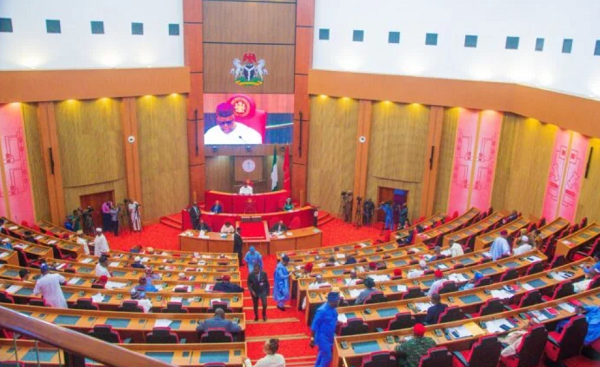
When the Nigerian Senate reversed its position on electronic transmission of election results on on Tuesday, many Nigerians celebrated what appeared to be a victory for democracy.
The Senate had bowed to public pressure following protests and widespread condemnation. However, a closer look at the amended Clause 60(3) reveals a carefully crafted escape route that could undermine the very transparency many fought for.
EDITOR’S PICKS
The new provision permits electronic transmission of results from polling units to the Independent National Electoral Commission’s (INEC) Result Viewing Portal (IReV), but with a critical caveat: “provided if the electronic transmission does not fail and becomes impossible to use, then the Form EC8A shall be the primary source of election results.”
EKO HOT BLOG gathered that this seemingly reasonable fallback provision has alarmed civil society organisations (CSOs) who see it as a repeat of the vulnerabilities that plagued the 2023 elections.
The ‘Network Failure’ Escape Clause
“The Senate’s ‘cosmetic’ amendment to the Electoral Act is nothing short of a calculated insult to the intelligence of the Nigerian people,” Ufuoma Nnamdi-Udeh, Executive Director of Enough is Enough (EiE) Nigeria, said, in a statement shared with EKO HOT BLOG on Wednesday.
“By creating a convenient ‘network failure’ escape clause, they have essentially legalised electoral fraud.”
The problem lies in what the clause does not say. It fails to define what constitutes transmission “failure,” who determines when it has “become impossible,” or what verification mechanisms must apply.
Seven civil society organisations, including Yiaga Africa, The Kukah Centre, and the Centre for Media and Society, jointly condemned this ambiguity in a statement released shortly after the Senate’s decision on Tuesday evening.
“The conditional language introduces troubling discretion in the results management process,” the organisations stated. “In the absence of clear safeguards, this clause risks creating a loophole that could undermine the very purpose of electronic transmission.”
The Senate must do what is right by the people.
We join our voices with other bodies to reject half‑measures. Nigerians deserve full transparency and the Senate's clause 60(3) is a clever loophole that drags us back. Our demand is simple, "Mandatory Electronic Transmission of… pic.twitter.com/oDGH83UyoP
— Yiaga Africa (@YIAGA) February 10, 2026
The facts on the ground make this concern more urgent. A joint committee of INEC and the Nigerian Communications Commission (NCC) found that network operators could cover approximately 93% of polling units during the 2019 elections, leaving only about 7% as genuine gaps.

Yet the Senate’s clause treats network failure as if it were the norm rather than the exception, creating a blanket excuse that could be invoked across all polling units, not just the legitimate 7%.
2023 All Over Again
The 2023 elections demonstrated exactly why this matters. Results from polling units in critical areas mysteriously failed to upload to INEC’s portal, creating windows for alteration during manual collation. The Supreme Court later ruled that electronic transmission was not legally mandatory, meaning INEC faced no consequences for the failures.
“This is legislative theatre at its worst,” Akindeji Aromaye, Senior Media Associate at EiE Nigeria, said. “The Senate calculated that Nigerians would celebrate the reversal without reading the fine print. But we’ve read it, and it’s clear: they’ve given themselves permission to ignore electronic transmission whenever it’s politically convenient.”
The Senate also removed the requirement for “real-time” transmission, a change that appears minor but carries significant implications. Real-time transmission eliminates the time gap between voting and result declaration, the very window that enables manipulation. Without a time-bound requirement, “after” could mean minutes, hours, or days, during which results can be compromised.
What Civil Society Wants
The coalition of CSOs has called on the Conference Committee harmonising the Senate and House versions to adopt the House of Representatives’ stronger provision.
The House version states: “The designated election official shall electronically transmit all election results in real time, including the number of accredited voters, directly from the polling units and collation centres to a public portal and the transmitted result shall be used to verify any other result before it is collated.”
This version makes electronic transmission mandatory, not optional, and requires that transmitted results be used to verify manual forms rather than the other way around. It also reinstates “real-time” transmission, closing the window for manipulation.
“Electronic transmission is not a symbolic reform,” the CSOs’ statement emphasised. “It is a structural safeguard designed to reduce manipulation between polling unit declaration and collation. Its strength lies in creating an immediate, verifiable audit trail. Making it optional or conditionally applied weakens its deterrent effect.”
FURTHER READING
The Conference Committee has one week to harmonise the two versions. Senate President Godswill Akpabio has expressed optimism that President Bola Tinubu will sign the bill into law within February.
Philip Ibitoye is a Special Correspondent with EKO HOT BLOG. Click here to find daily analysis and critical insight on trending issues in Lagos and other parts of Nigeria.
Click to watch the video of the week below: