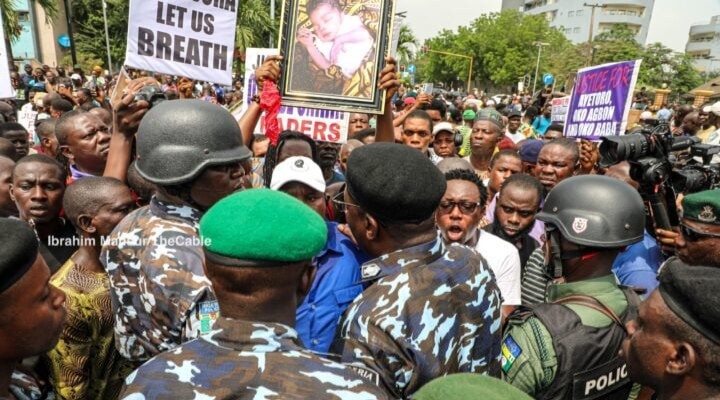
The Lagos State Police Command has filed five criminal charges against two activists, Taiwo Hassan and Dele Frank, following their participation in a protest against demolitions in several Lagos communities on Wednesday.
Among the charges is one particularly contentious allegation: that the activists “sang abusive songs against the police and the Lagos State Government with intent to provoke and tarnish the image of the Lagos State Government.”
EDITOR’S PICKS
This charge raises fundamental questions about the boundaries of lawful protest in a democracy.
Protests are rarely polite affairs. Throughout democratic history, demonstrators have employed songs, chants, and slogans that government officials find uncomfortable, unflattering, or even insulting. This is not incidental to protest, it is often central to it.
Citizens who feel aggrieved by government action, whether over demolitions, policies, or perceived injustices, frequently express their frustration through sharp language and satirical songs. The discomfort these expressions cause is, in many respects, their point.
Democratic standards on political speech
In democracies, the right to criticise government is protected precisely because such criticism can be harsh. Courts in established democracies have repeatedly held that speech which offends, shocks, or disturbs officials is protected under freedom of expression.
The European Court of Human Rights has noted that freedom of expression is “applicable not only to ‘information’ or ‘ideas’ that are favourably received or regarded as inoffensive, but also to those that offend, shock or disturb.”
Similarly, constitutional courts across Commonwealth countries have established that political speech, especially criticism of government, receives the highest level of protection, even when that speech is abusive or insulting.
Charging protesters with criminal offences for singing critical songs suggests that the offence lies not in any violence or genuine threat to public order, but in the content of the criticism itself.
The other charges against Hassan and Frank—conducting themselves in a manner likely to cause breach of peace and obstructing traffic—are more conventional public order offences. These relate to the manner of protest rather than its message. But criminalising “abusive songs” targets the substance of what was said about government. This distinction matters greatly in democratic governance.

The authoritarian parallel
Authoritarian governments routinely criminalise insults against state institutions or officials. Laws against “insulting the president,” “defaming the state,” or “spreading false information about government” are common tools for suppressing dissent in such systems.
Democratic governments, by contrast, are expected to tolerate harsh criticism, understanding that the remedy for speech one dislikes is more speech, not criminal prosecution.
Nigeria’s Constitution guarantees freedom of expression under Section 39. Whilst this right is not absolute, limitations must be “reasonably justifiable in a democratic society” — a test that becomes difficult to meet when the speech in question is political criticism, however abrasively expressed.
The Wednesday demonstration concerned demolitions affecting communities in Makoko, Owode Onirin, Oworonshoki, Otumara, and Baba-Ijora. These are matters of genuine public concern affecting thousands of residents.
A chilling effect on dissent
Perhaps the most significant concern is the message such charges send to future protesters. If singing critical songs about government can result in criminal prosecution, many citizens may simply choose silence over the risk of arrest.
This chilling effect on expression is precisely what free speech protections are designed to prevent. Democracy requires space for citizens to voice grievances, even, especially, when those grievances are expressed in ways that make officials uncomfortable.
Government officials may indeed celebrate democracy, but democracy’s value lies not in ceremony but in practice. The willingness to tolerate sharp criticism, unflattering songs, and uncomfortable protests is what distinguishes democratic governance from authoritarianism.
FURTHER READING
The charge against Hassan and Frank for singing “abusive songs” appears to criminalise the very expression that democratic systems are meant to protect. As the case proceeds through the Yaba Magistrate Court, it will test not merely the fate of two activists, but the robustness of democratic freedoms in Lagos State and by extension, Nigeria.
Philip Ibitoye is a Special Correspondent with EKO HOT BLOG. Click here to find daily analysis and critical insight on trending issues in Lagos and other parts of Nigeria.
Click to watch the video of the week below: