- 15 men, including four primary gunmen, to life imprisonment for the March 2024 assault on the Crocus City Hall music venue.
- The attack, which claimed 150 lives and injured over 600 others, remains the deadliest act of terrorism on Russian soil in more than two decades.
- While the Islamic State claimed responsibility, the Russian Investigative Committee reiterated its claim that the assault was planned in the interest of Ukraine, a charge Kyiv has repeatedly denied.
Justice has finally been served in a Moscow military court for the victims of the horrific Crocus City Hall massacre.
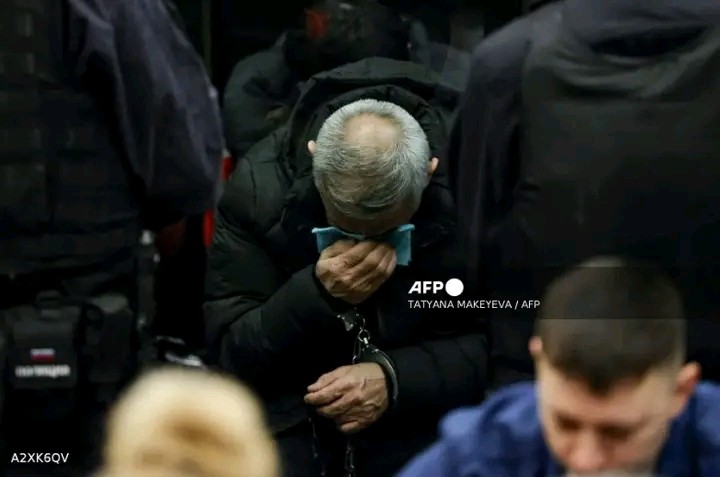
Eko Hot Blog reports that on Thursday, March 12, 2026, nearly two years after the tragedy, 15 men were sentenced to life in prison for their roles in the shooting spree and subsequent arson that turned a night of music into a scene of unimaginable carnage.
EDITOR’S PICK
- 540 Candidates Cleared as Lagos APC Moves to Elect LGA Executives
- Court Sentences Pastor to Death for Killing UniUyo Student
- Lagos Teacher Questions Lack of Recognition for One-Day Governor Mentors
Among those receiving life terms were the four primary gunmen: Shamsidin Fariduni, Dalerdzhon Mirzoyev, Makhammadsobir Fayzov, and Saidakrami Rachabolizoda, all citizens of Tajikistan.
The courtroom was filled with the somber presence of victims’ relatives as the judge read the verdicts.
The four gunmen, who had worked mundane jobs as taxi drivers and factory workers before their radicalization, stood in a reinforced glass cage under heavy guard.
Eleven other accomplices also received life sentences for providing logistical support and maintaining terrorist links.
Additionally, four other men connected to the group were handed prison sentences ranging from 19 to 22 years.
The attack occurred on March 22, 2024, just as the Soviet-era rock band Picnic was about to take the stage.
The gunmen stormed the hall, firing indiscriminately into the crowd before using incendiary devices to set the building ablaze.
The fire trapped hundreds of concertgoers, leading to the high death toll, which included six children. It was the most devastating assault in Russia since the 2004 Beslan school siege.
Despite the life sentences, some survivors and family members expressed lingering doubts during the proceedings.
Ivan Pomorin, a cameraman who was filming at the venue during the attack, questioned whether every high-level organizer had been identified, noting that the investigative work should continue to ensure no one behind the scenes remains free.
The trial also highlighted the complex geopolitical tensions surrounding the event.
Following the verdict, the Russian Investigative Committee stated it had “reliably established” that the attack was committed in the interest of Kyiv.
This narrative has been a point of contention since the early days of the investigation, as Western intelligence agencies had warned Russia of an imminent threat from the Islamic State (ISIS) weeks before the massacre took place.
The aftermath of the attack has led to a significant shift in Russian domestic policy, including a harsh crackdown on Central Asian migrants and a tightening of anti-migrant laws.
This has strained relations with allies in the region while simultaneously impacting the Russian economy, which relies heavily on migrant labor.
Interestingly, some suspects reportedly asked the court to be sent to the front lines in Ukraine to “redeem” themselves through combat, a request that was not granted given the severity of their crimes against the Russian state.