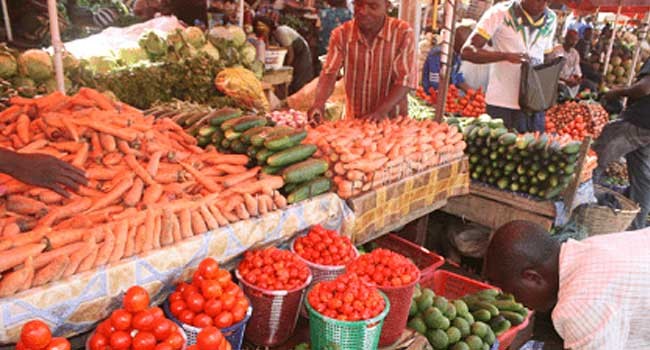
- Food remains the biggest driver of inflation in Nigeria.
- Services like transport and housing also pushed prices up.
- Inflation is lower than last year but still high in many states
Nigeria’s inflation landscape remained shaped largely by rising food and service costs in May 2026, even as some indicators showed a slowdown in overall price momentum compared with previous months, according to fresh data analysis from the National Bureau of Statistics (NBS).
Food and non-alcoholic beverages continued to dominate the inflation basket, contributing 6.38 percentage points to the country’s headline inflation rate, Eko Hot Blog gathered.
EDITOR’S PICK
- Federal Lawmaker Yaya Tongo Dies In Abuja Hospital
- Rep. Wale Raji Celebrates Alhaja Aduke Salimot Seriki on Birthday
- Nancy Isime Recalls Alex Ekubo’s Fearless Humor, Generosity at Late Actor’s Tribute
This underscores the continued strain on household budgets, as staple items remain expensive across markets nationwide.
Other key drivers included restaurants and accommodation services, which added 2.06 percentage points, while transport contributed 1.70 percentage points. Housing, water, electricity, gas and other fuel costs also remained significant, accounting for 1.34 percentage points.

Education services contributed 0.99 percentage points to inflation, closely followed by health at 0.97 percentage points. Clothing and footwear added 0.80 percentage points, while information and communication and personal care-related goods and services each contributed 0.52 percentage points.
Despite persistent price pressures, the report showed that the average inflation rate for the 12 months ending May 2026 stood at 18.36 per cent, a sharp decline from 30.57 per cent recorded in the same period of 2025.
Food inflation remained a central driver of household costs, standing at 16.96 per cent year-on-year in May, down from 24.55 per cent recorded a year earlier. On a month-on-month basis, however, food inflation eased slightly to 2.98 per cent from 3.63 per cent in April.
The NBS attributed ongoing food price increases to staples such as onions, maize, melon, water yam, cassava products, crayfish, pepper, tomatoes, yam tubers, ginger, plantain and cowpea.

Core inflation, which excludes volatile agricultural produce and energy prices, remained elevated at 16.82 per cent year-on-year. On a monthly basis, it rose sharply to 1.94 per cent from 1.03 per cent, indicating renewed underlying price pressure in the economy.
Urban inflation stood at 16.07 per cent year-on-year, while rural inflation was slightly lower at 15.60 per cent. However, monthly rural inflation slowed to 1.17 per cent from 2.80 per cent, suggesting easing pressure in some rural markets.
Services inflation remained high at 17.92 per cent year-on-year, reflecting sustained increases in transport, housing and other service-related costs. Imported food inflation stood at 14.60 per cent annually, while goods inflation was recorded at 6.62 per cent.
Energy inflation, though relatively lower than other categories, still rose by 5.73 per cent year-on-year.
At the state level, inflation trends varied widely across the country. Yobe recorded the highest annual inflation rate at 24.94 per cent, followed by Anambra at 23.29 per cent and Sokoto at 22.60 per cent. Niger State posted the lowest rate at 3.07 per cent.
Food inflation also showed sharp disparities, with Adamawa leading at 29.62 per cent, followed by Kwara and Rivers. In contrast, Borno recorded food deflation at -6.53 per cent.
On a monthly basis, Benue, Bayelsa and Borno recorded the fastest rises in headline inflation, while Niger, Zamfara and Taraba experienced declines.
The report highlights the uneven nature of inflation across Nigeria, driven by local supply conditions, security challenges and variations in market access, even as national figures suggest a gradual easing from last year’s peak levels.
FURTHER READING