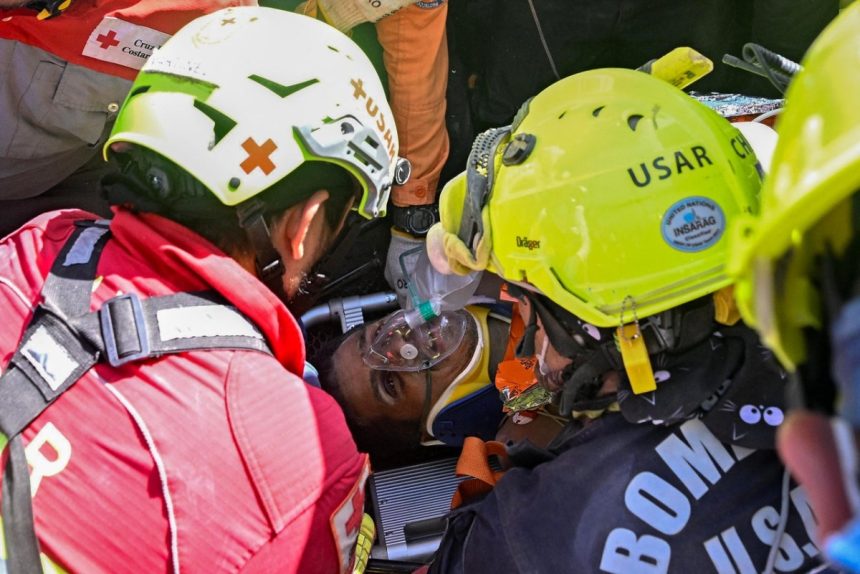
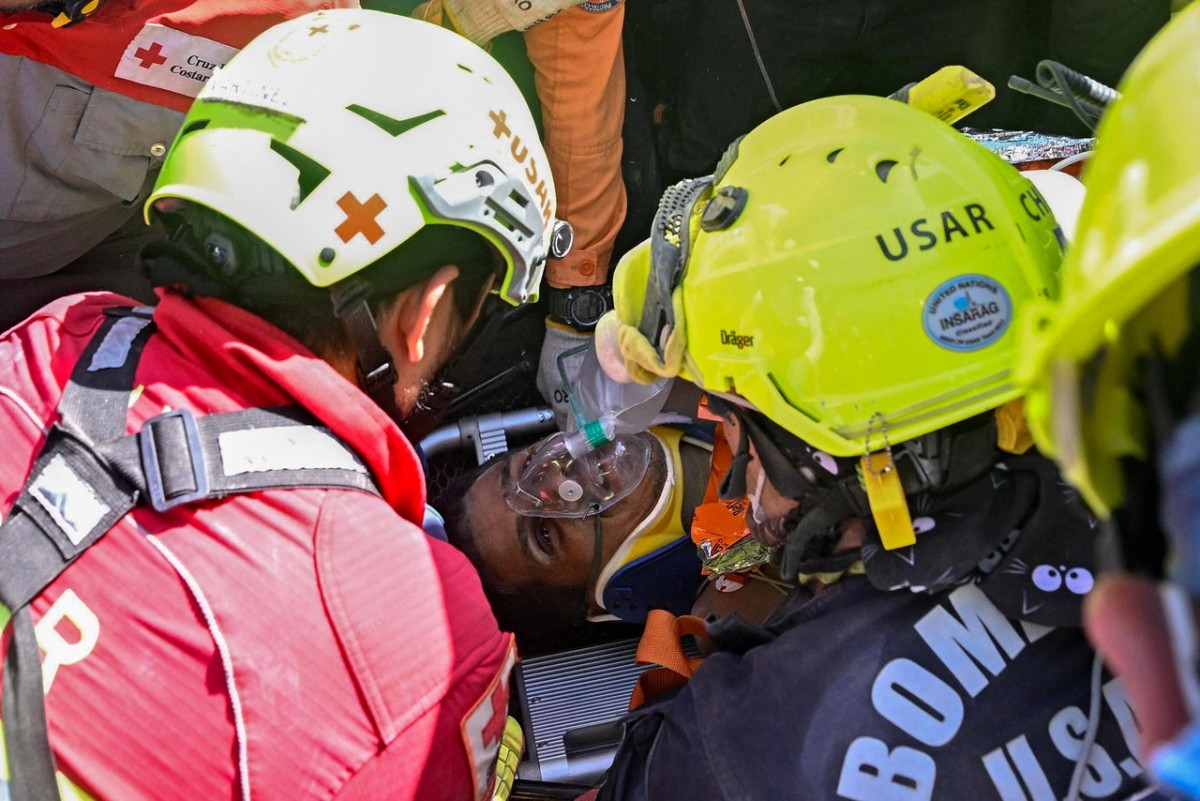
- Security guard Hernan Gil was pulled alive from the ruins of a collapsed seven-story building in Catia La Mar a staggering eight days after twin earthquakes devastated Venezuela.
- Specialized search and rescue teams from seven nations, including Venezuela, Chile, the United States, Portugal, Costa Rica, El Salvador, and Mexico, worked around the clock for three days to complete the highly complex and dangerous extraction.
- The official death toll has climbed to 2,295 with over 11,000 injured and tens of thousands still missing, as survivors face critical shortages of food, clean water, and an increased risk of disease outbreaks.
Emergency responders in Venezuela cheered and embraced on Thursday after successfully pulling a man alive from the ruins of a collapsed building eight days after a catastrophic pair of earthquakes struck the nation.
Eko Hot Blog reports that the rescue of Hernan Gil, a security guard who had been trapped beneath the concrete since the twin disasters on June 24, is being hailed as a major victory for search teams.
EDITOR’S PICK
- Hamzat Appoints Obanikoro as Campaign DG Ahead of 2027 Lagos Governorship Race
- Tinubu’s State Police Plan Gains Momentum as Amendment Looms
- Residents Raise Alarm After Two Bodies Found in Lagos Waterway
The dramatic scene unfolded in Catia La Mar, a coastal region that bore the full brunt of the seismological disaster and was left almost entirely flattened by the violent tremors.
Gil had been on duty at a seven-story building when the structures collapsed around him. For over a week, he survived beneath tons of shattered concrete and twisted metal while an international coalition fought to reach him.
His wife, Gusbimar Gonzalez, expressed her amazement at the sheer scale of humanity that converged on the site to save her husband, noting that it was deeply moving to witness so many nations unite for the sake of a single life.
The grueling extraction required a highly coordinated three-day effort involving specialized search and rescue teams from Venezuela, Chile, the United States, Portugal, Costa Rica, El Salvador, and Mexico.
The rescue operation itself was a hazardous race against time, compounded by extreme structural instability.
Teams on the ground had to navigate an environment where multiple severely damaged high-rises were visibly leaning into the very wreckage they were excavating.
Every movement had to be calculated with precision to avoid triggering a secondary collapse that would have proved fatal for both Gil and his rescuers.
Officials from the Los Angeles County Fire Department and the Salvadoran government emphasized that the constant threat of unpredictable aftershocks made this one of the most perilous and logistically complex rescue operations they had ever encountered.
While Gil’s survival is a rare beacon of hope, the broader picture across Venezuela remains grim as the country confronts the staggering scale of the tragedy.
Official figures released by the National Assembly indicate that the death toll has climbed to 2,295 individuals, with more than 11,000 others suffering injuries.
The twin quakes, registering massive magnitudes of 7.2 and 7.5, have left nearly 13,000 people entirely homeless, while tens of thousands of citizens remain unaccounted for beneath the ruins.
In the hardest-hit city of La Guaira, just north of Caracas, the landscape is defined by countless collapsed structures spray-painted with the letter ‘D’, a code indicating that search dogs and sensors found no signs of life, signaling that emergency workers must move on to areas where hope still lingers. Interim President Delcy Rodriguez has declared seven days of national mourning.
This catastrophe strikes Venezuela at a fragile historical juncture, as the nation is already grappling with decades of severe economic crisis that had heavily degraded its basic infrastructure and healthcare systems.
Furthermore, the country is currently navigating a volatile political transition just six months after the United States ousted leader Nicolas Maduro.
The focus for millions of survivors is now shifting from the immediate shock of the tremors to a desperate fight for daily survival.
Severe shortages of food and clean drinking water are plaguing displacement camps, forcing families to sleep in open parking lots and rely entirely on the goodwill of local volunteers.
With NASA satellite data indicating that nearly 59,000 buildings were damaged or entirely destroyed, and the World Health Organization warning of imminent outbreaks of preventable diseases due to low vaccination rates, international aid organizations like the World Food Programme are urgently appealing for $50 million to stave off an escalating humanitarian catastrophe.