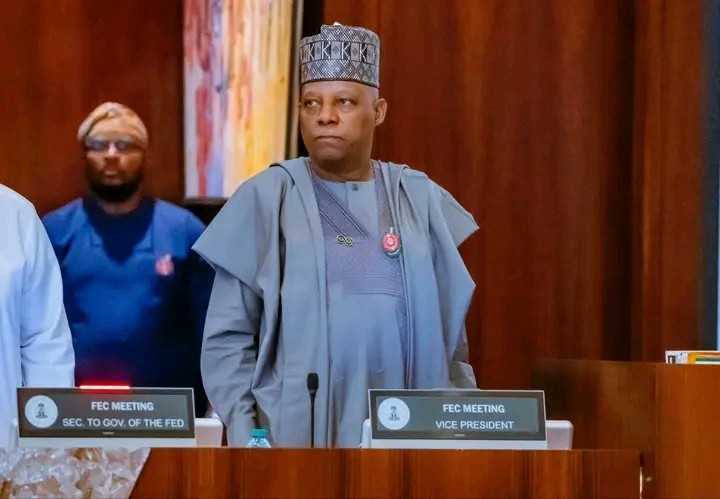
- Vice President Kashim Shettima has asserted that true leadership demands exceptional courage, stating that leaders must make highly difficult choices instead of seeking cheap public approval.
- Speaking in Abuja, Shettima pointed out that international observers often make unfair comparisons between Nigeria and smaller African nations without accounting for Nigeria’s vast population and unique domestic diversity.
- The Vice President called for a renewed commitment to the nation’s agricultural sector, describing it as a historic pillar capable of generating widespread employment and solidifying economic stability.
Vice President Kashim Shettima has stated that effective national governance requires administrative grit and decisive action, emphasizing that leadership is fundamentally about taking responsibility rather than pursuing popularity.
Eko Hot Blog reports that speaking on Wednesday while delivering his keynote address at the Niger Delta Agricultural Development and Investment Summit in Abuja, the Vice President argued that true statecraft demands a willingness to execute tough policies to secure long-term national growth.
EDITOR’S PICK
- Why Africa Still Cannot Win the FIFA World Cup Despite Its World Class Talent
- Man Allegedly Slits Father’s Throat, Mutilates Body in Anambra
- Lagos Court Convicts Director, Company Over N822.4m Fraudulent Conversion
Addressing the audience, Shettima referenced the administrative models of other African countries.
While acknowledging the economic turnarounds and achievements of leaders like Rwandan President Paul Kagame, he cautioned analysts against comparing smaller nations with the unique, complex demographic landscape of Nigeria.
The Vice President pointed out that many often-cited success stories operate at a fraction of Nigeria’s sheer human scale, emphasizing that demographic numbers play a critical role in governance challenges.
Shifting his focus to the core theme of the summit, Shettima made an impassioned plea for Nigerians to return to their agricultural roots.
He reminded stakeholders that before the discovery of crude oil, the Nigerian federation was built on a robust agrarian foundation that successfully sustained millions of families and created extensive economic opportunities.
To illustrate the federal government’s focus on unlocking agricultural investment, the Vice President commended Akwa Ibom State Governor, Umo Eno, for his swift approach to administrative hurdles.
Shettima recounted how representatives of a prominent Malaysian oil palm conglomerate alongside their local partners approached his office with a proposal to invest $500 million in Nigeria’s domestic oil palm sector.
The planned initiative, which aims to kick off with a 10,000-hectare plantation in Akwa Ibom, was met with immediate, decisive support from Governor Eno.
The Vice President cited the governor’s rapid feedback as a primary example of how public administrators must act with speed to capture foreign direct investment, rather than letting bureaucratic bottlenecks stall progress.
The Niger Delta Agricultural Development and Investment Summit served as a key platform for stakeholders from both public and private sectors to map out sustainable development strategies aimed at transforming regional farming into a primary engine of commercial wealth and youth empowerment.