- Official casualty reports confirm at least 132 people dead and over 880 injured following a violent 7.4-magnitude earthquake, while digital missing-person tracking databases list more than 3,200 individuals unaccounted for across affected cities.
- Newly sworn-in President Abelardo de la Espriella officially declared a state of national disaster, deploying military personnel and emergency capabilities to lead search operations across collapsed urban centers.
- Major cities including Pereira, Cali, Manizales, and Quibdó suffered severe structural collapses, hospital disruptions, and widespread power blackouts, prompting emergency aid pledges from the United States, the European Union, and regional allies.
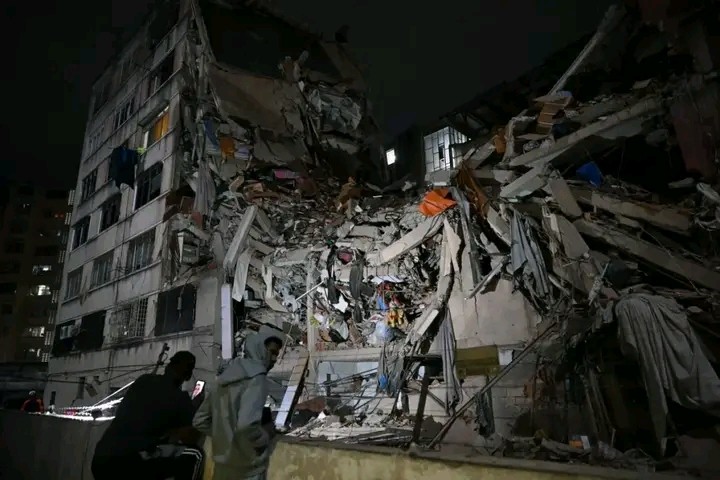
Search and rescue operations across western Colombia intensified as professional emergency workers, military units, and civilian volunteers cleared heavy rubble with basic hand tools and buckets to search for survivors following a devastating 7.4-magnitude earthquake.
Eko Hot Blog reports that the powerful seismic event, recognized as the country’s strongest earthquake in over a decade, has claimed the lives of at least 132 people, with over 880 others receiving medical care for varying degrees of injury across multiple departments, while more than 3,200 people remain missing.
EDITOR’S PICK
- Tinubu Approves Army Expansion, Recruitment of 28,000 Personnel
- Aregbesola Claims Record as First Nigerian Governor to Serve Eight Years Without Owning a House
- Ikosi-Ejinrin LCDA Commissions Fully Equipped NSCDC Divisional Headquarters, Donates Patrol Vehicle and Motorcycle to Boost Security
The violent tremor struck shortly after 7:30 a.m. local time on Monday, with its epicenter pinpointed near San José del Palmar in the northwestern department of Chocó, roughly 240 kilometers west of the nation’s capital, Bogotá.
According to the United States Geological Survey and the Colombian Geological Service, the quake originated at a depth of approximately 107 kilometers, triggered by deep fault movements within the Nazca tectonic plate.
Despite the focal depth, high-frequency shockwaves rippled across Colombia, causing structural failures and triggering widespread panic that sent thousands of residents pouring into the streets, while tremors were felt as far as neighboring Ecuador and Panama.
Presiding over his first major national crisis just three days after his presidential inauguration, Colombian President Abelardo de la Espriella declared a state of national disaster.
The declaration enables the federal government to bypass bureaucracy, reallocate emergency funds, and directly deploy military personnel to coordinate rescue maneuvers alongside fire departments and civil defense teams.
De la Espriella emphasized that the administration’s primary focus remains the immediate recovery of citizens trapped beneath collapsed concrete and fallen masonry.
The impact was particularly severe across Colombia’s western coffee-growing region and major urban centers. In Pereira, one of the hardest-hit cities, at least 60 fatalities were recorded as power outages plunged entire neighborhoods into darkness.
In Cali, Colombia’s third-largest city, municipal authorities confirmed that over 20 multi-story structures suffered total or partial collapse, while structural damage forced the evacuation and closure of key medical facilities, including the University Hospital of Valle.
In Manizales, the historic neo-Gothic Cathedral Basilica of Our Lady of the Rosary suffered severe structural failure when one of its main towers buckled onto the central nave.
Meanwhile, in Quibdó, the capital of Chocó department, public utility services and telecommunication networks were virtually shut down as local firefighters scrambled to respond to multiple collapse sites.
At least seven regional airports suspended flights due to structural inspections, while hospitals in five major capital cities remained on red alert. International support has begun mobilizing swiftly to aid the disaster response.
The United States pledged $15.5 million in emergency relief funding for shelter, food, and protective supplies, while the European Union activated its Copernicus satellite mapping service to assist ground teams in identifying structural damage.
Additional offers of humanitarian assistance and search units were extended by France, Mexico, Israel, and neighboring Latin American partners. Rescue crews continue to work around the clock using human chains and specialized equipment as search efforts enter a critical phase.
FURTHER READING