- Trump has asked the Supreme Court to allow construction of his proposed White House ballroom to continue
- Lower courts ruled that Congress must approve the $400 million project
- The Supreme Court will now determine whether Trump can proceed without congressional approval
President Donald Trump has turned to the US Supreme Court in an effort to revive construction of his proposed White House ballroom after federal judges blocked the project from advancing without congressional approval.
Eko Hot Blog gathered that the administration submitted an emergency application on Friday, asking the justices to suspend the lower-court restrictions that currently prevent above-ground work on the development.
The legal challenge centres on Trump’s plan to replace the former East Wing with a large event space estimated to cost about $400 million. Construction has already progressed significantly, despite the continuing dispute over whether the president has the authority to approve the project on his own.
The US Court of Appeals for the District of Columbia Circuit ruled last week that Trump could not proceed unilaterally. Its 2-1 decision supported an earlier ruling requiring the administration to stop work above ground until Congress authorises the project.
The appeals court temporarily held back enforcement of its ruling for two weeks, giving the Trump administration an opportunity to seek intervention from the Supreme Court.
US Solicitor General John Sauer, in the administration’s filing, argued that the president has constitutional and statutory authority to manage renovations and security improvements at the White House.
He also pointed to security threats against Trump as part of the administration’s justification for changes to the presidential complex.
The National Trust for Historic Preservation, which brought the case, disputes that position. The organisation maintains that the executive branch cannot use presidential authority to undertake such a major transformation of the White House without lawmakers’ involvement.
The appeals court agreed with the preservation group’s argument, saying decisions involving a project of this magnitude belong to Congress rather than being carried out solely through presidential authority.
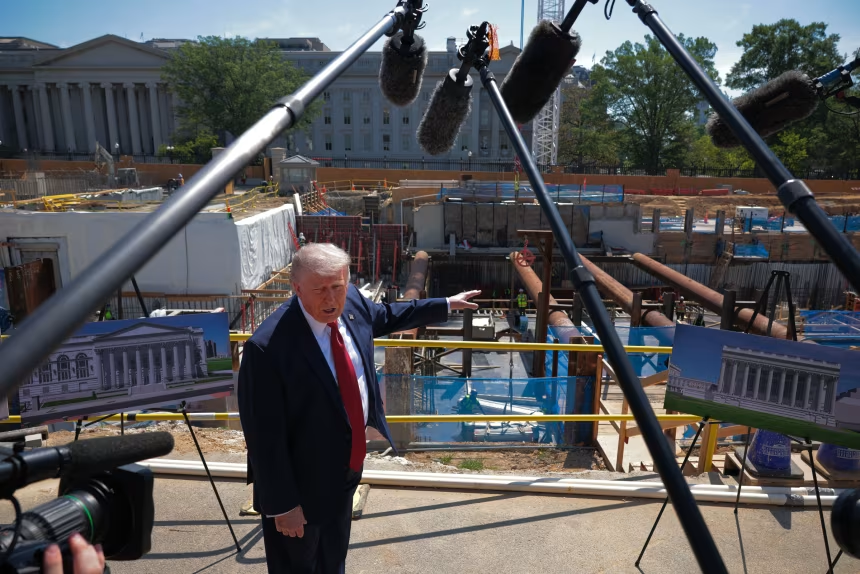
Construction nevertheless remains visible at the site. Work has produced large concrete structures and steel reinforcement, while cranes and other heavy equipment have been deployed around the former East Wing area.
Trump has also taken an active interest in the design process, including aspects of the building’s layout and materials.
Architect Shalom Baranes estimates that the ballroom will occupy approximately 89,000 square feet, making the proposed facility substantially larger than the Executive Mansion, whose main structure covers about 55,000 square feet.
The president has maintained that the project should not be subjected to extensive congressional scrutiny and has previously projected that construction will be completed by the summer of 2028.
The Supreme Court’s response could determine whether Trump can resume the disputed construction or whether the project will remain subject to congressional approval