EDITOR’S PICK
- Nearly 30 Years Later, Who Really Knows How Abacha Died?
- Dapo Abiodun, Ipara Is Waiting for Leadership
- Why Every Husband Must Protect His Wife, Even After Death
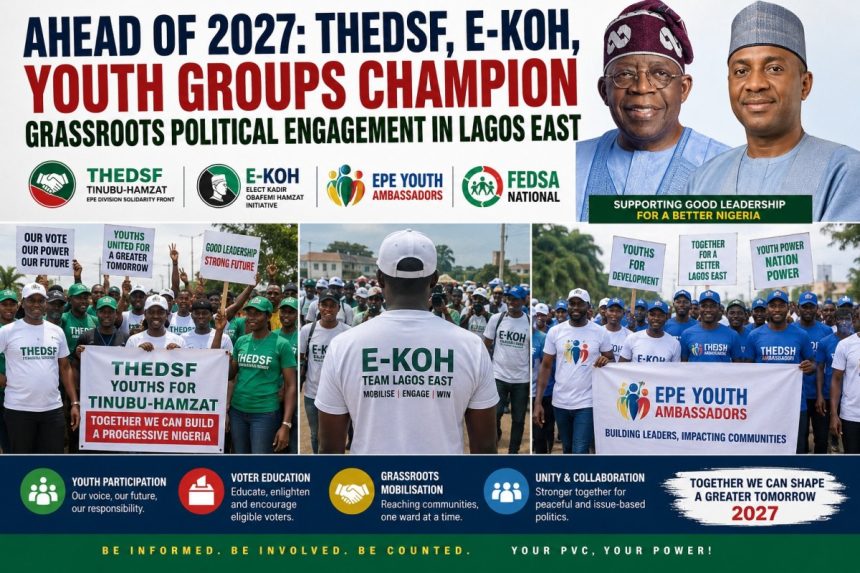
Across the Epe Division and the wider Lagos East Senatorial District, platforms such as the Tinubu-Hamzat Epe Division Solidarity Front (THEDSF), Elect Kadir Obafemi Hamzat Initiative (E-KOH), Epe Youth Ambassadors, and FEDSA National, among others, have continued to create platforms for political engagement and grassroots mobilisation.
The growing activities of these groups underscore the increasing role of organised youth participation in the political process, particularly as young people constitute a significant segment of the electorate.
The Tinubu-Hamzat Epe Division Solidarity Front (THEDSF) has continued to strengthen its grassroots structure across the Epe Division, with its youth leaders and coordinators engaging residents on political issues and encouraging active participation in the democratic process.
The group has also used community engagements, media interactions, consultations, and mobilisation activities to communicate its political objectives while promoting support for President Bola Ahmed Tinubu and Dr. Kadri Obafemi Hamzat.
THEDSF leaders have also emphasized the importance of unity among support groups, noting that different platforms should complement one another rather than compete for recognition.
The Elect Kadir Obafemi Hamzat Initiative (E-KOH) has equally expanded its grassroots engagement across Lagos East, bringing together coordinators, volunteers, political stakeholders, and youth leaders from different local governments and LCDAs for strategic discussions on mobilisation and voter engagement.
Through its senatorial district structure, E-KOH has continued to promote community outreach, political awareness, and engagement with eligible voters ahead of the forthcoming elections.
The Epe Youth Ambassadors have also provided a platform for youth participation in community development and civic engagement. Their involvement in community initiatives and youth-focused programmes offers young residents an opportunity to discuss issues affecting their communities and contribute ideas towards local development.
Other political support structures, including FEDSA National, have also contributed to grassroots political engagement within the Epe Division and surrounding communities.
The increasing number of support groups demonstrates the growing importance of grassroots networks in communicating political messages and connecting political movements with residents at the community level.
Political mobilisation in the modern era has also moved beyond traditional rallies and campaign posters. Social media has become an important tool for reaching young voters, sharing information, explaining policies, and creating conversations around political issues.
However, effective grassroots mobilisation also requires physical engagement. Community meetings, ward-level interactions, townhalls, voter education programmes, and direct conversations with residents remain essential to understanding the concerns of the people.
Youth support groups therefore have an opportunity to combine digital communication with traditional grassroots engagement to reach a wider audience.
As the 2027 elections approach, political support groups are also expected to contribute to meaningful conversations around governance and development, including education, employment, infrastructure, healthcare, security, entrepreneurship, transportation, technology, and opportunities for young people.
By encouraging voters to examine candidates’ records, policies, experience, and development plans, youth groups can contribute to a more informed electorate.
With several support groups operating across Lagos East, stakeholders have continued to emphasize the need for collaboration rather than rivalry.
Each group may have its own structure, leadership, and strategy, but constructive cooperation can strengthen grassroots mobilisation and promote a peaceful political environment.
Support groups can collaborate on voter education, community engagement, youth forums, and other activities while maintaining their individual identities and objectives.
The forthcoming elections provide another opportunity for young people to become more actively involved in determining the direction of governance.
Rather than being regarded merely as campaign volunteers, young people can contribute to political discussions, propose solutions to community challenges, participate in civic activities, and hold political leaders accountable through constructive engagement.
The growth of youth-focused support groups across Lagos East therefore represents an important development in grassroots politics.
As 2027 draws closer, the effectiveness of platforms such as THEDSF, E-KOH, Epe Youth Ambassadors, FEDSA National, and other emerging youth support groups will depend on their ability to sustain meaningful engagement, promote responsible political participation, and connect political conversations with the everyday concerns of the people.
Ultimately, the success of grassroots mobilisation will not be measured only by the size of political gatherings but by the ability to build informed, peaceful, organised, and genuinely engaged communities ahead of the elections.