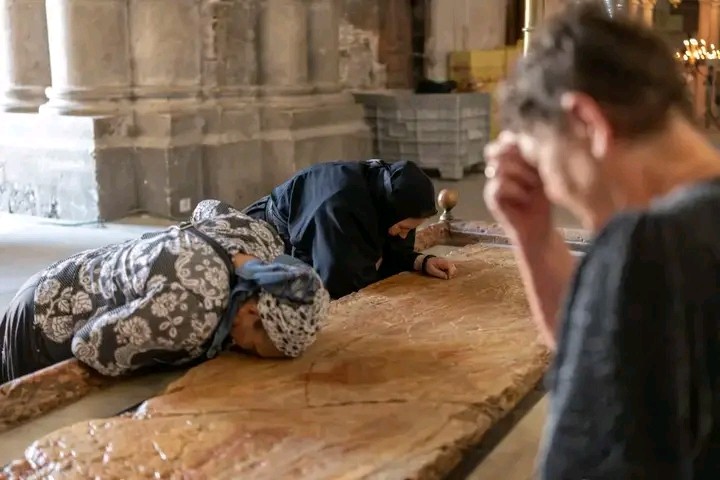
- Excavations beneath Jerusalem’s Church of the Holy Sepulchre reveal an ancient funerary and agricultural landscape.
- Researchers discovered evidence of cultivated fields, rock-cut tombs and an ancient garden.
- Archaeologists say the findings do not conclusively prove that Jesus was buried at the site.
Archaeologists excavating beneath the Church of the Holy Sepulchre in Jerusalem have uncovered an ancient landscape that closely resembles biblical descriptions of the area associated with the crucifixion and burial of Jesus Christ.
Eko Hot Blog reports that the discoveries emerged from excavations carried out beneath the historic church during restoration works that began several years ago.
EDITOR’S PICK
- How Lagos Achieved 57.4% Exclusive Breastfeeding Rate
- Shaibu Lists Nigeria’s Biggest Security Challenges
- Vote, Protect Your Mandate, Governor Adeleke Urges Residents Ahead of August 15 Polls.
The Church of the Holy Sepulchre has long been regarded by Christians as the site where Jesus was crucified, buried and resurrected.
Leading the excavation is Francesca Romana Stasolla of the University of Rome La Sapienza, whose team uncovered evidence suggesting that the area once served as both a burial ground and an agricultural landscape.
According to the researchers, the excavation revealed an abandoned quarry, cultivated plots, rock-cut tombs and what appears to have been an ancient garden.
The findings have generated renewed interest because of their similarities to the account in the Gospel of John, which describes a garden near the place of Jesus’ crucifixion and a newly prepared tomb within it.
Researchers found that parts of the former quarry, estimated to be about 20 feet deep, were later filled with soil and converted for agricultural use.
Evidence of olive trees and grapevines dating to around the period traditionally associated with Jesus’ death was also identified at the site.
Stasolla said the discovery of cultivated fields corresponded with descriptions of a green area located between Calvary and the tomb.
The team also uncovered graves carved directly into rock, a feature that aligns with Gospel descriptions of Jesus’ burial place as a rock-cut tomb.
Further evidence suggests that the location had been regarded as an important burial site long before the present church was constructed.
One of the chambers discovered during the excavation had reportedly been blocked by a Roman structure dating to the reign of Emperor Hadrian in the second century.
Centuries later, during construction activities linked to Emperor Constantine, the Roman structure was removed and the area was excavated again.
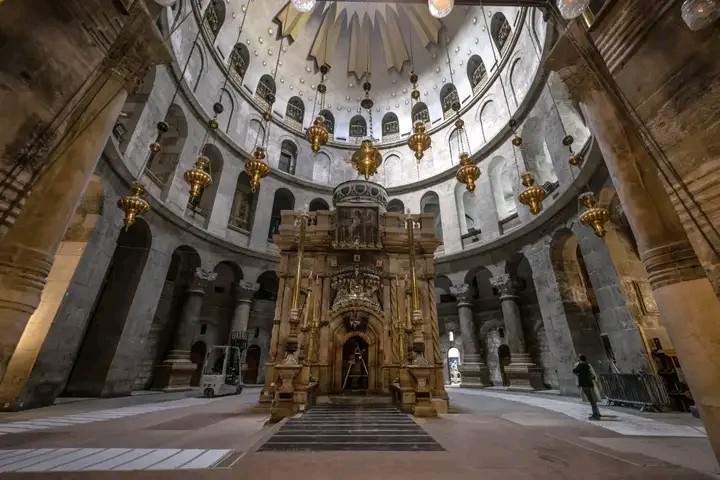
The tomb was subsequently separated from surrounding chambers and developed into a Christian shrine where pilgrims could gather for worship.
However, archaeologists have stressed that the discoveries do not provide conclusive proof that the tomb belonged to Jesus Christ.
Stasolla said the significance of the excavation also lies in the history of generations of Christians who have regarded the site as sacred.
The findings offer fresh archaeological insight into the development of one of Christianity’s holiest sites while adding to ongoing discussions about the historical landscape of ancient Jerusalem.
FURTHER READING