- A Chinese humanoid robot won the 100m race in 9.39 seconds
- It finished faster than Usain Bolt’s 9.58-second world record
- Another humanoid robot also ran faster than Bolt’s record
A Chinese humanoid robot has completed the 100-metre sprint in 9.39 seconds at the World Humanoid Robot Games in Beijing, recording a time faster than the human world record set by Jamaican sprint legend Usain Bolt.
Tiangong Ultra, developed by the Beijing Humanoid Robot Innovation Center, won its preliminary heat during the second edition of the competition on Saturday, Eko Hot Blog gathered.
The robot initially trailed Honor’s Lightning but accelerated in the closing stages to finish ahead in 9.39 seconds. Lightning crossed the line in 9.47 seconds, with both robots surpassing Bolt’s 9.58-second record established at the 2009 World Athletics Championships in Berlin.
EDITOR’S PICK
- Tinubu Directs Installation of 3,700 Telecom Towers Across Nigeria
- Alara of Ilara Praises Sanwo-Olu, LASU Staff’s Dedication To Progress
- Burna Boy, Tems Bag Nominations at 2026 MTV VMAs
The performance represents a major improvement for Tiangong Ultra, which won the 100-metre event at last year’s inaugural games in 21.50 seconds.
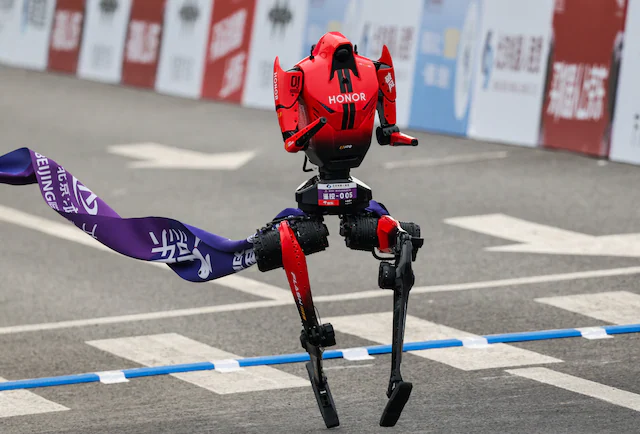
Tiangong Ultra also made history by winning the first humanoid robot half-marathon staged in Beijing last year.
Earlier on Saturday, Chinese state media reported that Lightning had recorded 9.32 seconds over 100 metres during a practice run, reaching a top speed of 14.5 metres per second.
Lightning had previously won this year’s humanoid half-marathon in 50 minutes and 26 seconds, completing the race at a pace faster than the elite men’s human world-record pace.
The robot stood 1.69 metres tall and had 95-centimetre legs during the half-marathon. Researchers later increased its leg length by 10 centimetres to 1.05 metres ahead of the Beijing games, according to CCTV.
The 100-metre sprint is one of 51 competitions featured at this year’s event. Other contests include football, dance and challenges designed to test robots on industrial tasks.
China has identified humanoid robotics as a strategic emerging sector, with government officials and technology companies investing heavily in artificial intelligence and robotic hardware.
The industry has also attracted significant investor interest. Shares of Unitree, one of China’s leading humanoid robot manufacturers, surged more than fivefold during its Shanghai debut earlier in the week, pushing its market valuation to around $50 billion.
This year’s competition has expanded considerably, attracting 2,056 robots representing 666 teams from 16 countries across six continents. That is a significant increase from the 280 teams that participated in the inaugural edition.
The games are being held at Beijing’s National Speed Skating Oval and are scheduled to continue until Wednesday.
FURTHER READING