- Dangote Petroleum Refinery has officially ended its brief dollar-denominated pricing scheme, resuming domestic gantry and coastal petrol sales in Nigerian Naira.
- The refinery increased its gantry ex-depot price by N140 per litre (a 13.02% jump), moving the baseline cost from N1,075 to N1,215 per litre.
- While the reversal to naira transactions eases foreign exchange pressure on local marketers, the higher ex-depot rate is expected to trigger secondary price adjustments across retail filling stations nationwide.
The Dangote Petroleum Refinery has officially resumed the sale of Premium Motor Spirit, commonly referred to as petrol, in Nigerian Naira, bringing an end to its short-lived dollar-denominated pricing regime while raising its ex-depot gantry price by N140 per litre.
Eko Hot Blog reports that the operational pivot comes exactly one week after the 650,000-barrel-per-day mega refinery suspended gantry truck loading and switched product invoicing to US dollars.
EDITOR’S PICKS
- FG Partners With Chinese Investors To Secure Land For 10,000-Home Mass Housing Project
- Intelligence Materials Were Shared With US, Not Seized – DHQ
- Man Arraigned in Adamawa Over Alleged Abuse Involving Daughter
That move had sent shockwaves through Nigeria’s downstream petroleum industry, restricting market liquidity, disrupting regional distribution chains, and driving independent marketers to source fuel from private depots at inflated costs.
The resumption of local currency transactions was formally communicated to petroleum marketers through a commercial circular issued by the refinery’s sales directorate and independently verified by energy market intelligence platform Petroleumprice.ng.
According to the pricing bulletin, titled “PMS Price Change Communication,” the revised gantry price of petrol has moved from N1,075 per litre to N1,215 per litre, representing a 13.02 percent upward adjustment.
Concurrently, coastal bulk loading prices were adjusted from N1,441,575 per metric tonne to N1,602,495 per metric tonne.
The official directive specified that all pending, unfulfilled, and unloaded gantry allocations would immediately be subject to repricing under the new naira template.
Industry analysts note that the temporary suspension of naira sales, which commenced on July 15, forced local marketers to rely heavily on private depot reserves.
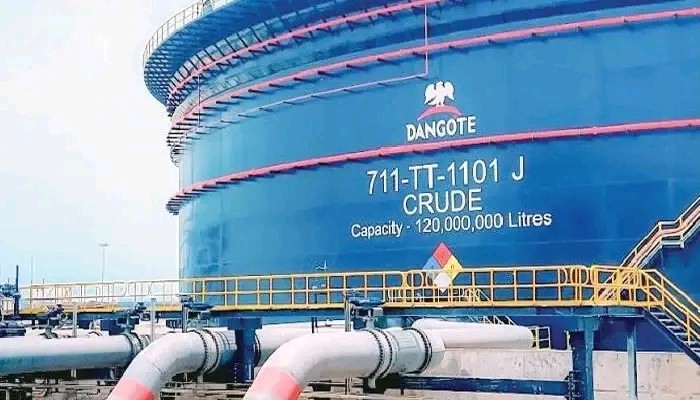
During that seven-day hiatus, average ex-depot prices at third-party tank farms in Lagos jumped from N1,075 to around N1,275 per litre, an 18.6 percent increase that triggered localized supply panics and queue build-ups across Lagos, Ogun, and Abuja retail outlets.
The refinery had defended its temporary migration to dollar-based billing by citing supply shortfalls under the Federal Government’s naira-for-crude framework.
Management explained that because state allocations under the agreement met less than a quarter of the plant’s massive crude requirement, it had to import significant volumes of foreign crude in foreign currency, necessitating a dollar-denominated cost-recovery mechanism for off-takers.
Confirming the resumption of operations, industry leaders acknowledged that returning to local currency pricing shields marketers from severe foreign exchange volatility while eliminating the need for off-takers to source up to $40 million daily in foreign currency to satisfy nationwide petrol consumption.
Speaking on behalf of market tracking firm Petroleumprice.ng, Chief Executive Officer Jeremiah Olatide confirmed that customers have already begun placing orders under the updated naira framework.
While the new ex-depot price of N1,215 per litre remains lower than private import prices, market operators anticipate that retail pump prices could stabilize between N1,300 and N1,380 per litre in the coming days as distribution logistics normalize across the country.