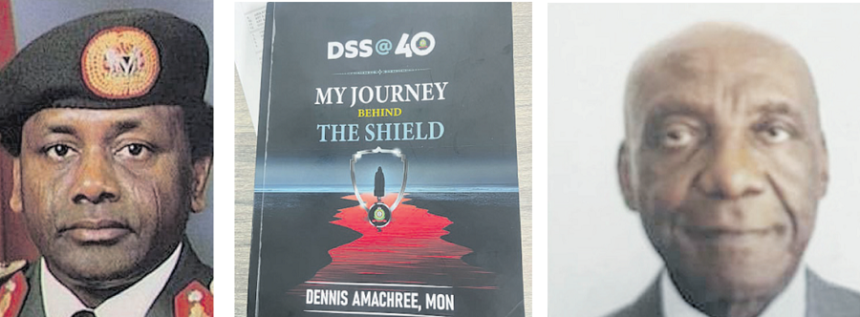
A retired Assistant Director of the Department of State Services, Dennis Amachree, has reopened one of Nigeria’s oldest political mysteries — how General Sani Abacha died on June 8, 1998 — with a new memoir.
The details of the memoir, titled DSS @40: My Journey Behind the Shield, became public on Tuesday after various media outlets reported excerpts.
EDITOR’S PICKS
The book disputes nearly every existing theory of Abacha’s, drawing on Amachree’s own role in the DSS investigation that followed.
Amachree’s Account
Amachree writes that at about 2:40 a.m. on June 8, shortly after Gen. Jeremiah Useni left the Aso Rock Guest House, Abacha’s girlfriend — an Igbo woman he does not name — arrived from an Abuja hotel with her younger sister, a pharmacist in town for a conference.
The girlfriend left soon after; the sister stayed, and it was in her company that Abacha suffered a coitus-induced cardiac arrest around 4:05 a.m.
The pharmacist fled to Lagos on an early flight. Amachree says DSS intelligence traced her, and he personally found and questioned her in Ogudu, where she told him: “I did not kill him, he died on top of me.”
What separates this from every other version: Amachree obtained it himself, from the one person actually in the room.
The Rival Theories
The handshake, in two versions. Al-Mustapha, Abacha’s Chief Security Officer, has long said Abacha’s health declined after a handshake with a security operative in former Palestinian President Yasser Arafat’s entourage during a June 7 visit.
In June 2021, Fani-Kayode went further on social media, claiming the same handshake was a CIA-ordered poisoning, carried out with the knowledge of two former Nigerian heads of state and a former military intelligence chief, and that the same network later had MKO Abiola killed via Susan Rice and a US diplomat.
Amachree disputes Al-Mustapha’s version on its own terms, citing a roughly ninety-minute gap in his timeline between Useni’s departure and the moment Al-Mustapha says he was alerted.
That gap matters beyond timing: Al-Mustapha was closest to Abacha, bound by years of loyalty and complicity in a regime he has never fully accounted for. A story ending in an unexplained handshake protects Abacha’s dignity; one involving a woman in the villa does not. Fani-Kayode’s CIA layer fares no better; it rests entirely on his own unverified claims, made years later, with no named source offered.
The poisoned apple. In a separate, earlier post from March 2018, Fani-Kayode had a different theory. He claimed two Indian women who spent the night with Abacha fed him a poisoned apple on CIA orders. Amachree calls this among the most sensational and least evidenced of all the theories. It also fits a pattern: Fani-Kayode’s public record on claims like this makes his word unreliable without outside corroboration.
…I believe that Pickering and Rice,both of whom work for the CIA,poisoned Abiola just as I believe that the 2 Indian girls that spent the night in the Villa with Gen. Sani Abacha and fed him the poisoned apple that killed him one month earlier to the day were also CIA…3/4.
— Femi Fani-Kayode (@realFFK) March 16, 2018
For what it is worth, Fani-Kayode did mention in a different post that “an eastern Nigerian girl” was with the Indian girls the night of Abacha’s demise. Amachree also mentioned that Abacha’s girlfriend was an Igbo woman, but there are still a conflict in the accounts. The former DSS chief does not mention the involvement of any foreigners.
Not true. It is real. There was also an eastern Nigerian girl with them that night. They all spent the night in House 10 of the Villa. After the C in C died the 3 girls were detained and interrogate. The Indians were flown out of the country two days later. These are the facts.
— Femi Fani-Kayode (@realFFK) March 17, 2018
Susan Rice’s version. Amachree also describes an account attributed to Rice that echoes rumours Abacha died among foreign prostitutes, possibly aided by Viagra, one he says lacks concrete evidence and is rejected by people close to Abacha.
Rice was a foreign diplomat relaying secondhand claims, not someone with access to the villa; an account with no firsthand basis cannot outweigh one built on direct interrogation.
Foreign poisoning, via David Orr. The Irish Times journalist cited an unnamed diplomat claiming disaffected officers poisoned Abacha, a claim Amachree notes a Nigerian autopsy report already ruled out.
Where the Physician’s Account Fits In
Brig.-Gen. Oviemo Ovadje, a military physician, has suggested Abacha’s death followed years of health complications worsened by poor medical management, including steroid use.
Amachree lists this among the accounts he says lack verifiable evidence, but it need not compete with his own version; it can sit underneath it. A heart already strained by undertreated illness is more likely to fail under sudden exertion during intercourse.
Ovadje may explain why Abacha’s heart was vulnerable; Amachree describes the moment it gave out.
Why Amachree’s Account Carries the Most Weight
Not because it is the most plausible story on offer, but because it rests on greater authority than the rest.
Amachree was Assistant Director of Operations and Intelligence at the DSS’s Lagos command at the time, and no one has disputed his claim that he personally found and interrogated the woman at the centre of the story. He is also a familiar face on Nigerian television as a security analyst, raising the cost of getting this wrong: publishing a memoir built on a lie, timed to the DSS’s own 40th anniversary, is a risk few in his position would take.
FURTHER READING
That does not make his account proven; it still leaves gaps unexplained. But of the versions in circulation nearly three decades on, his alone is grounded in direct investigative access rather than rumour, loyalty, or distance from the scene. For now, the closest thing to an authoritative answer.
Philip Ibitoye is a Special Correspondent with EKO HOT BLOG. Click here to find daily analysis and critical insight on trending issues in Lagos and other parts of Nigeria.
Click to watch the video of the week below: